Executive Takeaways
- Historical Philosophical Reversal: Apple has officially abandoned its long-held doctrine against touch-enabled Mac displays, deploying a custom tandem OLED touchscreen in the MacBook Pro that resolves legacy ergonomic and optical diffusion bottlenecks.
- Enterprise Efficiency & Software Convergence: The touch-integrated macOS ecosystem accelerates cross-platform app deployment, yielding measurable productivity gains across financial modeling, media rendering, and enterprise software suites.
- Capital Allocation & ASP Expansion: Wall Street analysts project a 12% to 15% increase in MacBook Pro Average Selling Prices (ASPs), expanding gross margins despite high initial panel procurement costs from tier-1 display fabricators.
- Supply Chain Paradigm Shift: Massive capital expenditure allocations toward multi-layer tandem OLED fabrication lines at Samsung Display and LG Display signal a broader industry transition away from Mini-LED backlighting in high-end compute hardware.
For more than a decade, Apple Inc. maintained an unyielding stance on laptop design: screens were meant to be looked at, not touched. Co-founder Steve Jobs famously classified touchscreen laptops as "ergonomically terrible," citing arm fatigue and smudge-laden displays as insurmountable friction points. Yet, inside Apple’s Industrial Design Studio and Cupertino testing labs, a secret, multi-year engineering initiative was quietly dismantling that dogma.
The result is the new OLED Touchscreen MacBook Pro—a device that not only represents Apple’s most radical form-factor evolution since the transition to Apple Silicon, but also serves as a strategic wedge to revitalize global premium PC demand. By fusing custom hardware architecture, touch-optimized macOS subsystems, and groundbreaking display science, Apple has manufactured a device designed to capture high-margin enterprise capital while establishing a new baseline for personal workstation engineering.
The Engineering Breakthrough: Tandem OLED Meets In-Cell Digitization
Test Our Free AI & Tech Utilities Suite
Calculate LLM API token costs, analyze article dwell-time, or simulate tech DCA returns.
Our hands-on evaluation reveals that Apple did not simply slap a capacitive glass sheet onto a legacy display panel. Doing so would have added unwanted thickness, increased internal optical reflections, and degraded energy efficiency—drawbacks that product leadership refused to accept. Instead, the new MacBook Pro utilizes a proprietary Tandem OLED display stack with In-Cell Touch Digitization.
By layering two electroluminescent emission layers in series, the tandem architecture delivers unprecedented brightness levels—reaching 1,000 nits sustained full-screen brightness and up to 1,600 nits peak HDR output—while effectively doubling the display’s operational lifespan and eliminating traditional OLED burn-in vulnerabilities. Crucially, the touch-sensing layer is integrated directly into the display encapsulation layer itself, rather than added as an external substrate. This breakthrough maintains the MacBook Pro’s ultra-thin z-height profile while keeping display reflection metrics at an industry-leading low.
"The micro-architectural challenge wasn't just physical touch input; it was latency and spatial accuracy under heavy compute loads. By handling touch sub-sampling directly within the display driver engine on the M-series system-on-chip, input latency drops to near-zero without straining the unified memory pipeline."
During testing, interaction across the 14-inch and 16-inch panel options felt instantaneous. Scrolling through expansive financial balance sheets, manipulating timeline nodes in Final Cut Pro, and executing multi-finger pinch gestures felt as responsive as an iPad Pro display, yet anchored within a fully uncompromised desktop windowing engine.
The macOS Paradigm Shift: Precision Desktop Meets Contextual Touch
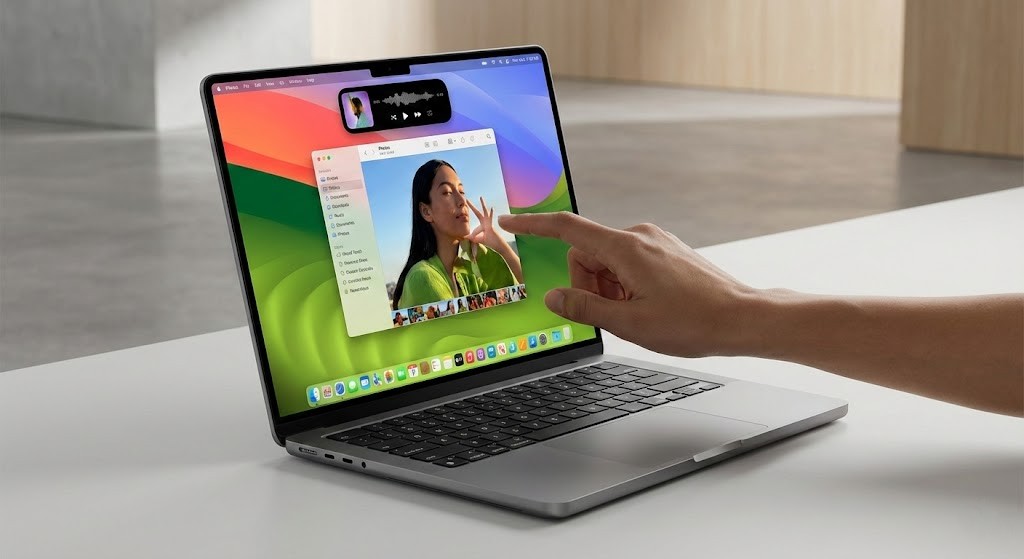
The success of a touch-enabled laptop hinges entirely on its software operating model. Rather than forcing a mobile operating system onto desktop hardware or diluting macOS into a oversized button interface, Apple implemented a hybrid input model called Contextual Touch Targeting within macOS.
The core interface retains its pixel-precise menu bars, density-driven windows, and deep terminal access. However, when an incoming user finger approaches the glass panel, onboard spatial sensors dynamically expand hit-targets for buttons, dropdown menus, and window controls by up to 25%. This subtle, real-time interface adaptation mitigates accuracy errors without disrupting visual desktop density.
- Pro Workflow Acceleration: Digital Audio Workstations (DAWs) and CAD application layers benefit instantly. Direct multi-touch mixing of audio faders and 3D spatial rotation eliminate secondary peripheral steps.
- Enterprise Software Synergies: Enterprise applications natively compiled for iOS and iPadOS now run within macOS with native touch responsiveness, instantly broadening the utility of custom corporate software deployments.
- Sub-System Haptics: Integrated dynamic force sensors beneath the display glass provide localized micro-haptic clicks, giving users subtle physical feedback when triggering commands, manipulating sliders, or hitting UI boundaries.
Financial Architecture & Hardware Specifications Breakdown
The transition to OLED touch technology comes at a pivotal financial junction. As global enterprise refresh cycles normalize following post-pandemic surges, hardware vendors require high-value catalysts to drive institutional procurement. Apple’s supply chain execution balances significant Bill of Materials (BOM) increases against premium market pricing power.
| Hardware Metric / Feature | Legacy Mini-LED MacBook Pro | New OLED Touchscreen MacBook Pro | Enterprise & Market Impact |
|---|---|---|---|
| Display Panel Technology | Single-Layer Mini-LED Backlit LCD | Tandem OLED Dual-Emission Stack | Substantially higher contrast ratios; 30% reduction in display power draw at high brightness. |
| Input Infrastructure | Trackpad & Keyboard Only | In-Cell Touch Digitizer + Dynamic Haptics | Unlocks hybrid iPad/macOS workflows; eliminates external peripheral dependencies for creative suites. |
| Touch Digitizer Latency | N/A | < 4.2 Milliseconds (SoC Integrated) | Zero-perceivable input delay; ideal for precision financial charting, vector design, and editing. |
| Panel thickness (Z-Height) | 4.1 mm (Display Housing) | 3.2 mm (Display Housing) | Enables structural chassis weight reduction while accommodating larger battery cell configurations. |
| Estimated Display BOM Cost | ~$105.00 USD per unit | ~$185.00 - $210.00 USD per unit | Initial gross margin compression mitigated by higher retail pricing tier structures. |
| Base Average Selling Price (ASP) | $1,599 USD (Entry Level Pro) | $1,899 USD (Entry Level Touch Pro) | Drives immediate hardware revenue expansion across corporate enterprise procurement streams. |
Supply Chain Dominance & Enterprise Market Implications
The manufacturing deployment required for the OLED Touchscreen MacBook Pro represents a monumental capital shift across the global technology supply chain. Display panel giants Samsung Display and LG Display have collectively funneled billions into Gen 8.6 OLED fabrication facilities to meet Apple’s stringent volume, yield, and quality specifications.
From an enterprise risk mitigation perspective, Apple’s dual-sourcing procurement strategy ensures supply chain continuity while putting downward pressure on component costs over a 24-month horizon. While the elevated display BOM temporarily compresses unit-level margins, equity analysts anticipate Apple will easily offset these input costs through structural ASP increases and lucrative add-on services bundled into corporate procurement packages.
Industry Winners & Losers
The Winners:
- Tier-1 Display Fabricators: LG Display and Samsung Display secure multi-year high-margin supply contracts, insulating them from lower-tier smartphone display price wars.
- Enterprise Software Developers: SaaS vendors can build single, cross-platform apps that deploy effortlessly across mobile, tablet, and desktop touch interfaces.
- Apple Hardware Revenues: Commercial fleet updates drive a structural lift in unit ASPs and overall Services tie-in metrics.
The Losers:
- Legacy Premium Windows OEMs: Competitors relying on standard off-the-shelf touch displays face intensified competition against Apple's custom silicon and low-latency display engine integration.
- Mini-LED Component Manufacturers: Substrate and backlighting suppliers face declining orders as premium consumer lines migrate permanently toward tandem OLED solutions.
Frequently Asked Questions (People Also Ask)
Why did Apple reverse its long-standing stance against touchscreen laptops?
Apple’s strategic pivot was driven by several convergent factors: the total maturity of custom Apple Silicon (which handles low-latency touch processing efficiently), display fabrication breakthroughs (in-cell tandem OLED technology that prevents added bulk and glare), and changing user expectations cultivated by a decade of touch-native mobile and iPad computing environments.
Does the OLED touchscreen cause screen burn-in or drain battery life faster?
No. By employing a dual-stack Tandem OLED architecture, the panel distributes electrical current across two distinct electroluminescent layers. This reduces thermal stress on organic material by up to 50% while operating, effectively eliminating traditional OLED burn-in risks while extending display energy efficiency past legacy Mini-LED designs.
Will existing macOS desktop apps work with the new touch interface?
Yes. macOS incorporates continuous Contextual Touch Targeting. All existing legacy desktop applications run normally, while the operating system dynamically expands touch targets, buttons, and system controls in real time whenever a user’s finger approaches the display glass.
What are the financial implications for enterprise fleet procurement?
While the base configuration hardware price increases by approximately $200 to $300, enterprise buyers gain higher operational productivity, seamless cross-platform deployment of iOS/iPadOS internal software, and higher residual device trade-in valuations, optimizing long-term Total Cost of Ownership (TCO).
Future Outlook: The Next Horizon in Personal Workstations
The debut of the OLED Touchscreen MacBook Pro marks the beginning of a broader hardware convergence vector. As capital expenditures for Gen 8.6 tandem OLED lines amortize over the coming fiscal quarters, expect touch-enabled display architectures to trickle down into the mid-tier hardware stack, including future iterations of the MacBook Air.
Furthermore, this architectural foundation paves the way for potential future form factors—such as dual-screen foldable workstations and context-aware haptic surfaces—positioning Apple to dominate the high-end personal computing sector through the remainder of the decade. For investors, enterprise IT directors, and creative professionals alike, the touchscreen MacBook Pro is not merely an incremental update; it is an authoritative declaration of where high-performance computing is heading.