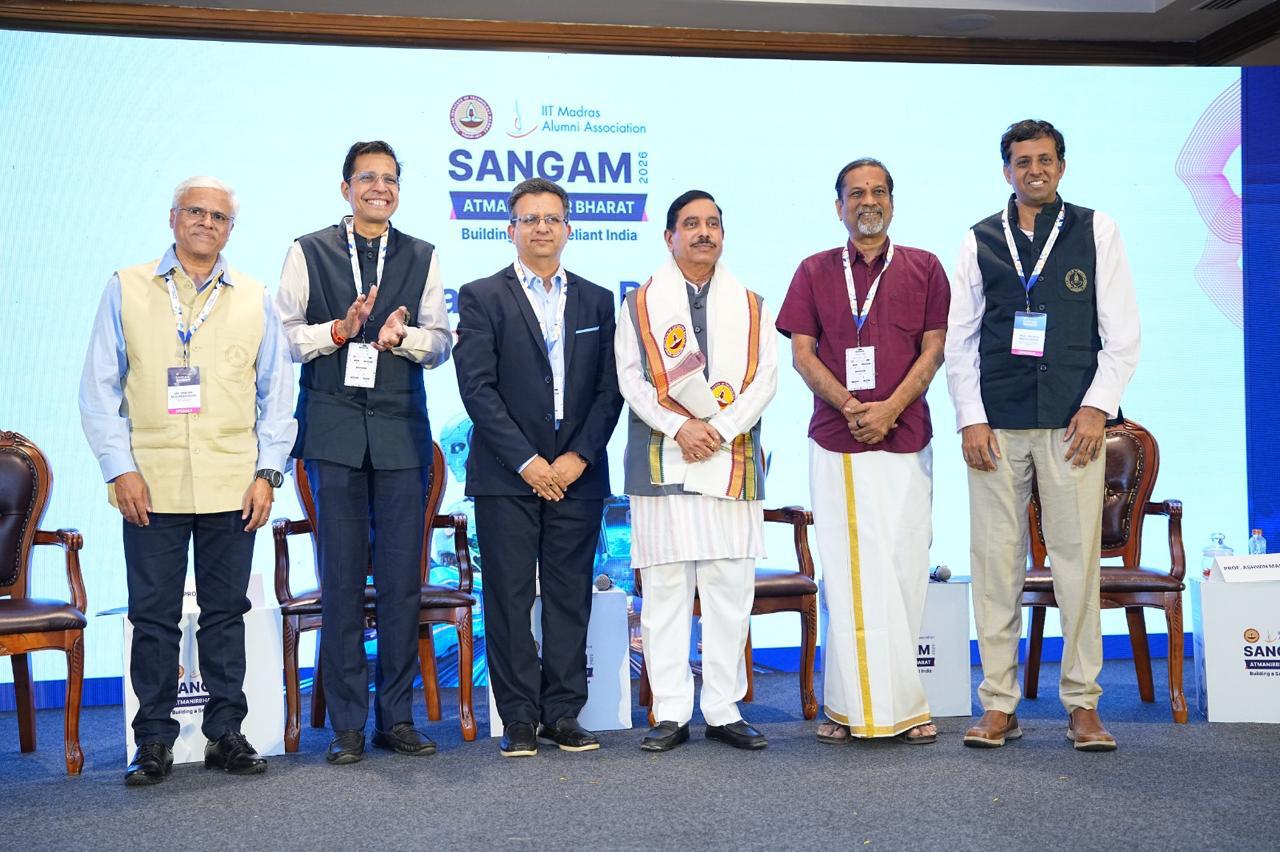
NEW DELHI — In an era defined by geopolitical technological friction and supply chain weaponization, the Indian Institute of Technology Madras Alumni Association (IITMAA) has drawn a definitive roadmap for the nation's economic sovereignty. At the flagship IITMAA Sangam 2026 summit, policymakers, global venture capitalists, and top-tier technologists converged to unveil an aggressive master plan centered on artificial intelligence (AI), semiconductor fabrication, and indigenous deep tech development.
The high-stakes summit underscored a singular, urgent national mandate: India can no longer remain a back-office consumer of Western and East Asian technological infrastructure. Instead, the world’s fifth-largest economy is positioning itself as an autonomous powerhouse capable of inventing, manufacturing, and scaling critical technologies from the silicon wafer up to large-scale sovereign AI models.
The Tipping Point for India’s Deep Tech Economy
For decades, India’s technological narrative was dominated by IT services, software outsourcing, and digital public infrastructure (DPI). However, IITMAA Sangam 2026 marked a psychological and structural pivot toward high-risk, high-reward deep tech engineering.
Industry leaders at the summit emphasized that the intersection of generative AI and physical hardware requires unprecedented capital allocation and academic-industrial collaboration. With global supply chains permanently altered by post-pandemic realities and trade restrictions, India’s domestic market of over 1.4 billion people provides the ideal sandbox for rapid deployment and validation.
- Sovereign Silicon: Moving past the initial policy announcements of the India Semiconductor Mission (ISM) toward active commercial silicon tape-outs and packaging ecosystems.
- AI Autonomy: Developing localized large language models (LLMs) and edge-AI applications tailored to Indian linguistic diversity, agricultural needs, and industrial automation.
- Venture Capital Shift: A massive reallocation of domestic private equity and venture capital toward hardware startups, quantum computing, and advanced materials rather than consumer internet aggregators.
Core Pillars of IITMAA Sangam 2026

The conference focused heavily on bridging the historic "valley of death" that plagues academic research in India—the gap between laboratory prototypes and commercialized mass manufacturing. IIT Madras, consistently ranked as India’s top engineering institution, is leveraging its sprawling research park to incubate companies that build physical products.
Discussions during the plenary sessions dissected the mechanics of building a self-sustaining semiconductor ecosystem. Experts noted that while fab construction requires multi-billion-dollar capital expenditure, India’s competitive advantage lies in semiconductor design, electronic design automation (EDA) software, and specialized chemical supply chains.
Key Focus Areas & Strategic Objectives
| Technology Domain | Primary Objective | Impact Horizon |
|---|---|---|
| Semiconductors | Domestic fab integration, OSAT facilities, and indigenous chip design. | 2026–2030 |
| Artificial Intelligence | Sovereign compute infrastructure and vernacular generative AI models. | Immediate (Ongoing) |
| Deep Tech & Advanced Materials | Commercializing lab-scale research in quantum tech, drones, and EV components. | 2028–2035 |
Bridging Capital and Engineering Excellence
A recurring theme at Sangam 2026 was the evolution of India's venture ecosystem. Institutional investors and veteran founders discussed the maturation of deep tech financing. Unlike software-as-a-service (SaaS) startups, deep tech ventures require long gestation periods and patient capital.
Speakers noted that public-private partnerships (PPPs) will play an instrumental role in derisking early-stage hardware investments. By utilizing government grants alongside private venture funds, India is building a robust pipeline capable of supporting founders who choose to build complex physical systems.
“India’s transition from a service economy to a product and deep tech superpower is no longer optional; it is an economic and national security imperative. The synergy between IIT alumni, global capital, and state backing is creating a once-in-a-generation momentum.” — Industry consensus at IITMAA Sangam 2026
Looking Ahead: The Road to 2030
As IITMAA Sangam 2026 concluded, the actionable takeaways for corporate boardrooms and startup founders were unmistakable. The window to establish global leadership in next-generation computing and manufacturing is narrowing. By harnessing its vast diaspora network and tightening the loop between academic research and market execution, India is laying down the foundational blocks for a self-reliant technological future.
Frequently Asked Questions
What is the primary objective of IITMAA Sangam 2026?
The summit aims to accelerate India's journey toward technological self-reliance (Atmanirbhar Bharat) by fostering collaboration across AI, semiconductor manufacturing, and deep tech commercialization.
Why are semiconductors and deep tech central to India’s current economic strategy?
With global supply chains facing chronic vulnerabilities, developing domestic semiconductor design, packaging, and advanced deep tech capabilities is vital for long-term national security, economic resilience, and high-value job creation.