From Bicycle-Transported Rockets to Lunar Pioneers: How India’s Space Economy Became a Trillion-Dollar Powerhouse
NEW DELHI & MUMBAI — Decades ago, the Indian Space Research Organisation (ISRO) transported its earliest rocket components on the carriers of bicycles. Today, the nation stands as an undisputed titan in the global aerospace arena. Driven by radical policy overhauls, cost-redefining engineering, and surging international partnerships, India’s space sector is undergoing a historic metamorphosis, shifting from a state-run scientific endeavor into a vibrant, commercially driven economic engine.
According to comprehensive policy briefs released by premier analytical institutions like Vajiram & Ravi, this evolution is no longer just about national prestige. It is about capturing a massive share of the global commercial space market. With deep structural reforms opening the floodgates to private enterprise, India is rapidly cementing its status as the world’s most cost-effective and reliable gateway to the stars.
The Evolution: From Humble Beginnings to Commercial Autonomy
The genesis of India’s space journey dates back to 1969 with the establishment of ISRO under the visionary leadership of Vikram Sarabhai. Operating under severe resource constraints and stringent international technology denials, Indian scientists pioneered indigenous technology. The early milestones—ranging from the experimental Aryabhata satellite in 1975 to the workhorse Polar Satellite Launch Vehicle (PSLV)—were built on a foundation of frugality and self-reliance.
However, the true turning point arrived recently with the deregulation of the space economy. For decades, ISRO held a monopoly on end-to-end space activities. The creation of the Indian National Space Promotion and Authorization Centre (IN-SPACe) as a single-window nodal agency changed the paradigm. By inviting private participation, India transformed from a tightly guarded state enterprise into an open marketplace.
- Democratization of Space: Startups and private conglomerates can now build launch vehicles, operate satellites, and offer space-based applications independently.
- The Role of NSIL: NewSpace India Limited (NSIL), the commercial arm of ISRO, has streamlined technology transfers, allowing homegrown industries to commercialize space-grade innovations.
- Capital Influx: Venture capital and private equity are increasingly flowing into Indian spacetech startups, fostering an ecosystem of rapid innovation.
Unprecedented Achievements: Redefining Deep Space Economics
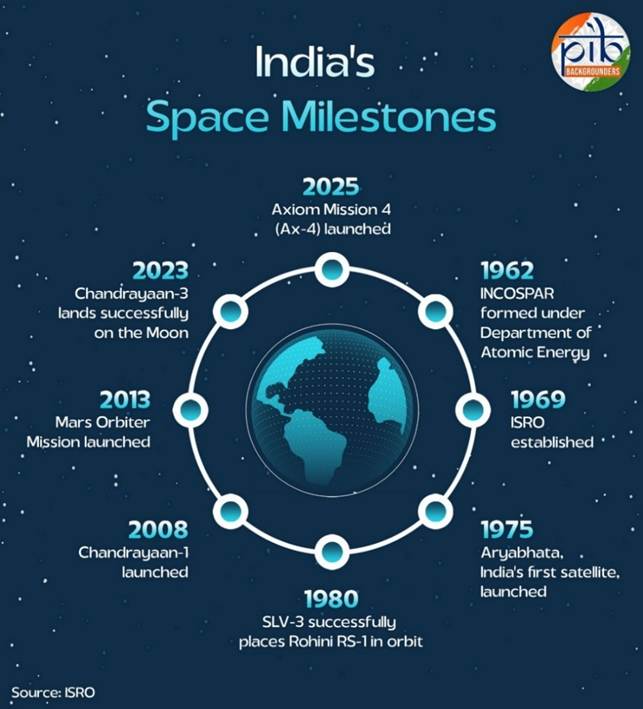
India’s ascent has been marked by a series of historic technical triumphs that have repeatedly shocked the global establishment. Most notably, the Chandrayaan-3 mission successfully landed a spacecraft near the uncharted lunar South Pole, making India the first nation in history to achieve the feat and only the fourth country to execute a soft landing on the moon.
What sets the Indian model apart is its legendary frugality. Operating on a budget a fraction of traditional Western space programs, ISRO achieved its lunar triumph at a cost widely reported to be less than the budget of Hollywood sci-fi blockbusters. This unmatched price-to-performance ratio has made India a magnet for international satellite deployment.
| Mission / Milestone | Year | Strategic Significance |
|---|---|---|
| Aryabhata | 1975 | India's maiden foray into satellite technology. |
| PSLV-C37 (Cartosat-2 Series) | 2017 | World record for launching 104 satellites in a single mission. |
| Chandrayaan-3 | 2023 | Historic soft landing on the lunar South Pole. |
| Aditya-L1 | 2023-24 | India's first dedicated solar observatory mission. |
Global Partnerships and the Geopolitical Horizon
Beyond domestic breakthroughs, India is stitching together vital international alliances. The signing of the Artemis Accords signaled New Delhi’s commitment to transparent, peaceful, and cooperative space exploration alongside global superpowers like the United States.
Concurrently, ISRO continues to launch commercial payloads for dozens of countries, cementing its reputation as the global launch pad of choice for small and medium-sized satellites. Joint ventures, technology-sharing frameworks, and collaborative earth-observation initiatives—such as the NASA-ISRO Synthetic Aperture Radar (NISAR) mission—demonstrate that India is an indispensable partner in mapping the future of our planet and beyond.
Key Pillars of India's Global Space Strategy
As international demand for reliable, low-cost launch services surges, India’s strategic geographic advantage (thanks to the Satish Dhawan Space Centre in Sriharikota) combined with its robust diplomatic outreach positions it uniquely. Western space agencies, facing domestic manufacturing backlogs and escalating costs, increasingly look to Indian private players to sustain their orbital supply chains.
Future Outlook: Towards a Multi-Billion Dollar Economy
The economic stakes are monumental. Current projections indicate that India’s space economy—currently valued at around $8.4 billion—is poised to skyrocket past $44 billion by 2033. With ambitious future endeavors on the horizon, including the crewed Gaganyaan mission, lunar sample return concepts, and the establishment of an indigenous space station, the runway for growth is vast.
Yet, challenges remain. Regulatory clarity, long-term venture capital commitment, and the scaling up of heavy-lift manufacturing capabilities will be critical hurdles for Indian startups to clear. Nevertheless, the trajectory is unmistakable. From bicycle carriers to lunar south pole footprints, India’s space sector has evolved into a premier symbol of modern technological might and economic dynamism.
Frequently Asked Questions
1. What major policy changes fueled India’s space sector growth?
The establishment of IN-SPACe (Indian National Space Promotion and Authorization Centre) as an independent regulatory body allowed private companies and startups to build rockets, launch satellites, and utilize ISRO infrastructure, effectively ending the state monopoly.
2. How does India manage to execute space missions at such a low cost?
India leverages frugal engineering, highly skilled and cost-efficient domestic scientific talent, optimized supply chains, and a modular design philosophy that minimizes waste without compromising mission reliability.