Executive Takeaways
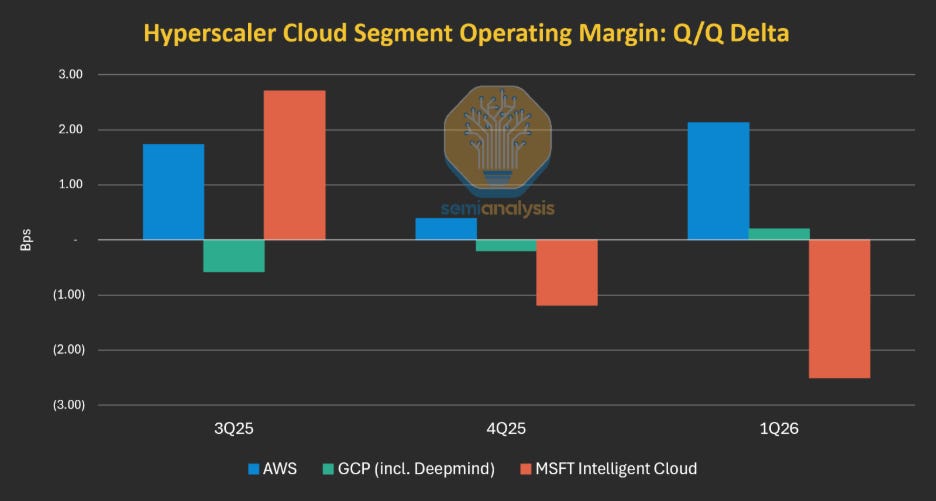
- Structural Margin Expansion: Amazon Web Services (AWS) is outperforming legacy cloud peers in operating margin recovery, propelled by proprietary silicon efficiency and high-margin generative AI software abstractions via Amazon Bedrock.
- The Anthropic Catalyst: According to proprietary insights from SemiAnalysis’s "Tokenomics 2.0" framework, AWS’s strategic equity and infrastructure partnership with Anthropic creates a self-reinforcing flywheel of compute demand and software monetization.
- Bedrock Mix Optimization: By abstracting foundational models through managed APIs, AWS successfully mitigates raw GPU commoditization, capturing superior take-rates and enterprise software economics compared to bare-metal compute resale.
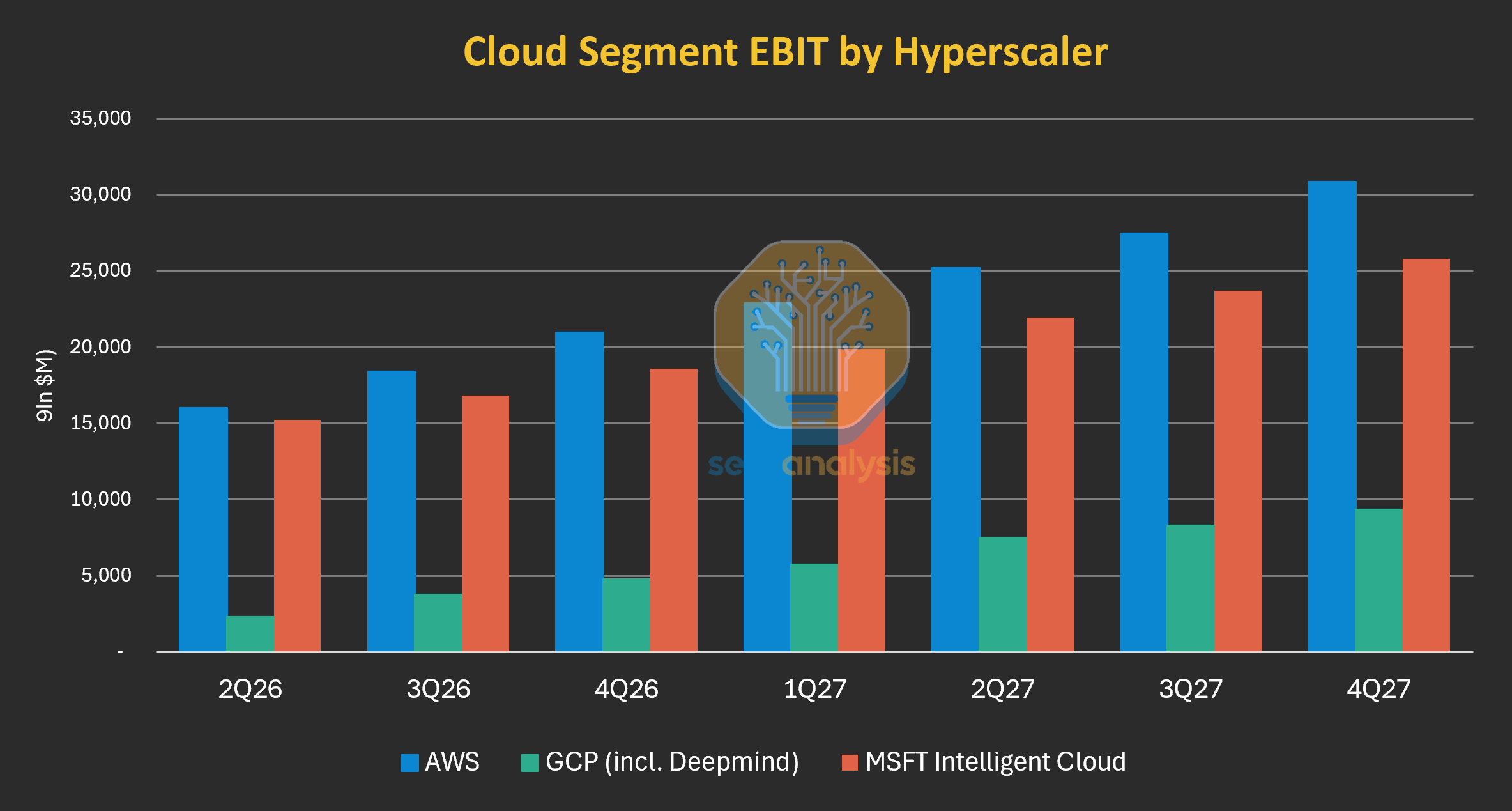
- Competitive Divergence: While Microsoft Azure and Google Cloud navigate heavy capital expenditure cycles and margin dilution from proprietary infrastructure buildouts, AWS’s diversified mix insulates its balance sheet.
SEATTLE & NEW YORK — For nearly four years, Wall Street’s primary anxiety regarding the hyperscale cloud triopoly centered on a brutal arithmetic: massive capital expenditure outlays for artificial intelligence infrastructure threaten to compress operating margins before software revenue can catch up. Yet, recent forensic analyses of cloud unit economics are painting a starkly divergent reality. According to comprehensive data models from industry research firm SemiAnalysis, Amazon Web Services (AWS) has engineered a masterclass in enterprise monetization, leveraging deep strategic alignments with foundational model builders to structurally outpace its direct competitors.
At the center of this financial transformation are two compounding forces: the explosive commercial adoption of Amazon Bedrock and the structural mechanics of AWS’s landmark partnership with AI pioneer Anthropic. As enterprise clients accelerate their transition from experimental proof-of-concepts to mission-critical production deployments, the convergence of optimized infrastructure scalability, favorable vendor deal terms, and proprietary software mix is driving AWS operating margins higher precisely when market skeptics predicted margin degradation.
The Genesis of Tokenomics 2.0: Deconstructing the AWS Advantage
Test Our Free AI & Tech Utilities Suite
Calculate LLM API token costs, analyze article dwell-time, or simulate tech DCA returns.
To understand how AWS is successfully bending the cost curve while legacy peers navigate margin pressure, one must look beneath the surface of cloud compute architecture. SemiAnalysis’s newly released Tokenomics 2.0 model provides an exhaustive granular breakdown of how inference workloads, silicon utilization, and software abstraction layers interact at scale.
Historically, cloud providers operated on a relatively straightforward infrastructure-as-a-service (IaaS) margin profile: rent out servers, storage, and networking at a fixed markup over depreciated capital costs. However, the generative AI boom fundamentally disrupted this model. Raw Nvidia H100 and upcoming Blackwell cluster deployments represent front-loaded capital allocation burdens that risk compressing cash flows unless offset by high-margin software services.
AWS circumvented this trap by pioneering a managed service ecosystem centered on Amazon Bedrock. Rather than forcing enterprise clients to provision raw virtual machines and manage complex open-source model weights independently, Bedrock provides a unified control plane for accessing industry-leading foundation models—most notably Anthropic’s Claude family of models—via fully managed API endpoints.
This architectural choice fundamentally alters enterprise ROI calculations. Customers are willing to pay a premium for reduced operational friction, enterprise-grade data privacy, zero data retention guarantees, and seamless integration with existing enterprise data warehouses like Amazon Redshift and data lakes on Amazon S3. For AWS, this translates into superior software-like gross margins sitting on top of its optimized Trainium and Inferentia hardware stacks.
The Anthropic Vector: Structuring a High-Yield Ecosystem
The crown jewel of AWS’s AI strategy is its multi-billion-dollar alliance with Anthropic. While initial headlines focused primarily on the sheer scale of Amazon’s financial commitment, sophisticated financial analysts have increasingly turned their attention to the structural terms governing the partnership.
Under the hood, the deal mechanics are structured to align long-term incentives while maximizing cloud consumption velocity. Anthropic utilizes AWS as its primary cloud provider for safety research and model training workloads, anchoring multi-year compute commitments that ensure high baseline utilization for Amazon's custom silicon infrastructure.
Simultaneously, making Anthropic’s Claude models exclusively or preferentially prominent across the Bedrock ecosystem creates an irresistible commercial funnel. As enterprise customers increasingly demand state-of-the-art reasoning capabilities for complex financial modeling, automated code generation, and regulatory compliance workflows, the consumption of Claude tokens through Bedrock scales exponentially.
“The synergy here is not merely about top-line revenue expansion; it is about margin accretion,” notes a senior tech equity research analyst based in New York. “Anthropic’s model efficiency combined with AWS’s pricing power and proprietary infrastructure stack creates a distinct economic moat. Selling Claude on Bedrock is simply a highly attractive business model because it captures both the compute infrastructure layer and the high-value software abstraction layer.”
Comparative Metrics: AWS vs. Cloud Peers
The tangible results of this strategy are becoming glaringly evident in quarterly financial disclosures and granular unit economic models. While Microsoft Azure benefits immensely from its exclusive partnership with OpenAI, the heavy reliance on capital-intensive Azure OpenAI Service deployments has exposed Microsoft to tighter capacity constraints and higher marginal hosting costs passed down through aggressive compute-sharing structures.
Google Cloud Platform (GCP), meanwhile, continues to leverage its proprietary Tensor Processing Units (TPUs) effectively but has historically faced structural headwinds in enterprise software sales execution relative to Amazon’s deeply entrenched enterprise account relationships.
| Metric / Dimension | Amazon Web Services (AWS) | Microsoft Azure | Google Cloud Platform (GCP) |
|---|---|---|---|
| Primary AI Foundation Partner | Anthropic (Claude Series) | OpenAI (GPT Series) | Internal (Gemini) & Multi-Model |
| Managed AI Architecture | Amazon Bedrock (Broad Abstraction) | Azure OpenAI / AI Studio | Vertex AI |
| Silicon Diversification Strategy | Nvidia + Custom Trainium/Inferentia | Nvidia + Custom Maia Chips | Nvidia + Advanced Custom TPUs |
| Operating Margin Trajectory | Expanding / Resilient (Optimized Mix) | Pressured by High CapEx Cycles | Gradually Scaling into Profitability |
| Enterprise Integration Moat | Deep S3, Redshift & Data Lake Tie-Ins | Deep Microsoft 365 & Office Suite Tie-Ins | Workspace & Advanced Data Analytics |
Industry & Market Implications: Who Wins and Who Loses
The structural advantage currently being enjoyed by AWS carries profound downstream consequences for enterprise technology markets, valuation multiples, and competitive dynamics across the broader cloud computing landscape.
Corporate Enterprise Buyers: The maturation of managed multi-model platforms like Bedrock lowers the barrier to entry for deploying bespoke AI agents. Organizations no longer need to maintain expensive, specialized in-house machine learning engineering teams just to fine-tune and host custom models securely. This democratizes high-end artificial intelligence while ensuring strict regulatory compliance and data governance.
Cloud Infrastructure Competitors: For Azure and GCP, AWS’s margin resilience serves as an urgent strategic wake-up call. Simply spending capital on raw GPU compute capacity is no longer a sufficient recipe for dominant market share. Competitors must refine their software abstraction layers and optimize their proprietary silicon roadmaps to match the unit economic efficiencies demonstrated in SemiAnalysis’s latest findings.
Semiconductor Manufacturers & Silicon Providers: While Nvidia remains the undisputed beneficiary of aggregate AI infrastructure demand, the rapid scaling of Amazon’s custom Trainium and Inferentia chips—alongside internal efforts by Microsoft and Google—signals a long-term structural shift. As hyperscalers optimize inference workloads away from general-purpose GPUs toward specialized accelerators, chipmakers must adapt to increasingly cost-conscious enterprise architectures.
Frequently Asked Questions (People Also Ask)
How does Amazon Bedrock directly drive higher margins for AWS compared to traditional cloud infrastructure?
Traditional cloud infrastructure (IaaS) operates on relatively thin margins derived from renting raw compute and storage capacity. Amazon Bedrock shifts AWS into higher-margin software-as-a-service (SaaS) and platform-as-a-service (PaaS) territory. By abstracting foundational models like Anthropic's Claude into managed APIs, AWS captures lucrative software take-rates, reduces customer churn through integrated enterprise workflows, and optimizes internal hardware utilization.
What specific insights does SemiAnalysis’s Tokenomics 2.0 model reveal about the AWS-Anthropic partnership?
The Tokenomics 2.0 framework models the granular unit economics of token generation, inference costs, and infrastructure utilization. It highlights how AWS's strategic investment and infrastructure terms with Anthropic create a symbiotic loop: Anthropic secures massive, reliable compute resources for training and scaling, while AWS locks in high-volume, premium-margin enterprise token consumption exclusively across its managed Bedrock ecosystem.
Why are legacy cloud peers experiencing margin compression while AWS margins expand?
Competitors like Microsoft Azure and Google Cloud have faced heavier capital expenditure headwinds and cost structures tied directly to proprietary model hosting and dense GPU cluster maintenance. AWS’s diversified model mix—incorporating custom silicon (Trainium/Inferentia), multi-model flexibility via Bedrock, and deeply entrenched enterprise data storage ties—insulates its balance sheet and yields superior operating leverage.
What are the primary risk factors that could disrupt AWS’s current generative AI margin advantage?
Key risk factors include potential price wars among hyperscalers as open-source foundation models commoditize basic text generation, unforeseen bottlenecks in custom silicon manufacturing, and evolving regulatory frameworks surrounding data privacy, copyright, and AI safety compliance that could increase operational overhead.
Future Outlook: Strategic Milestones to Watch
As the enterprise artificial intelligence market matures past its initial hype cycle, the battleground for cloud dominance will be decided by operational execution, cost discipline, and software monetization velocity. Several key milestones will dictate whether AWS can sustain its current margin outperformance over the medium to long term:
- Custom Silicon Scaling: Monitor the deployment velocity and enterprise adoption rates of Amazon’s next-generation Trainium accelerators. The degree to which AWS can migrate inference workloads off expensive Nvidia GPUs and onto proprietary silicon will directly dictate future gross margin expansion.
- Enterprise Agentic Workflows: Watch for the commercial rollout of complex, multi-step autonomous agent applications built on top of Amazon Bedrock. As enterprises transition from simple chat interfaces to autonomous backend business processes, token consumption volumes are projected to scale non-linearly.
- Competitive Counter-Offensives: Track how Microsoft Azure and Google Cloud restructure their respective partner ecosystems and pricing models to counter Amazon’s software abstraction advantages. Antitrust scrutiny regarding exclusive hyperscaler-model developer partnerships will also remain a vital regulatory wildcard.
For executive leadership, institutional investors, and enterprise technology buyers, the message emanating from the latest data is unambiguous: the era of brute-force infrastructure spending is giving way to an era of refined cloud unit economics. In this new paradigm, AWS has successfully positioned itself at the vanguard of profitable, scalable generative AI monetization.