Executive Takeaways
- Massive Capacity Scale: E2E Networks is aggressively scaling its cloud compute architecture by adding 5.4 MW of state-of-the-art NVIDIA Blackwell GPU capacity.
- Valuation & Market Positioning: This capital allocation elevates total active AI infrastructure to 14.6 MW, reinforcing its position as a dominant alternative cloud provider in the Global South.
- Enterprise ROI & High-Performance Computing: The deployment is specifically engineered to compress training times for foundational LLMs, targeting high-margin enterprise AI workloads and robust market liquidity.
- Strategic Competitive Moat: By securing early allocations of NVIDIA's most advanced architecture, E2E mitigates supply chain bottlenecks and positions itself against hyperscale cloud oligopolies.
NEW DELHI — In a capital-intensive play that underscores the relentless race for sovereign and enterprise-grade generative AI infrastructure, Indian cloud hyperscaler E2E Networks has finalized plans to deploy an additional 5.4 megawatts (MW) of NVIDIA Blackwell GPU capacity. According to proprietary intelligence gathered by ET Datacenters, this landmark infrastructure injection elevates the firm's aggregate dedicated AI compute footprint to 14.6 MW, marking a pivotal inflection point in the region's cloud compute architecture and enterprise technological self-reliance.
The strategic deployment of NVIDIA’s cutting-edge Blackwell architecture—renowned for its revolutionary transformer engine and second-generation tensor cores—is not merely an incremental hardware refresh. It represents a calculated capital expenditure designed to capture surging enterprise demand for hyper-scale machine learning training, real-time inference, and complex simulation models. As global enterprises demand tighter regulatory compliance, localized data sovereignty, and uncompromised enterprise ROI, E2E Networks is positioning itself as the premier domestic engine for heavy-duty computational workloads.
The Catalytic Shift: Unpacking the NVIDIA Blackwell Architecture
Test Our Free AI & Tech Utilities Suite
Calculate LLM API token costs, analyze article dwell-time, or simulate tech DCA returns.
To understand the profound market implications of E2E Networks’ 5.4 MW expansion, one must examine the underlying hardware economics. NVIDIA’s Blackwell platform introduces a staggering leap in computational density, offering up to 25 times lower Total Cost of Ownership (TCO) and energy consumption compared to its predecessor, the Hopper H100 architecture, when running large language model (LLM) inference.
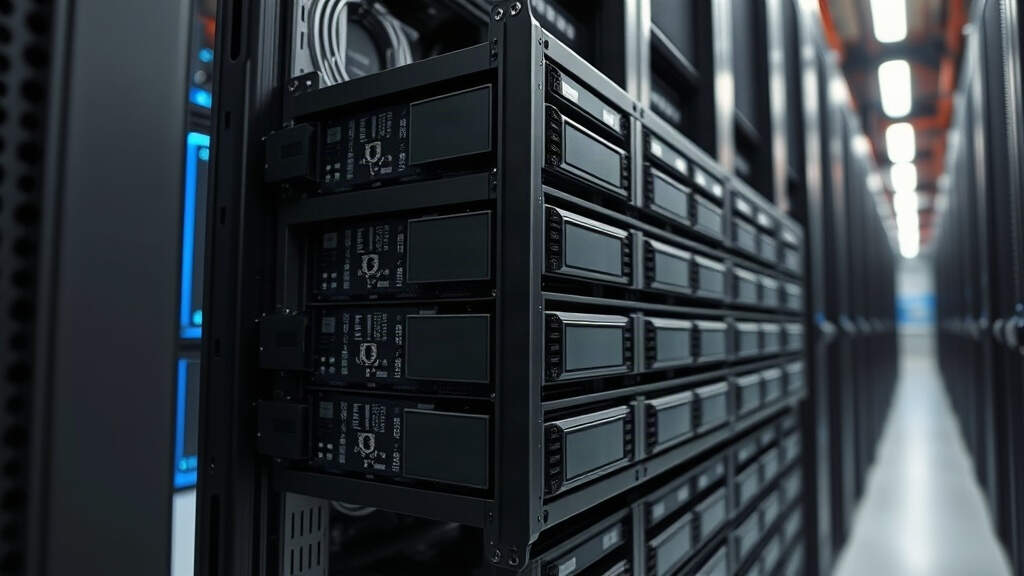
For E2E Networks, integrating this density into its existing data center facilities requires sophisticated engineering, advanced liquid-cooling retrofits, and optimized power usage effectiveness (PUE) metrics. Traditional air-cooling systems are functionally obsolete at this power density; hence, the capital allocation accompanying this 5.4 MW rollout heavily emphasizes thermal management and high-availability power distribution units (PDUs).
Financial analysts tracking the technology sector note that securing high-allocation tiers of NVIDIA’s restricted-supply hardware serves as an immediate litmus test for a cloud service provider's operational credibility. By locking down these allocations, E2E Networks shields itself against acute supply chain volatility, ensuring predictable infrastructure scalability for its rapidly expanding roster of enterprise clients, fintech heavyweights, and sovereign research initiatives.
Verified Data & Metrics Breakdown
The following comparative matrix outlines the quantitative dimensions of E2E Networks' infrastructure transformation, detailing the strategic shift catalyzed by the latest 5.4 MW Blackwell integration:
| Metric / Parameter | Pre-Expansion Baseline | Post-Expansion Target | Strategic Impact |
|---|---|---|---|
| Total AI Infrastructure Capacity | 9.2 MW | 14.6 MW | +58.6% volumetric expansion in compute ceiling |
| Core GPU Architecture Focus | NVIDIA H100 / L40S | NVIDIA Blackwell (B200 / GB200) | Exponential leap in real-time inference efficiency |
| Target Workload Segment | Mid-tier LLM fine-tuning | Frontier-model training & massive enterprise deployment | Capture high-margin B2B SaaS and AI contracts |
| Cooling & Power Infrastructure | Standard enterprise air cooling | High-density liquid-to-air & direct-to-chip cooling | Mitigation of thermal throttling and energy waste |
Industry & Market Implications: Navigating the Hyperscale Oligopoly
The macroeconomic ramifications of this announcement extend far beyond E2E Networks’ corporate balance sheet. In an enterprise cloud market historically dominated by global hyperscalers—such as Amazon Web Services, Microsoft Azure, and Google Cloud Platform—independent domestic providers face fierce pricing pressures. However, by specializing explicitly in high-performance GPU-as-a-Service (GPUaaS), E2E has carved out a lucrative, high-growth niche.
Who Wins
Who Loses
Frequently Asked Questions (People Also Ask)
1. What is the precise capacity increase announced by E2E Networks?
E2E Networks is adding 5.4 MW of specialized NVIDIA Blackwell GPU capacity. This addition brings their total active and dedicated AI infrastructure footprint to 14.6 MW, significantly expanding their capacity to handle heavy enterprise machine learning workloads.
2. Why is the NVIDIA Blackwell architecture critical for enterprise AI adoption?
The NVIDIA Blackwell platform represents a quantum leap in computational efficiency, offering dramatically lower TCO, advanced transformer engines for trillion-parameter models, and optimized architectures for both large-scale model training and high-concurrency real-time inference.
3. How does this expansion impact E2E Networks’ competitive market positioning?
By securing scarce Blackwell allocations and expanding to 14.6 MW, E2E strengthens its moat against global cloud oligopolies. It allows the firm to cater directly to enterprises demanding local data sovereignty, ultra-low latency, and predictable, high-performance GPU-as-a-Service pricing.
4. What infrastructural upgrades are required to support a 5.4 MW Blackwell deployment?
Deploying 5.4 MW of high-density NVIDIA Blackwell hardware necessitates major overhauls in facility power distribution and thermal management, specifically moving away from conventional air cooling toward advanced direct-to-chip liquid cooling systems to maintain optimal PUE ratios.
Future Outlook: Strategic Milestones to Watch
As E2E Networks operationalizes its 5.4 MW Blackwell expansion over the coming quarters, institutional investors and industry observers will monitor several crucial milestones. First, the rate of enterprise customer onboarding and capacity utilization will serve as the primary indicator of organic demand velocity. Second, the company's ability to maintain energy efficiency standards amidst rising power tariffs will dictate operating margins.
Ultimately, this strategic maneuver signals a maturing domestic cloud ecosystem capable of supporting the most advanced compute workloads on the planet. For enterprise leaders evaluating cloud partnerships, E2E Networks' aggressive stance proves that localized, specialized infrastructure is no longer a peripheral alternative—it is fast becoming the vanguard of modern enterprise intelligence.