Executive Takeaways
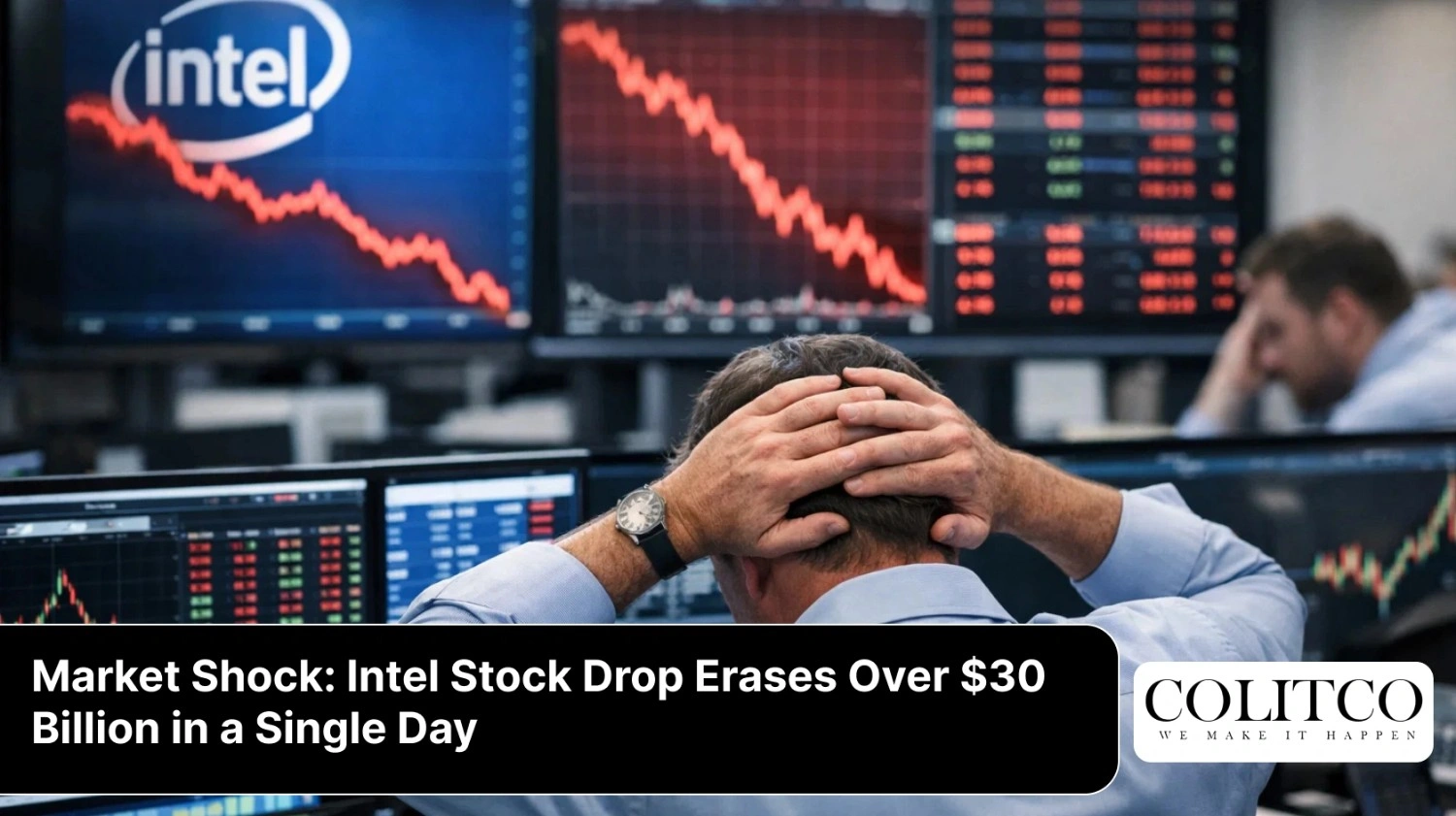
- Unprecedented Valuation Collapse: Intel’s historic single-day stock rout erased over $30 billion in market capitalization, compounding into a staggering $140 billion enterprise value wipeout from its historical peaks.
- Foundry Strategy Execution Stalls: CEO Pat Gelsinger’s ambitious pivot to contract chip manufacturing (Intel Foundry) severely compressed operating margins, triggering an unexpected suspension of the company's decades-long dividend payout.
- Capital Allocation and Cash Burn: Massive capital expenditures required for leading-edge node development (Intel 18A) severely strained free cash flow, alarming institutional investors and credit rating agencies.
- Artificial Intelligence Misstep: Slow enterprise infrastructure scalability and early miscalculations in generative AI accelerator demand allowed rival NVIDIA and AMD to capture virtually all high-margin enterprise ROI.
For more than half a century, the blue-and-white "Intel Inside" logo served as the undisputed hallmark of digital supremacy. It was the digital heartbeat of the personal computing revolution, a titan of American industrial engineering that commanded global semiconductor markets with near-monopolistic impunity. Today, that fortress of technological dominance is undergoing a historic structural stress test. The silicon colossus has suffered its worst market rout in decades, resulting in an eye-watering $140 billion equity evaporation that has stunned Wall Street, alarmed Washington policy-makers, and forced institutional portfolio managers to reevaluate the entire semiconductor supply chain.
To understand how a foundational pillar of modern enterprise IT reached this precipice requires dissecting a complex matrix of strategic miscalculations, aggressive capital allocation gambles, and a seismic shift in cloud compute architecture. This investigative report breaks down the systemic failures, financial hemorrhaging, and macro-economic repercussions of Intel's unprecedented market collapse.
The Catalyst: A Disastrous Earnings Print and Guidance Shock
Test Our Free AI & Tech Utilities Suite
Calculate LLM API token costs, analyze article dwell-time, or simulate tech DCA returns.
The immediate catalyst for the historic single-day plunge was a catastrophic second-quarter earnings report that shattered any remaining investor confidence in Intel’s near-term recovery timeline. While top-line revenue missed consensus estimates, the true shock lay in management's forward-looking guidance and a staggering deterioration of gross margins. For decades, Intel’s business model was anchored by high-margin x86 microprocessor sales that routinely generated gross margins north of 60%. The latest financial disclosures revealed adjusted gross margins plummeting toward historical lows, dragged down by underutilized fabrication plants and exorbitant startup costs associated with its aggressive foundry pivot.
Compounding the top-line disappointment, CEO Pat Gelsinger and Chief Financial Officer David Zinsner announced a draconian cost-reduction program, most notably the immediate suspension of Intel’s quarterly dividend. For income-focused institutional funds and retail shareholders alike, the dividend was sacred. Its elimination signaled to the market that management’s internal cash-generation forecasts had deteriorated far faster than previously communicated, triggering an algorithmic sell-off and subsequent liquidity panic.
| Metric / Financial Indicator | Prior Fiscal Period | Latest Disclosed Quarter | Market Impact / Significance |
|---|---|---|---|
| Market Capitalization Peak | ~$260 Billion (Historical Highs) | Sub-$100 Billion Range | Massive valuation multiples compression; exit from top-tier tech valuation bracket. |
| Non-GAAP Gross Margin | ~55% - 60% (Historical Standard) | Sub-40% Projected Near-Term | Reflects extreme manufacturing underutilization and high startup costs for Intel 18A nodes. |
| Free Cash Flow (FCF) | Positive ($5B - $10B Annually) | Deeply Negative / Burning Cash | Forced suspension of dividend and aggressive capital expenditure rollbacks. |
| Workforce Reductions | Baseline Operations | Over 15,000+ Layoffs Announced | Drastic opex reduction targeting over $10 billion in total savings by the fiscal year-end. |
The Foundry Gambit: High Stakes, High Burn Rate
At the heart of Intel’s current crisis is the "IDM 2.0" strategy. When Pat Gelsinger returned to lead Intel in 2021, he inherited a company suffering from severe technological stagnation, most notably painful delays in transitioning to the 7-nanometer and 5-nanometer manufacturing nodes. To reclaim crown-jewel status, Gelsinger committed to an extraordinarily audacious dual mandate: rebuilding Intel's internal product leadership while simultaneously standing up an independent contract manufacturing business—Intel Foundry—to compete directly with Taiwan Semiconductor Manufacturing Company (TSMC) and Samsung.
The logic on paper was sound, offering vital geopolitical risk mitigation and tapping into the lucrative external foundry market. However, the financial execution has been punishing. Building leading-edge semiconductor fabrication facilities (fabs) in Ohio, Arizona, Oregon, and Europe requires staggering capital expenditure outlays. Unlike fabless competitors such as NVIDIA and AMD, which outsource manufacturing and maintain lean balance sheets, Intel absorbed the full brunt of building multi-billion-dollar cleanrooms while its legacy PC and server markets faced cyclical downturns.
Furthermore, Intel Foundry reported operating losses widening to billions of dollars annually. External customers—who would ideally utilize Intel's bleeding-edge nodes—remained hesitant to commit production volumes to a competitor with unproven foundry execution reliability. This created a vicious cycle: low external utilization led to unabsorbed overhead costs, which crushed gross margins and starved the core business of necessary research and development agility.
Missing the Generative AI Super-Cycle
While Intel consumed its capital reserves building out foundry infrastructure, the broader technology sector underwent a tectonic shift driven by generative artificial intelligence. Hyperscale cloud providers (Microsoft, Google, Amazon, and Meta) abruptly pivoted their capital allocation strategies, diverting billions of dollars away from traditional CPU-centric server upgrades toward specialized Graphics Processing Units (GPUs) and AI accelerators.
Intel was dangerously sluggish to recognize and capitalize on this paradigm shift. While NVIDIA aggressively captured over 80% of the high-performance AI training and inference market, and AMD steadily carved out market share with its MI300 series accelerators, Intel’s Gaudi AI chips struggled to gain meaningful enterprise traction. In enterprise data centers, where infrastructure scalability and maximum performance-per-watt are paramount, corporate buyers favored mature software ecosystems (such as NVIDIA’s CUDA) over unproven hardware alternatives.
The result was a devastating loss of market share in the high-margin enterprise data center segment—historically Intel’s most profitable division. As cloud architects prioritized AI workloads, Intel’s Xeon processors were relegated to secondary supporting roles rather than serving as the primary engines of next-generation compute clusters.
Industry & Market Implications: Who Wins, Who Loses
The collapse of Intel’s equity value ripples far beyond the company’s corporate headquarters in Santa Clara, fundamentally altering the competitive landscape of global technology:
- The Winners: Advanced Micro Devices (AMD) and NVIDIA stand as the primary immediate beneficiaries. AMD continues to capture lucrative x86 server and client market share from Intel’s weakened footing, while NVIDIA tightens its monopolistic grip on enterprise AI infrastructure. Meanwhile, TSMC solidifies its position as the undisputed titan of global contract semiconductor manufacturing, facing diminished domestic rivalry in the near term.
- The Losers: Enterprise IT buyers face reduced supply chain optionality. With Intel struggling to maintain parity, the x86 ecosystem risks becoming a single-vendor dependent market if AMD cannot fully absorb enterprise demands. Additionally, PC and laptop original equipment manufacturers (OEMs) face margin pressures as processor pricing dynamics shift.
- Geopolitical and Regulatory Fallout: Washington policy-makers are watching the crisis with acute alarm. Intel is the primary domestic recipient of CHIPS Act subsidies, envisioned as the cornerstone of American semiconductor manufacturing independence. A weakened Intel complicates national security objectives, raising difficult questions in Washington regarding whether direct government equity stakes or emergency intervention may eventually be required to safeguard domestic manufacturing capacity.
Frequently Asked Questions (People Also Ask)
Why did Intel stock drop so drastically?
Intel’s historic stock drop was triggered by a combination of disappointing second-quarter earnings, a drastic slash in forward-looking revenue guidance, projected gross margins falling well below historical norms, and the abrupt suspension of its quarterly dividend. Compounding these financial shocks were widening losses in its new foundry division and a failure to capture meaningful market share in the generative AI accelerator boom.
Is Intel going bankrupt or facing imminent insolvency?
No. While Intel is experiencing severe financial distress and a historic valuation compression, the company maintains substantial asset backing, ongoing credit lines, and significant backing from federal funding initiatives like the CHIPS Act. Management is executing aggressive opex reductions, including over 15,000 job cuts and reduced capital expenditures, to stabilize cash flows.
What is Intel’s "IDM 2.0" strategy and why is it struggling?
IDM 2.0 (Integrated Device Manufacturer 2.0) is Intel’s strategic pivot to both manufacture its own chips and operate as an independent contract foundry for external fabless semiconductor companies. It is struggling because building leading-edge fabrication facilities requires massive upfront capital expenditure while external customer adoption has been slow due to unproven execution history and severe pressure on operating margins.
Can Intel recover its market dominance in the AI era?
Recovery depends entirely on the successful execution of its upcoming manufacturing nodes (particularly Intel 18A) and the market adoption of its next-generation AI accelerators (such as Gaudi 3). While reclaiming total dominance over NVIDIA in generative AI remains an uphill battle, successfully stabilizing its foundry business and defending its x86 core markets are critical baseline steps for a long-term turnaround.
Future Outlook: Critical Milestones to Watch
As Intel navigates the most perilous chapter in its corporate history, institutional investors, risk analysts, and industry observers will be closely monitoring several critical operational milestones over the next 12 to 18 months:
- Execution of the Intel 18A Node: The commercial success and yield maturity of Intel’s 18A manufacturing process are non-negotiable. If Intel can successfully demonstrate parity or superiority over TSMC’s equivalent nodes, it will validate the foundry strategy and attract tier-one external customers.
- Cash Burn and CapEx Rationalization: Wall Street will scrutinize quarterly cash flow statements to verify whether management’s drastic capital expenditure cutbacks successfully stabilize free cash flow without permanently compromising long-term technological competitiveness.
- External Foundry Customer Announcements: Securing binding volume commitments from major fabless designers (such as Qualcomm, Apple, or AMD) for Intel Foundry will serve as the ultimate litmus test of market confidence in Intel’s manufacturing renaissance.
- Strategic Restructuring and Asset Spinoffs: Persistent rumors regarding the potential separation of Intel’s product design and foundry manufacturing divisions into independent entities will continue to hang over executive leadership. Activist investor pressure may force management to accelerate structural break-up scenarios to unlock shareholder value.
The $140 billion wipeout serves as a stark, unforgiving reminder that in the high-stakes arena of modern enterprise technology, historical legacy provides no immunity against rapid architectural disruption and execution missteps. Intel’s immediate future hangs in the balance of a high-risk, capital-intensive turnaround that will define the trajectory of American semiconductor manufacturing for generations to come.