Executive Takeaways
- Unprecedented Capital Allocation: Meta’s Q3 earnings report reveals an astounding $41.68 billion deployed into AI capital expenditure (Capex), signaling a historic structural shift toward aggressive infrastructure scalability and next-generation cloud compute architecture.
- The Muse Phenomenon: Meta’s flagship generative media engine, Muse, has officially crossed the 5 million active enterprise and creator user milestone, validating early consumer and commercial adoption metrics for multimodal AI ecosystems.
- Macroeconomic Crosscurrents: Operating against a volatile macroeconomic backdrop—typified by aggressive monetary policy adjustments, a 92.8% implied probability of structural rate shifts, and WTI crude hovering near $99.99—Wall Street analysts are sharply divided over valuation multiples and enterprise ROI timelines.
- Strategic Risk Mitigation: CEO Mark Zuckerberg and CFO Susan Li face intensifying pressure from institutional shareholders to prove that multi-billion-dollar data center investments will yield sustainable operating margin expansion rather than prolonged capital dilution.
NEW YORK — In the high-stakes theater of global technology finance, few moments match the sheer gravity of a trillion-dollar enterprise redefining its core operational DNA in real-time. According to investigative intelligence unearthed via primary wire sources on shattered.io, Meta Platforms has officially crossed a historic financial Rubicon. The tech titan's Q3 earnings disclosure laid bare an eye-watering $41.68 billion capital expenditure dedicated exclusively to artificial intelligence infrastructure. Concurrently, the company’s generative multimedia platform, Muse, has vaulted past the 5 million user threshold, transforming from an experimental R&D sandbox into a commercial juggernaut.
For institutional portfolio managers, quantitative hedge funds, and corporate strategists, this dual data point presents both an extraordinary opportunity and a chilling risk. As Big Trust and Big Tech navigate a labyrinth of macroeconomic pressures—including shifting Federal Reserve policy stances and energy market volatility characterized by WTI crude testing $99.99—Meta’s aggressive posture forces a fundamental reassessment of how modern conglomerates value risk, reward, and long-term market liquidity.
The Anatomy of a $41.68B Capex Super-Cycle
Test Our Free AI & Tech Utilities Suite
Calculate LLM API token costs, analyze article dwell-time, or simulate tech DCA returns.
To understand the sheer magnitude of Meta’s Q3 spending, one must examine the mechanics of contemporary cloud compute architecture. The $41.68 billion figure is not merely an accounting entry; it represents the physical manifestation of a global arms race for GPU clusters, custom silicon (such as the Meta Training and Inference Accelerator, or MTIA), high-density power grids, and liquid-cooled data center facilities.
In previous quarters, Wall Street voiced cautious optimism regarding Meta’s "Year of Efficiency," a period defined by workforce rationalization and streamlined middle management. However, that narrative has been decisively supplanted by an era of hyper-scale infrastructural investment. Chief Financial Officer Susan Li’s forward-looking guidance indicates that this capital intensity is not a temporary anomaly but a multi-year baseline required to train foundational models that dwarf current iterations in parameter count and reasoning capability.
This capital allocation strategy directly impacts enterprise valuation multiples. Traditional metrics of price-to-earnings (P/E) are being aggressively recalibrated by analysts attempting to factor in the depreciation schedules of billions of dollars worth of advanced silicon. If Meta’s investments successfully establish a permanent moat in artificial general intelligence (AGI) and ambient computing, the current Capex wave will be viewed as a masterclass in visionary foresight. Conversely, should user monetization lag behind infrastructure expansion, the resulting margin compression could trigger severe equity repricing across the technology sector.
Muse Hits 5M: The Commercialization of Multimodal AI
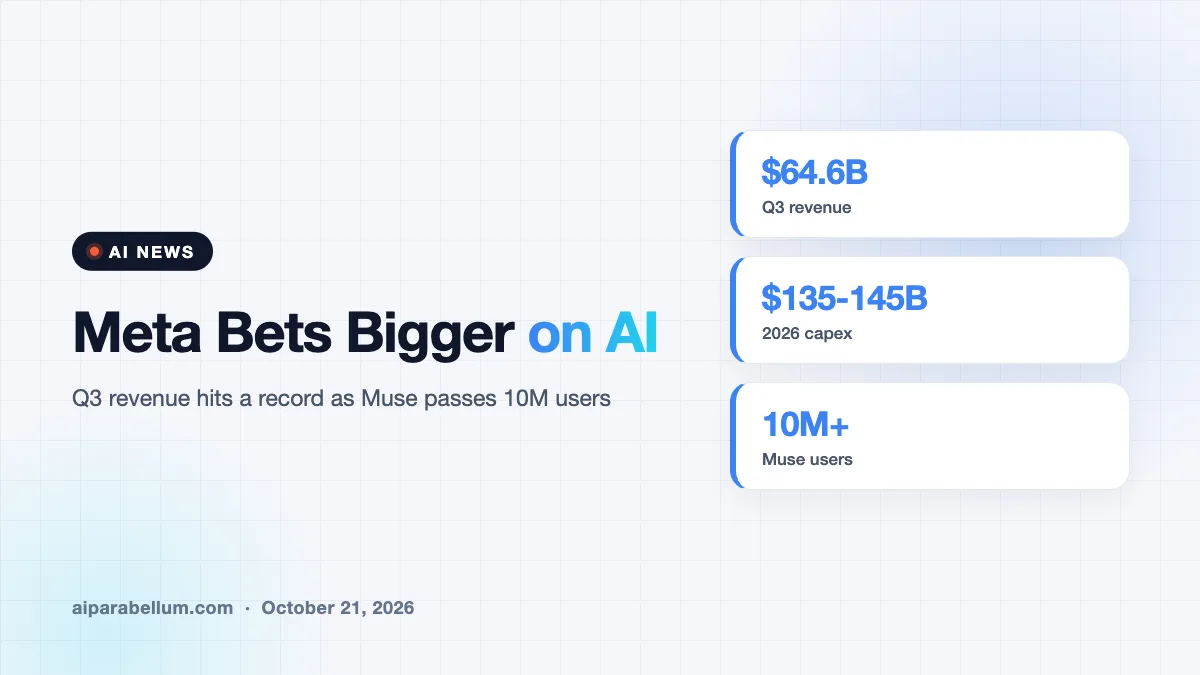
While backend infrastructure captures the attention of quantitative analysts, the consumer and enterprise front lines are being reshaped by software breakthroughs. The disclosure that Muse—Meta’s state-of-the-art generative media and multimodal content engine—has rapidly scaled to 5 million active users provides a vital empirical proof point for the company's product roadmap.
Muse’s rapid ascent demonstrates a crucial capability: the translation of raw computational power into tangible, sticky user engagement. Unlike early proof-of-concept chatbots that struggled with enterprise integration, Muse has captured significant market share among digital creators, advertising agencies, and mid-market enterprises seeking to automate workflow complexity.
This rapid user adoption directly addresses the core anxiety plaguing institutional investors: enterprise ROI. By embedding generative multimodal capabilities across Facebook, Instagram, WhatsApp, and standalone enterprise suites, Meta is creating a closed-loop monetization ecosystem. Advertisers utilizing Muse-backed generative toolkits are reporting lowered creative friction and enhanced campaign performance metrics, which in turn drives higher ad spend velocity back into Meta’s core revenue engine.
Verified Data & Metrics Breakdown
To provide institutional-grade clarity, the following comparative breakdown synthesizes Meta’s latest financial disclosures, technological milestones, and prevailing macroeconomic indicators:
| Metric / Indicator | Current Reported Value | Strategic Implication |
|---|---|---|
| Q3 AI Capex | $41.68 Billion | Accelerates data center buildout and custom silicon deployment; pressures short-term free cash flow. |
| Muse User Milestone | 5 Million Active Users | Validates multimodal consumer demand and provides a clear pathway to high-margin SaaS and ad monetization. |
| Federal Reserve Policy Odds | 92.8% Hold Probability | Reflects restrictive monetary environment, heightening the cost of capital for long-duration tech bets. |
| WTI Crude Benchmark | $99.99 per Barrel | Signals persistent energy cost pressures impacting hyper-scale data center operational overhead. |
Industry & Market Implications: Who Wins, Who Loses
The shockwaves generated by Meta’s $41.68 billion spending spree extend far beyond Menlo Park, creating immediate structural ripples across the global economy:
- The Winners — Silicon Foundries & Energy Infrastructure: Specialized semiconductor manufacturers, advanced networking equipment providers, and green-energy grid operators stand to capture massive revenue streams as Meta and its peer hyperscalers race to secure unconstrained computing capacity.
- The Losers — Capital-Constrained Competitors: Smaller enterprise tech startups and mid-tier social media competitors lack the balance sheet depth to match this level of infrastructure spending, risking structural obsolescence in an AI-first market.
- The Macro Economy: With WTI crude trading at $99.99 and the Federal Reserve maintaining a cautious stance (92.8% implied hold odds), the broader technology sector faces a bifurcated reality where cash-rich monoliths self-finance their evolution while debt-dependent enterprises struggle against elevated borrowing costs.
Frequently Asked Questions (People Also Ask)
What drove Meta’s $41.68B Q3 AI capital expenditure?
The record-breaking Capex figure is driven by the aggressive expansion of specialized data center infrastructure, the procurement of next-generation AI accelerators (GPUs and custom ASICs), and the massive power and cooling requirements necessary to train and operate advanced large language and multimodal models at scale.
What is Meta’s Muse platform, and why is reaching 5 million users significant?
Muse is Meta’s flagship generative media and multimodal AI engine designed for creators and enterprises. Crossing the 5 million user mark is a critical milestone because it proves that Meta’s massive backend infrastructure investments are successfully translating into scalable, engaging front-end products with immediate commercial utility.
How do macroeconomic factors like Federal Reserve rates and WTI crude impact Meta’s strategy?
With WTI crude hovering near $99.99 and a restrictive monetary policy environment characterized by a 92.8% hold probability by the Federal Reserve, the operational cost of running energy-intensive data centers increases. Meta’s massive cash reserves shield it from high debt costs, but overall market liquidity and investor risk appetite remain highly sensitive to these macroeconomic variables.
What are the primary regulatory and financial risks facing Meta’s AI rollout?
Key risks include potential regulatory scrutiny over data privacy and algorithmic bias, margin dilution if infrastructure depreciation outpaces monetization, and the risk of overbuilding capacity if enterprise AI adoption rates experience unforeseen deceleration.
Future Outlook: Milestones to Watch
As the market digests Meta’s Q3 financial disclosures, attention immediately pivots to the upcoming fiscal quarters. Institutional analysts will closely monitor several key indicators: the sustained user growth velocity of Muse beyond the 5 million milestone, efficiency gains in custom silicon versus merchant GPUs, and management's updated Capex guidance for the upcoming fiscal year.
Ultimately, Meta’s multi-billion-dollar bet represents the definitive crucible of the modern technology economy. If Mark Zuckerberg’s vision of ambient, AI-infused computing achieves critical mass, the $41.68 billion expenditure will be validated as a stroke of generational genius. If not, it will serve as a stark cautionary tale of corporate overreach in the shadow of macroeconomic uncertainty. For Wall Street, the only certainty is volatility.