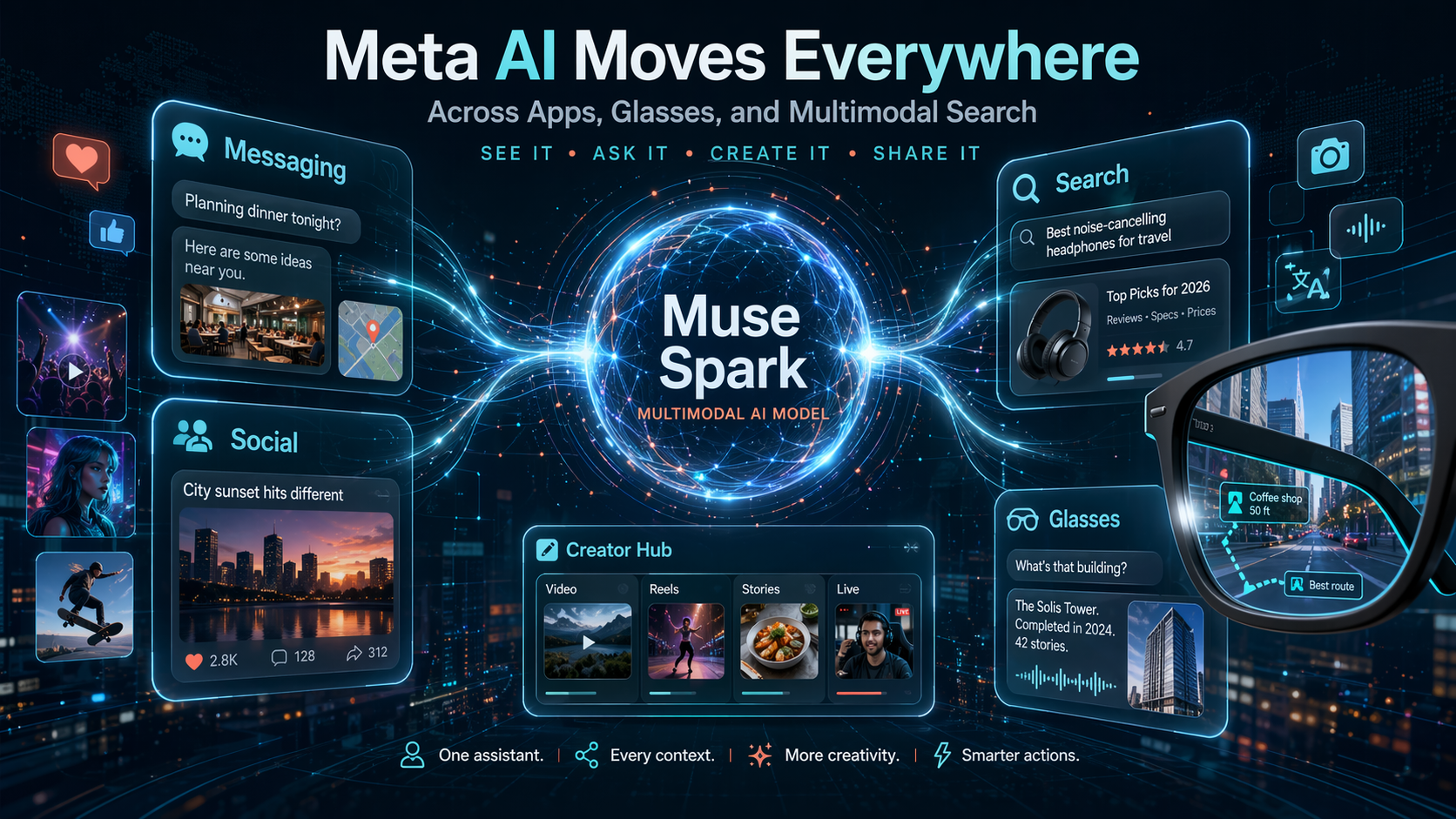
MENLO PARK, Calif. — In a calculated bid to redefine human-machine collaboration and challenge the enterprise productivity strongholds of Microsoft and Google, Meta Platforms Inc. has formally introduced Spaces, a persistent, shared operating canvas engineered specifically for synchronous interaction with its flagship autonomous intelligence agent, Muse.
The roll-out marks an inflection point in Meta’s aggressive artificial intelligence pivot. Moving beyond consumer-facing social chatbots and passive text-generation interfaces, Meta is operationalizing its multi-billion-dollar compute infrastructure to capture high-margin, enterprise-tier workflows. Spaces serves as an orchestration environment where distributed human teams and persistent Muse agents co-author code, model complex financial structures, and design three-dimensional digital assets in real time. Backed by proprietary multimodal model checkpoints from the Llama ecosystem, the launch represents a direct play for high enterprise ROI, corporate cloud compute architecture, and collaborative market dominance.
Executive Takeaways
Test Our Free AI & Tech Utilities Suite
Calculate LLM API token costs, analyze article dwell-time, or simulate tech DCA returns.
- The Core Launch: Meta has deployed Spaces, a dynamic, real-time workspace integrating the Muse autonomous agent. The platform eliminates prompt-and-response isolation in favor of shared context windows, visual whiteboarding, and continuous multi-agent execution.
- Infrastructure & Compute Scale: Powered by Meta’s scaled GPU cluster infrastructure—leveraging next-generation network fabrics and low-latency inference pipelines—Spaces provides sustained sub-100 millisecond interaction loops across multimodal inputs (code, audio, vector graphics, and 3D spatial models).
- Enterprise Monetization Pivot: The deployment signals Meta’s transition toward enterprise-grade software-as-a-service (SaaS) and private cloud licensing, directly challenging Microsoft 365 Copilot, Google Workspace Gemini, and OpenAI’s enterprise canvas environments.
- Strategic Capital Allocation: With capital expenditure allocations tracking upwards of $40 billion annually, Meta is leveraging Spaces to demonstrate clear productization and economic return on its massive silicon acquisitions and data-center expansions.
The Architecture of Spaces: Moving Beyond the Chat Interface
For the past two years, enterprise generative AI has remained largely constrained by single-threaded, linear chat interfaces. This asynchronous "command-and-wait" paradigm has imposed productivity ceilings on engineering teams, design studios, and corporate strategy groups. Spaces fundamentally dismantles this constraint.
Conceived within Meta’s Central Applied Science and Product Infrastructure organizations, Spaces operates as an infinite, stateful digital canvas. Rather than relying on transient conversational threads, Spaces maintains a continuous, deterministic state. Multiple team members can enter a Space simultaneously, where the Muse agent acts not as a distant query responder, but as an active, omniscient peer participant.
At the center of this experience is the Muse agent, an orchestration layer built on customized, highly aligned variants of Meta’s state-of-the-art open-weights architecture. Muse possesses native multimodal capabilities: it ingests real-time voice, live codebases, high-resolution visual schemas, and structural API specifications. Within Spaces, Muse can simultaneously observe whiteboard wireframes, execute compiler scripts in an isolated sandbox environment, and dynamically update financial forecast models as executive participants articulate revised assumptions over low-latency spatial audio.
Agentic Autonomy and Persistent Context Memory
The foundational technical breakthrough underpinning Spaces is its persistent memory architecture. Traditional large language models suffer from catastrophic context evaporation once a session terminates or exceeds its token window. Spaces employs a hybrid memory retrieval-augmented generation (RAG) framework combined with dynamic vector caching.
When an enterprise team configures a project within Spaces, Muse compiles an active knowledge graph of the team’s organizational taxonomy, code repositories, internal design systems, and compliance constraints. This allows the agent to exercise autonomous task execution without continuous human supervision. A user can delegate an entire sub-objective—such as refactoring an authentication service to meet SOC2 Type II standards while updating API documentation—and Muse will perform the tasks directly inside the Space, presenting diffs, dependency mappings, and visual architecture diagrams for human review.
Comparative Analysis: The Enterprise Collaborative Landscape
The enterprise productivity arena is witnessing unprecedented consolidation as tech titans aggressively position their ecosystems to capture corporate budgets. Meta’s entry with Spaces and Muse disrupts the current duopoly held by Microsoft and Google, while drawing battle lines against nimble frontier labs.
| Platform / Ecosystem | Primary Architecture | Interaction Modality | Context Retention | Enterprise Compliance & Security | Compute Infrastructure Basis |
|---|---|---|---|---|---|
| Meta Spaces (Muse Agent) | Stateful Multi-Agent Infinite Canvas | Real-Time Synchronous (Audio, Text, Canvas, 3D Assets) | Persistent Organizational Knowledge Graph + RAG | Enterprise Tier: On-Premises Isolated Clusters / VPC Private Endpoints | Custom Meta AI Research SuperCluster (NVIDIA H100/H200/B200 & MTIA) |
| Microsoft 365 Copilot | Side-Panel Conversational Overlay | Asynchronous Prompt / Scripted App Automation | Session-Bound Microsoft Graph Grounding | Native Azure Active Directory / Purview Compliance Framework | Microsoft Azure Global Distributed AI Infrastructure |
| Google Workspace (Gemini) | Document-Embedded Conversational Assistant | Inline Text Completion & Side-Panel Queries | Google Drive Indexing & Workspace Context | Google Cloud Enterprise Security & Model Armor | Google Cloud TPU (v4/v5e/v5p) Mesh Networks |
| OpenAI Canvas / Operator | Dual-Pane Document/Code Canvas | Semi-Synchronous Iterative Text Editing | Session Memory with Custom Instructions | SOC2, Enterprise Data Privacy Safeguards (Zero Retention Options) | Microsoft Azure Hosted Cloud Clusters |
Wall Street and Macroeconomic Implications: Capital Allocation & Enterprise ROI
Meta’s aggressive operationalization of Muse and Spaces lands squarely amid intense investor scrutiny over hyperscaler capital expenditure. Over the past six quarters, institutional investors on Wall Street have repeatedly questioned the timeline for tangible economic monetization stemming from Meta’s massive AI infrastructure build-out. Mark Zuckerberg’s strategy has centered on maintaining open-weights momentum via the Llama series to commoditize base models, while reserving differentiated, proprietary execution layers for direct commercial monetization.
Spaces represents that monetization engine. By offering an enterprise-tier collaborative product that integrates directly into corporate workflows, Meta creates an entry point for recurring B2B software revenue, diversifying its balance sheet away from its historical reliance on consumer programmatic digital advertising. For Chief Information Officers (CIOs) and Chief Technology Officers (CTOs), the value proposition pivots on measurable enterprise ROI: reducing software engineering cycle times, compressing graphic design and prototyping phases, and consolidating fragmented SaaS toolstacks into a unified intelligent canvas.
Furthermore, this deployment has significant ramifications for tech equity valuations across the valley. As Meta moves upward in the software stack, pure-play productivity platforms, collaborative whiteboard providers, and stand-alone AI interface wrappers face existential compression in their valuation multiples. If an enterprise can deploy a persistent, secure, and infinitely scalable collaborative ecosystem directly backed by Meta’s massive compute efficiency, the financial justification for maintaining separate point-solution subscriptions quickly evaporates.
Risk Mitigation, Cloud Security, and Regulatory Governance
Deploying autonomous agents within collaborative spaces introduces high-stakes regulatory and security challenges. Enterprises operating in highly regulated sectors—such as financial services, healthcare, and defense—face stringent constraints regarding data residency, model drift, algorithmic governance, and liability for code introduced by autonomous systems.
Meta has built Spaces with an emphasis on enterprise-grade isolation. To satisfy compliance frameworks including the European Union’s AI Act, HIPAA, and the General Data Protection Regulation (GDPR), Spaces guarantees that proprietary corporate inputs remain strictly cordoned off from baseline model training. Enterprise deployments support Zero Data Retention (ZDR) architecture, customer-managed encryption keys (CMEK), and granular role-based access control (RBAC).
Additionally, Muse incorporates deterministic safety guardrails engineered to prevent hallucinated vulnerabilities in corporate codebases. Code generated by the agent undergoes continuous, sandboxed automated testing and static code analysis before it can be merged into live production environments, directly mitigating the corporate liability risks that have historically stalled wide-scale agentic adoption.
Frequently Asked Questions (People Also Ask)
What is Meta Spaces, and how does it integrate with the Muse agent?
Meta Spaces is a persistent, real-time digital collaboration environment that enables distributed teams of humans and autonomous AI agents to work together on an interactive visual and code-based canvas. The Muse agent acts as an embedded team member within the Space, capable of understanding context, writing and executing code, generating visual and structural models, and retaining project history across sessions.
How does Meta Muse differ from conversational chatbots like ChatGPT or Meta AI?
Unlike standard conversational chatbots that operate through single-threaded, prompt-and-response text prompts, Muse is an autonomous, multimodal task-execution agent. It operates within a shared environment, understands complex, multivariant inputs (voice, text, design, code), interacts with external APIs, executes code inside isolated sandboxes, and proactively contributes to project deliverables without needing step-by-step guidance for every micro-task.
Is enterprise data shared inside Spaces used to train Meta’s public AI models?
No. Meta has structured Spaces with strict enterprise data governance protocols. For commercial and organizational accounts, data transmitted, stored, and generated within a Space is isolated through VPC private endpoints and customer-managed encryption keys. Enterprise terms explicitly state that customer proprietary inputs, proprietary code, and strategic workflows are completely exempt from baseline model training.
Can Meta Spaces be integrated with existing enterprise tools like GitHub, Jira, and Figma?
Yes. Spaces is built with an API-first extensible architecture. Muse can connect to external version control repositories (such as GitHub and GitLab), project tracking databases (such as Jira and Linear), and cloud development pipelines. This enables the Muse agent to draw context from existing production pipelines and directly update tasks, push commit branches, and generate documentation within established enterprise workflows.
Future Outlook: The Road Ahead for Meta’s AI Ecosystem
The introduction of Spaces and Muse is merely the opening gambit in Meta’s long-term computing roadmap. The architecture of Spaces has been engineered with native spatial computing compatibility, positioning it to seamlessly bridge desktop screens, mobile interfaces, and spatial hardware such as the Meta Quest 3 and future enterprise-grade augmented reality glasses.
In the coming quarters, Meta is expected to roll out multi-agent orchestration frameworks within Spaces, allowing teams to deploy specialized clusters of Muse agents—one optimized for systems engineering, another for user-experience architecture, and another for regulatory compliance auditing—collaborating simultaneously with human overseers. As capital allocation continues to funnel into scalable, low-latency computing architectures, Meta’s Spaces stands as a defining milestone in the corporate shift toward true human-agent symbiosis, fundamentally altering how enterprise value is engineered, governed, and delivered.