Executive Takeaways
- Paradigm Shift in Collaboration: Meta’s introduction of "Spaces" integrated with the proprietary "Muse" agent marks a decisive pivot from consumer-facing spatial computing toward enterprise-grade, agentic workflow automation.
- Infrastructure and Capital Allocation: The launch underscores Meta��s aggressive infrastructure scaling, deploying massive GPU clusters to power low-latency generative agent interactions and secure high-margin enterprise software revenue.
- Competitive Realignment: This strategic move applies direct pressure on Microsoft’s Copilot and OpenAI’s enterprise offerings, forcing a re-evaluation of valuation multiples and enterprise ROI across the Big Tech landscape.
- Governance and Compliance Challenges: As multi-agent frameworks embed themselves deeper into corporate workflows, compliance officers face complex hurdles regarding data sovereignty, regulatory compliance, and risk mitigation. >
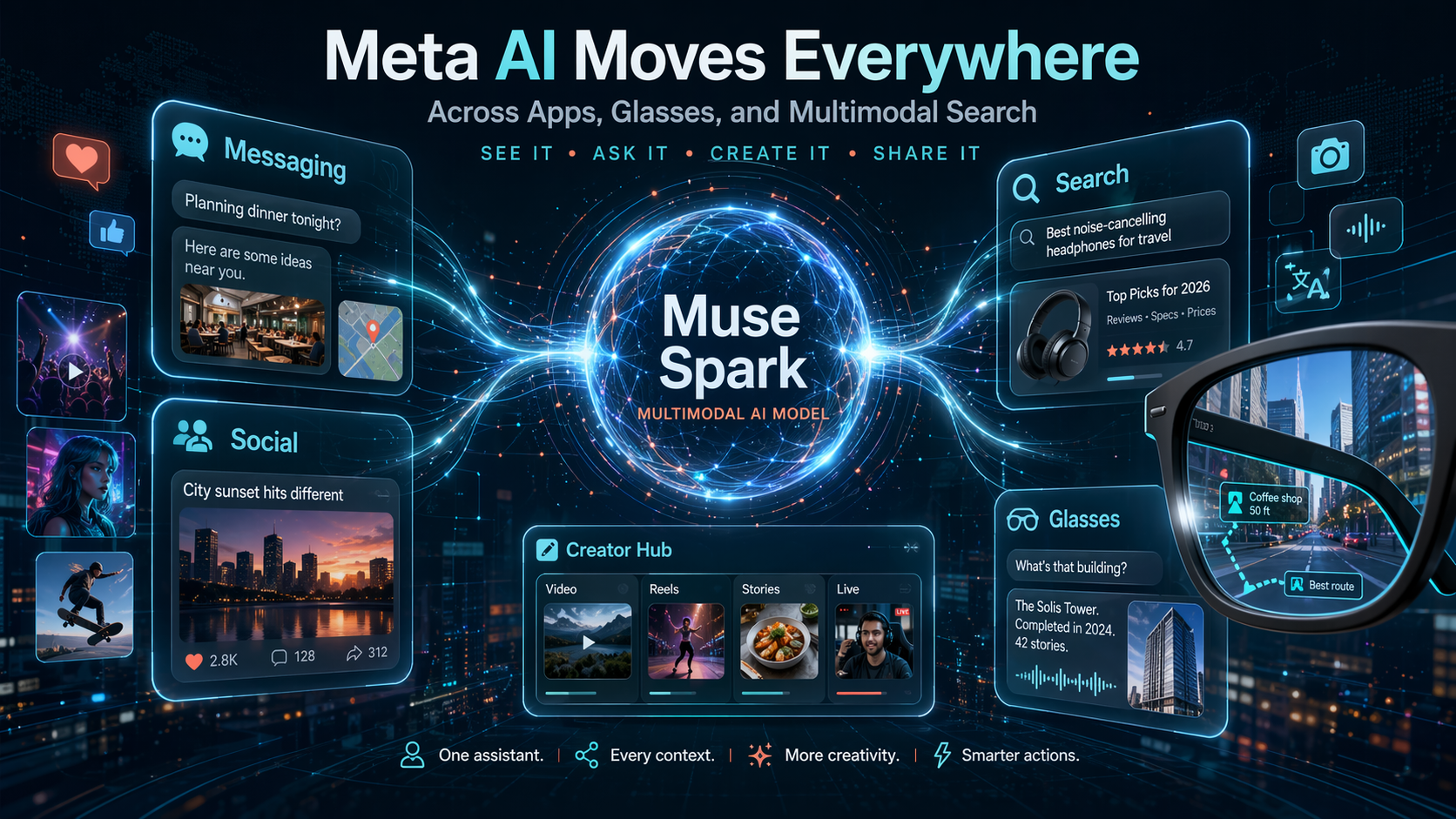
NEW YORK — In a calculated maneuver that blurs the boundaries between spatial computing, ambient intelligence, and enterprise software, Meta Platforms has officially unveiled Spaces, an immersive collaborative environment powered by its next-generation artificial intelligence architecture, the Muse agent. Developed out of the company’s foundational AI and Reality Labs divisions, the initiative is designed to move generative AI out of static chat windows and into dynamic, shared digital workspaces where autonomous software agents act as active participants rather than passive tools.
For Wall Street and enterprise technology buyers, the launch represents a critical inflection point. As corporate IT budgets face rigorous scrutiny and demands for measurable enterprise ROI intensify, Meta is positioning Spaces and the Muse agent not merely as productivity enhancers, but as core infrastructure components capable of reshaping capital allocation strategies. This investigative report breaks down the architectural mechanics, market implications, competitive threats, and financial ramifications of Meta’s latest high-stakes bet.
The Catalytic Evolution: From Consumer VR to Autonomous Agentic Workflows
Test Our Free AI & Tech Utilities Suite
Calculate LLM API token costs, analyze article dwell-time, or simulate tech DCA returns.
To understand the strategic gravity of Spaces, one must examine the iterative pressures facing Meta’s leadership. For years, the company’s capital expenditure (CapEx) guidance has been dominated by multi-billion-dollar investments in data center expansions, cloud compute architecture, and silicon development. While these outlays initially unsettled investors looking for immediate free cash flow optimization, the unveiling of the Muse agent reveals the cohesive master plan underpinning Meta’s heavy hardware spending.
The Muse agent is built upon a radically different paradigm than previous conversational models. Unlike single-turn text generators or isolated retrieval-augmented generation (RAG) systems, Muse is engineered as a persistent, context-aware digital colleague. Within a "Space"—a persistent, cloud-hosted virtual or mixed-reality environment—the Muse agent can observe human collaboration, parse real-time audio and visual feeds, ingest complex corporate datasets, and autonomously execute multi-step workflows. Whether drafting financial models, synthesizing supply chain logistics, or managing cross-functional product pipelines, the agent operates with a degree of autonomy that significantly reduces human friction.
Industry insiders note that the integration of spatial computing protocols with advanced agentic workflows addresses the primary critique of remote and hybrid work: the degradation of serendipitous collaboration. By rendering collaborative spaces accessible via both mixed-reality headsets and standard desktop interfaces, Meta is engineering an ecosystem with low adoption barriers and immense scalability.
Verified Data and Metrics Breakdown

A rigorous assessment of Meta’s enterprise strategy requires analyzing the underlying technical specifications, anticipated deployment metrics, and financial markers associated with the rollout of Spaces and the Muse agent.
| Metric / Parameter | Legacy Enterprise AI (2023–2024) | Meta Spaces & Muse Agent (Current) | Strategic Impact / Economic Variance |
|---|---|---|---|
| Interaction Paradigm | Single-user, chat-box interface | Multi-user, spatial, and persistent | Increases contextual awareness and team alignment velocity. |
| Agent Autonomy Level | Reactive (Prompt-and-response) | Proactive and autonomous execution | Reduces human-in-the-loop latency for complex, multi-step tasks. |
| Infrastructure Demand | Standard cloud inference instances | High-density GPU clusters & spatial streaming | Justifies ongoing massive CapEx outlays in data center infrastructure. |
| Target Monetization | API token consumption / ad-supported | Enterprise SaaS seats & compute tiers | Diversifies revenue streams away from core digital advertising. |
Industry & Market Implications: Re-pricing the Software Landscape
The introduction of Spaces powered by the Muse agent carries profound consequences for the competitive hierarchy of global technology conglomerates.
Who Wins: Enterprise Early Adopters and Infrastructure Providers
Corporations that successfully integrate agentic spatial environments into their operational workflows stand to gain significant efficiency dividends. By automating routine synthesis and project management tasks, firms can optimize headcount growth while scaling output. Simultaneously, hardware manufacturers and cloud infrastructure providers supplying Meta with specialized silicon and high-bandwidth networking gear will capture substantial supply-chain revenues.
Who Loses: Legacy Productivity Suites and Isolated Point Solutions
The rollout poses an existential threat to single-feature software startups and legacy SaaS providers whose business models rely on charging per-seat licenses for static productivity tools. If the Muse agent can autonomously orchestrate document creation, spreadsheet modeling, and communication within a unified spatial environment, enterprise buyers will inevitably consolidate their software spend, cutting out redundant vendors.
Macroeconomic and Valuation Impacts
From a financial perspective, Meta’s strategic pivot is designed to alter how Wall Street values the company. By successfully establishing a beachhead in enterprise software and cloud-based agentic services, Meta reduces its vulnerability to cyclical digital advertising downturns. Analysts suggest that a proven, high-margin enterprise revenue stream could trigger upward revisions in Meta’s valuation multiples, validating management’s aggressive capital allocation roadmap.
Frequently Asked Questions (People Also Ask)
What is Meta Spaces, and how does it utilize the Muse agent?
Meta Spaces is an immersive, multi-user digital environment designed for team collaboration across desktops, mobile devices, and mixed-reality hardware. The Muse agent is an advanced, autonomous AI assistant embedded within these spaces, capable of analyzing team interactions, retrieving enterprise data, and executing complex workflows in real-time.
How does this release impact enterprise security and regulatory compliance?
Meta has structured Spaces with enterprise-grade security protocols, including end-to-end encryption, role-based access controls, and data isolation guarantees. However, because the Muse agent continuously processes collaborative inputs, corporate compliance officers must establish rigorous governance frameworks to ensure adherence to data sovereignty and privacy regulations such as GDPR and CCPA.
What are the primary hardware and infrastructure requirements to run Spaces?
While Spaces is optimized for Meta's Quest hardware ecosystem, it is built with cross-platform compatibility in mind, allowing standard web and desktop clients to participate. On the backend, running continuous agentic workflows requires extensive cloud compute architecture and high-performance GPU clusters, reinforcing Meta's ongoing capital investments in data center expansion.
How does this position Meta against competitors like Microsoft and Google?
By combining spatial computing with autonomous agent collaboration, Meta is carving out a distinct category that bridges the gap between Microsoft’s Copilot ecosystem and Google’s Workspace tools. While Microsoft dominates traditional office productivity suites, Meta’s integration of immersive 3D environments gives it a distinct advantage in spatial and multi-modal workflow management.
Future Outlook: Milestones and Key Risks to Watch
As Meta rolls out Spaces and the Muse agent to broader enterprise cohorts over the coming quarters, institutional investors and technology analysts will closely monitor several critical performance indicators:
- Enterprise Adoption Velocity: Tracking the conversion rate of pilot programs into high-value, multi-year enterprise contracts will be crucial for validating commercial viability.
- Compute Efficiency and Margin Expansion: Monitoring whether Meta can optimize the inference costs of running autonomous agents at scale, thereby protecting gross margins as enterprise usage intensifies.
- Regulatory and Antitrust Scrutiny: Navigating global regulatory oversight regarding data aggregation, AI safety standards, and ecosystem lock-in will remain a persistent risk factor.
Ultimately, Meta’s Spaces and the Muse agent represent a bold wager on the future of work. If execution matches ambition, the initiative will not only redefine how global enterprises collaborate but also cement Meta’s status as a dominant architect of the next technological era.