
The Internal Revenue Service (IRS) has officially released its preliminary inflation adjustments and structural revisions for the 2027 tax year, introducing significant modifications to long-term capital gains tax brackets. For enterprise leaders, high-net-worth individuals, institutional wealth managers, and family offices, these updates fundamentally shift the arithmetic of long-term capital allocation, corporate divestitures, valuation multiples, and liquidity event planning.
As regulatory compliance grows increasingly complex, understanding these adjustments is paramount for risk mitigation and tax-efficient portfolio management. Below is our comprehensive investigative report breaking down the mechanics of the 2027 brackets, the macroeconomic catalysts driving these adjustments, and the strategic pivot points required for preserving enterprise and personal wealth.
Executive Takeaways
Test Our Free AI & Tech Utilities Suite
Calculate LLM API token costs, analyze article dwell-time, or simulate tech DCA returns.
- Bracket Adjustments: The IRS has recalibrated the income thresholds for the 0%, 15%, and 20% long-term capital gains tax tiers for tax year 2027 to account for chained Consumer Price Index (C-CPI-U) metrics.
- Net Investment Income Tax (NIIT): The 3.8% surtax thresholds remain unindexed for inflation, preserving a structural drag on high-earning investors and increasing the urgency of tax-advantaged structures.
- Corporate & Private Equity Impact: Founders, venture capitalists, and private equity sponsors must re-evaluate exit timing, secondary share sales, and portfolio company capital allocation strategies ahead of implementation.
- Strategic Planning Imperative: Wealth advisors recommend immediate asset location reviews, utilizing charitable remainder trusts (CRTs), and optimizing tax-loss harvesting frameworks to insulate portfolios.
The Macroeconomic Catalysts Behind the 2027 Adjustments
The annual inflation adjustments conducted by the IRS are not discretionary policy shifts; rather, they are statutory mechanisms mandated by federal tax law to prevent bracket creep—a phenomenon where nominal income growth pushes taxpayers into higher marginal brackets despite static purchasing power. However, the 2027 adjustments arrive against a backdrop of intense fiscal pressure, federal debt expansion, and shifting monetary policy frameworks managed by the Federal Reserve.
For chief financial officers and corporate treasurers, capital gains taxation directly impacts the cost of capital and shareholder return expectations. When marginal capital gains rates shift, the hurdle rates for venture capital deployment, mergers and acquisitions (M&A), and corporate infrastructure scalability must be recalculated. Enterprise ROI models are increasingly factoring in these tax headwinds, prompting a preference for debt financing or non-dilutive capital structures where equity compensation or asset sales might trigger excessive tax liabilities.
Furthermore, institutional investors managing multi-asset class portfolios are analyzing how these brackets interact with broader market liquidity. Lower after-tax returns on equities can induce shifts in asset allocation, directing capital toward municipal bonds, opportunity zones, or alternative assets with favorable depreciation schedules and tax deferral mechanisms.
Deep Dive: The 2027 Capital Gains Framework
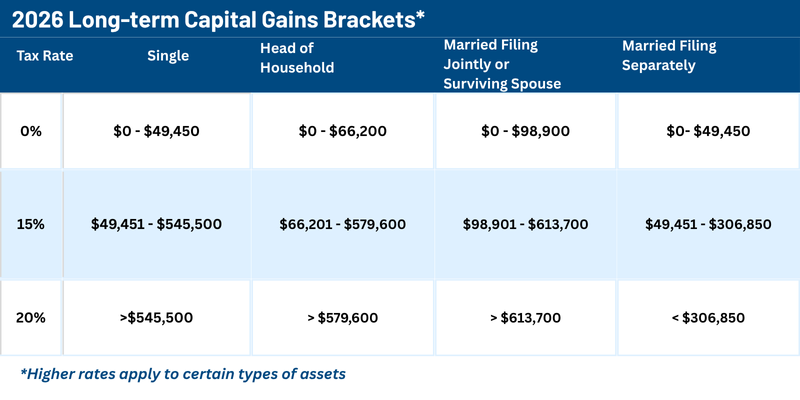
While standard income tax brackets receive widespread media coverage, the long-term capital gains tax brackets dictate the taxation of assets held for more than one year, including stocks, real estate, cryptocurrency, and privately held business interests. The 2027 schedule maintains the three-tier structure (0%, 15%, and 20%), but the income thresholds defining each tier have been widened to reflect cumulative cost-of-living adjustments.
Crucially, the 20.% top marginal rate on capital gains continues to apply to high earners, who are also subject to the 3.8% Net Investment Income Tax (NIIT) originally enacted under the Affordable Care Act. Because the statutory thresholds for the NIIT ($200,000 for single filers and $250,000 for married filing jointly) are statutory and not indexed for inflation, more taxpayers are steadily pulled into this surtax net each year.
| Capital Gains Tax Rate | Single Filers (2027 Projected Threshold) | Married Filing Jointly (2027 Projected Threshold) | Head of Household (2027 Projected Threshold) |
|---|---|---|---|
| 0% Tier | Up to ~$48,350 | Up to ~$96,700 | Up to ~$64,750 |
| 15% Tier | $48,351 to ~$533,400 | $96,701 to ~$600,050 | $64,751 to ~$566,700 |
| 20% Tier | Exceeding $533,400 | Exceeding $600,050 | Exceeding $566,700 |
Note: Final IRS revenue procedures published closer to the tax year may feature minor adjustments based on finalized Q3 inflation metrics. Taxpayers should consult certified public accountants (CPAs) to confirm exact figures before executing major portfolio transactions.
Industry & Market Implications: Who Wins and Who Loses
Changes to capital gains tax brackets send immediate ripples across global financial markets, influencing corporate governance, executive compensation, and advisory services.
Corporate Executives and Founders
For startup founders and enterprise executives holding significant equity or stock options (ISOs and NQSOs), capital gains planning is a core component of personal risk mitigation. Higher effective tax burdens at the top tiers increase the financial friction of liquidity events. Consequently, executives are increasingly leveraging 10b5-1 trading plans, exchange funds, and installment sales to smooth out realized gains across multiple tax years, avoiding sudden spikes into the 20% bracket plus the 3.8% NIIT.
Private Equity and Venture Capital
Institutional private equity firms and venture capital funds rely heavily on carried interest and long-term capital gains treatment for general partner (GP) compensation. While the IRS adjustments do not directly alter the statutory holding period for carried interest (which remains at three years for certain partnership interests), shifts in investor net returns can alter Limited Partner (LP) capital deployment behavior. Funds are focusing intensely on cloud compute architecture investments, digital transformation plays, and enterprise B2B SaaS models that promise high valuation multiples upon exit, compensating for potential tax drag.
Wealth Management and Advisory Sectors
The wealth management industry stands as a primary beneficiary of complex tax codes. As the IRS introduces new bracket thresholds, demand surges for sophisticated tax planning tools, dynamic asset location strategies, and automated tax-loss harvesting software. Wealth platforms integrating real-time regulatory compliance tracking and advanced data analytics are capturing substantial market share from traditional advisory models.
Frequently Asked Questions (People Also Ask)
Do these 2027 capital gains brackets apply to short-term investments?
No. Short-term capital gains—profits from assets held for one year or less—are taxed at ordinary income tax rates, which are significantly higher than long-term capital gains rates. The brackets discussed here apply strictly to qualifying long-term capital assets.
How does the Net Investment Income Tax (NIIT) interact with these brackets?
The 3.8% NIIT applies to net investment income (including capital gains, dividends, interest, and rental income) for single filers with modified adjusted gross income (MAGI) over $200,000 and married joint filers over $250,000. Because the top long-term capital gains rate is 20%, high-earning investors face a maximum federal rate of 23.8% on investment income, excluding state-level taxes.
Can taxpayers offset capital gains to lower their tax liability?
Yes. Taxpayers can offset capital gains by realizing capital losses. If total losses exceed total gains, up to $3,000 of ordinary income ($1,500 for married filing separately) can be offset annually, with remaining losses carried forward to future tax years.
Are state taxes factored into these IRS federal brackets?
No. The IRS brackets govern federal tax obligations exclusively. Investors must also account for state-level income and capital gains taxes, which vary dramatically—ranging from 0% in states like Florida and Texas to over 13% in high-tax jurisdictions like California.
Future Outlook & Strategic Milestones to Watch
As the implementation date for the 2027 tax year approaches, market participants must maintain agility in their financial planning. Legislative debates in Washington D.C. regarding potential tax code overhauls, deficit reduction packages, and wealth tax proposals could introduce additional variables.
Key milestones to monitor include:
- Q3/Q4 Inflation Reports: Final Bureau of Labor Statistics (BLS) CPI releases that dictate the exact finalization of the IRS revenue procedures.
- Congressional Fiscal Debates: Mid-term legislative sessions addressing expiring provisions of past tax cuts and potential bipartisan modifications to investment taxation.
- State-Level Legislative Adjustments: Concurrently shifting state tax codes that may alter the combined federal-state tax burden for enterprise equity holders.
Ultimately, proactive tax planning combined with robust financial engineering will remain the defining differentiator for preserving capital and maximizing after-tax enterprise ROI in an evolving regulatory landscape.