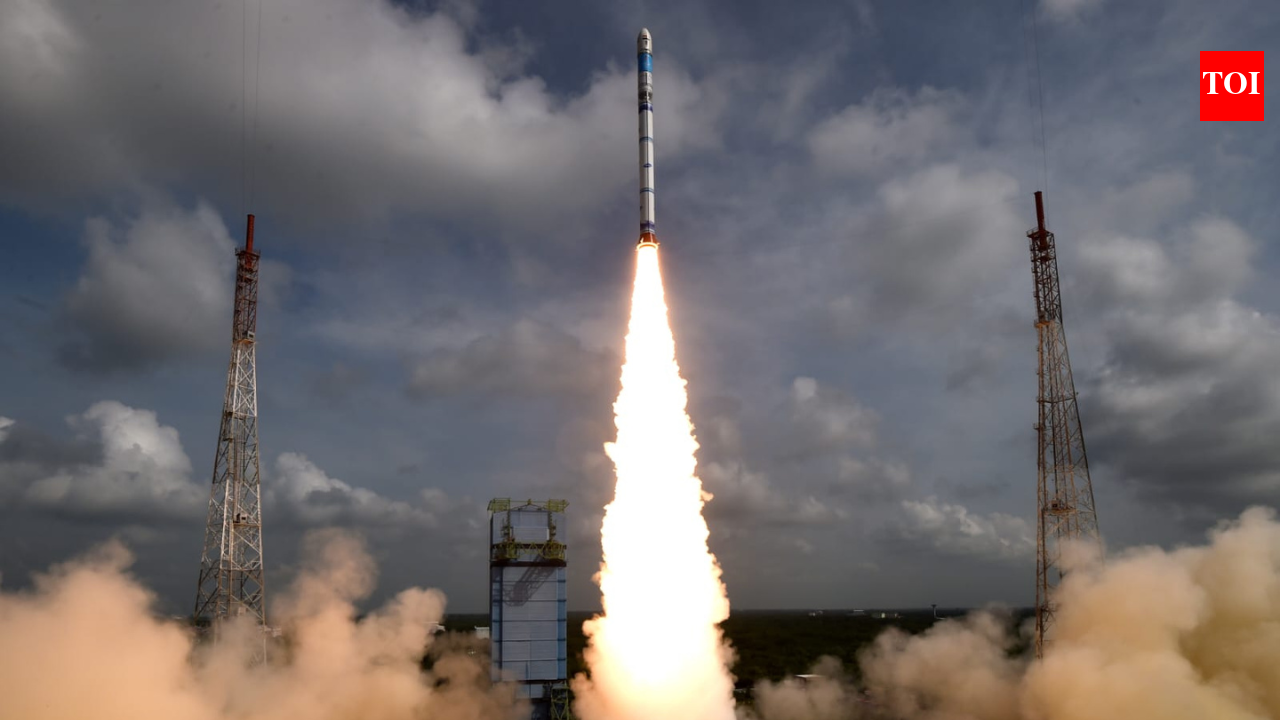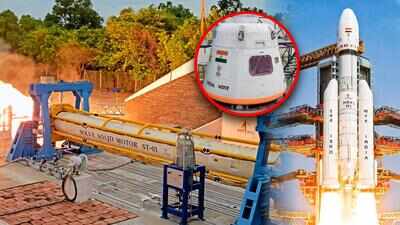
BENGALURU/NEW DELHI — The Indian Space Research Organisation (ISRO) has successfully conducted the static test of a newly developed propulsion motor, a critical milestone in building the specialized rocket dedicated to testing the parachute deceleration systems for India’s maiden human spaceflight mission, Gaganyaan.
The successful trial, confirmed by primary wire reports, marks a major engineering stride as the national space agency accelerates ground-testing protocols for the ambitious project. The specialized vehicle is engineered specifically to simulate high-stress atmospheric conditions, ensuring that the crew module's parachute recovery system can safely deploy and slow down returning astronauts under emergency and normal descent scenarios.
The Engineering Leap Behind the Gaganyaan Parachute Test Vehicle
For a crewed space mission, the safety margin must be absolute. The Gaganyaan mission relies on a complex, multi-stage deceleration system involving apex cover separation, extraction parachutes, drogue chutes, and massive main parachutes that must deploy in a precise sequence to cushion the crew module's splashdown.
To rigorously test these heavy-duty parachutes under real-flight dynamic pressures—known in aerospace engineering as Max Q—ISRO is utilizing a dedicated test rocket. The newly tested motor provides the necessary thrust and ballistic trajectory profile required to lift the dummy crew module to the targeted upper atmosphere altitudes where parachute deployment dynamics are most volatile.
- Precision Ballistics: The new motor was subjected to rigorous static firing parameters, measuring thrust curves, pressure limits, and structural integrity.
- Simulation Accuracy: The test vehicle is designed to replicate the exact aerodynamic loads the Gaganyaan service and crew modules will experience during atmospheric re-entry.
- Safety Validation: Data harvested from this motor test will dictate the parameters for upcoming Integrated Main Parachute Airdrop Tests (IMAT).
Senior propulsion scientists at ISRO’s Vikram Sarabhai Space Centre (VSSC) noted that developing a custom motor for parachute qualification eliminates guesswork, ensuring that the recovery system undergoes the most punishing flight environments well before astronauts step into the orbital module.
Strategic Stakes and Global Aerospace Context

The acceleration of ISRO’s testing timeline comes at a time of intense global focus on commercial and national space programs. India’s Gaganyaan program aims to demonstrate human spaceflight capabilities by launching a crew into a low Earth orbit (LEO) and safely returning them to Earth, splashing down in the designated waters of the Bay of Bengal or the Arabian Sea.
While propulsion and orbital launch vehicles like the LVM3 have proven their mettle with uncrewed missions and heavy commercial payloads, human-rating a rocket requires an exponential leap in redundancy, fault tolerance, and rigorous component testing. Every pyrotechnic device, parachute reefing system, and separation mechanism must achieve near-100% reliability.
Industry analysts point out that ISRO’s meticulous step-by-step validation approach—moving from subsystem static tests to complex airdrop trials and uncrewed orbital flights—underscores the agency’s commitment to astronaut safety above aggressive scheduling constraints.
| Mission Parameter | Technical Detail / Objective |
|---|---|
| Primary Focus | New propulsion motor testing for Gaganyaan parachute trials |
| Agency | Indian Space Research Organisation (ISRO) |
| Core Objective | Validate atmospheric deceleration and crew module recovery systems |
| Next Milestone | Integrated Main Parachute Airdrop Tests (IMAT) and uncrewed test flights |
What Lies Ahead for India's Human Spaceflight Timeline
Following the successful static test of the new motor, ISRO will integrate the propulsion system into the designated test vehicle configuration. Subsequent phases will involve flight tests where the rocket will loft the crew module mockup to high altitudes, intentionally triggering the parachute deployment sequence under supersonic and transonic speeds.
The data acquired from these telemetry streams will be analyzed by joint task forces comprising aerospace engineers, life-support specialists, and safety auditors. As India builds toward sending its first Vyauthanauts (astronauts) into space, every successful motor ignition and parachute deployment brings New Delhi one step closer to joining the elite club of nations capable of independent human space exploration.
With international partnerships expanding and domestic technological self-reliance taking center stage, ISRO’s persistent ground-testing regime highlights a mature space program preparing to cross its final and most challenging frontier.
Frequently Asked Questions (FAQ)
1. What is the purpose of the newly tested motor by ISRO?
The newly tested motor is built for a specialized rocket designed to conduct rigorous parachute trials for the Gaganyaan mission. It simulates extreme atmospheric flight conditions to test how well the crew module's parachute recovery system deploys under real-world stress.
2. Why are parachute trials critical for the Gaganyaan mission?
Parachute systems are the final and most critical line of defense for returning astronauts. They must safely decelerate the heavy crew module from high speeds during re-entry to ensure a gentle splashdown, making exhaustive ground and flight testing mandatory for astronaut safety.