Executive Takeaways
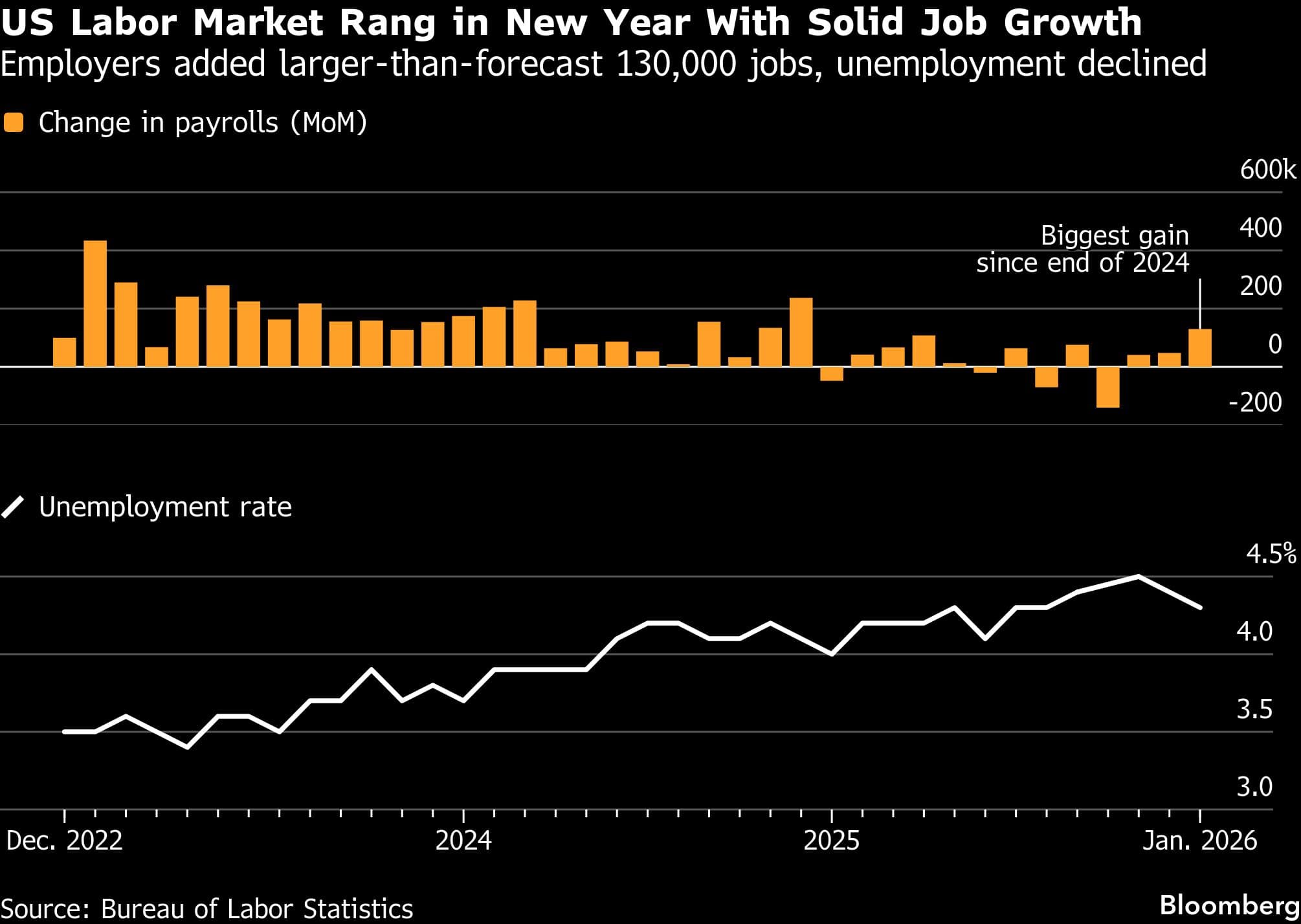
- Surging Payrolls: Recent Bureau of Labor Statistics data reveals a substantial rebound in nonfarm payrolls, invalidating fears of an imminent hard landing.
- Unemployment Compression: The headline jobless rate contracted to 4.1%, driven by robust hiring across service sectors, healthcare, and infrastructure-adjacent industries.
- Monetary Policy Pivot: The tightening labor market directly impacts Federal Reserve capital allocation strategies, forcing a recalibration of anticipated interest rate adjustments.
- Corporate Risk Mitigation: Chief financial officers and institutional investors must reassess valuation multiples, wage inflation pressures, and enterprise ROI amid sustained consumer spending.
The United States labor market has once again demonstrated remarkable endurance, confounding macroeconomic forecasters and recalibrating global risk equations. Following a period of subdued hiring and mounting anxiety over restrictive monetary policy, the latest employment report confirms that nonfarm payrolls surged while the national unemployment rate retreated to 4.1%. This macroeconomic inflection point alters the strategic landscape for institutional investors, corporate treasurers, and central bankers alike, upending prevailing assumptions about capital allocation, market liquidity, and enterprise risk mitigation.
For months, financial markets have parsed conflicting signals from corporate earnings calls, supply chain metrics, and regional Federal Reserve surveys. Skeptics pointed to cooling discretionary spending and compressed margins as harbingers of systemic deceleration. However, the latest employment figures provide definitive proof of underlying structural strength. Businesses across sectors—ranging from advanced cloud compute architecture providers to industrial manufacturing conglomerates—continue to prioritize talent acquisition and infrastructure scalability, driving a renewed wave of job creation that challenges bearish market theses.
Catalytic Forces Behind the Labor Market Rebound
Test Our Free AI & Tech Utilities Suite
Calculate LLM API token costs, analyze article dwell-time, or simulate tech DCA returns.
The resurgence in US employment is not a monolith; rather, it is propelled by several distinct catalytic forces operating concurrently across the economy. Primary among these is the sustained demand for skilled labor in technology-adjacent fields, healthcare services, and automated logistics. As enterprises accelerate digital transformation initiatives and invest heavily in high-performance computing infrastructure, the demand for specialized human capital remains exceptionally inelastic.
Simultaneously, federal legislation enacted over the past three years—including the Infrastructure Investment and Jobs Act and the CHIPS and Science Act—is finally exerting its full economic multiplier effect. Billions of dollars in public capital are flowing into domestic manufacturing, semiconductor fabrication facilities, and civil engineering projects. This capital deployment has triggered a localized hiring boom, lifting employment metrics across industrial supply chains and generating significant second-order economic activity.
Wage growth, while stabilizing from the hyper-inflationary spikes of the post-pandemic era, continues to outpace core consumer price indices. This dynamic supports robust consumer spending, which accounts for roughly seventy percent of US gross domestic product. Consequently, retailers, hospitality operators, and financial institutions are experiencing resilient demand, further justifying continued workforce expansion and mitigating fears of a sudden demand-side collapse.
Verified Data & Metrics Breakdown

To contextualize the trajectory of the labor market, financial analysts look to key quantitative indicators published by federal statistical agencies and private-sector processors. The following table outlines the comparative metrics defining the current macroeconomic environment:
| Economic Indicator | Previous Reading | Current Reading | Macroeconomic Implication |
|---|---|---|---|
| Unemployment Rate | 4.3% | 4.1% | Tightening labor pool; sustained upward pressure on wage floors. |
| Nonfarm Payrolls (Monthly Change) | +114,000 (Revised) | +254,000 | Substantial upside surprise, indicating broad-based corporate hiring. |
| Average Hourly Earnings (YoY) | 3.6% | 4.0% | Real wage gains support consumer spending but complicate Federal Reserve inflation models. |
| Labor Force Participation Rate | 62.7% | 62.7% | Stable worker availability despite rising absorption rates. |
Industry & Market Implications: Winners, Losers, and Capital Reallocation
A resilient labor market sending unemployment down to 4.1% carries profound ramifications across global financial markets. Institutional asset managers are rapidly adjusting equity and fixed-income portfolios to reflect a "higher-for-longer" interest rate reality, as the Federal Reserve weighs robust job creation against lingering inflationary pressures.
Who Wins
Consumer Discretionary & Retail Conglomerates: Persistent employment and real wage growth ensure that household balance sheets remain liquid, directly benefiting consumer-facing equities.
Industrial & Infrastructure Giants: Firms directly tied to civil engineering, domestic manufacturing, and supply chain reshoring continue to enjoy strong revenue visibility and robust project pipelines.
Commercial Real Estate (Prime Assets): Premium, energy-efficient office properties and logistics hubs in major metropolitan growth corridors benefit as corporate tenants commit to long-term physical footprints.
Who Loses
Fixed-Income Bond Holders: Strong employment data dampens expectations of aggressive monetary easing, pushing bond yields higher and compressing fixed-income valuations.
Margin-Compressed Small Businesses: Main Street enterprises lacking pricing power face continued pressure as they compete with large corporations for scarce talent, driving up labor overhead.
Growth-Stage Tech Startups: High-growth ventures reliant on cheap debt and abundant venture capital face stiffer competition for technical talent, increasing burn rates and delaying profitability milestones.
Frequently Asked Questions (People Also Ask)
What does a 4.1% unemployment rate signal for the broader US economy?
A 4.1% unemployment rate indicates a historically tight labor market that is operating near or at full employment. For the broader economy, it signals sustained consumer purchasing power and robust business activity, significantly reducing the probability of an immediate recession. However, it also requires the Federal Reserve to carefully balance growth against potential wage-driven inflation pressures.
How will this employment report influence Federal Reserve monetary policy?
Strong job creation and a falling unemployment rate complicate the central bank's rate-cut trajectory. While inflation has cooled from its peak, a buoyant labor market prevents the Fed from aggressively slashing interest rates. Policymakers are likely to favor measured, data-dependent adjustments rather than rapid monetary easing to prevent reigniting inflationary cycles.
Which specific sectors are driving the current surge in job growth?
The primary engines of recent job growth include healthcare and social assistance, leisure and hospitality, government employment, and professional and business services. Additionally, manufacturing and construction sectors have posted steady gains, buoyed by federal infrastructure spending and corporate investments in domestic supply chain resilience.
Are wages keeping pace with inflation in this labor market?
Yes. Average hourly earnings have risen at an annualized rate of approximately 4.0%, which currently outpaces headline consumer price inflation. This dynamic results in positive real wage growth, enhancing household purchasing power and supporting ongoing consumer outlays across the retail and service sectors.
Future Outlook and Key Milestones to Watch
As the economic narrative pivots from recession anxiety to growth management, market participants must monitor several critical milestones over the coming quarters. Corporate earnings disclosures will offer granular insight into how chief financial officers plan to manage labor costs against flattening profit margins. Furthermore, upcoming consumer price index prints and core personal consumption expenditures (PCE) data will dictate the Federal Reserve's precise timeline for monetary policy adjustments.
For enterprise leaders, the mandate is clear: strategic agility and rigorous risk mitigation remain paramount. Organizations that successfully leverage automation, optimize cloud compute architectures, and execute disciplined capital allocation will outperform in an environment defined by higher baseline labor costs and resilient consumer demand. The 4.1% unemployment milestone is not merely a statistical data point; it is a testament to the structural adaptability of the American economy, setting the tone for capital markets as the fiscal year draws to a close.