Executive Takeaways
- Active Seismic Signatures: High-resolution orbital telemetry confirms that Valles Marineris—the solar system's largest canyon system—is experiencing modern tectonic activity, overturning decades of geological consensus.
- Planetary Cooling Mechanics: Unlike Earth, which relies on dynamic plate tectonics, Martian activity is driven by localized lithospheric cooling and stress release, offering unprecedented insights into planetary evolution.
- Astrobiological & Infrastructure Risk: The confirmation of contemporary marsquakes fundamentally alters risk mitigation protocols and capital allocation frameworks for future crewed Artemis-style lunar and Martian habitats.
- Commercial Aerospace Re-evaluation: Private space infrastructure providers and public-sector agencies must recalibrate engineering tolerances to account for active subsurface seismic hazards.
For generations, planetary scientists operated under a convenient, uniform geological consensus: Mars was a quiet, geologically dead world. Aside from ancient volcanic remnants like Olympus Mons and dry riverbeds scarred by primordial floods, the Red Planet was categorized as a frozen relic—a textbook example of a planetary body that had exhausted its internal thermal budget billions of years ago. That foundational paradigm has now been shattered.
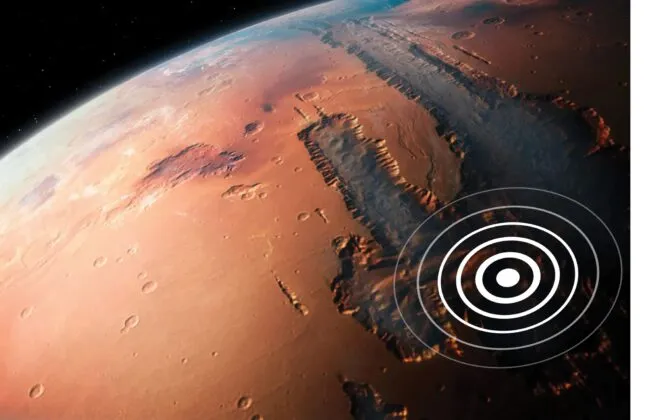
Recent data releases aggregated from global wire services and deep-space telemetry confirm that the colossal canyon system known as Valles Marineris is not a static scar of the deep past, but a dynamically alive, tectonically active fracture zone. This revelation fundamentally rewrites our understanding of Martian geodynamics, forcing aerospace leaders, capital allocators, and planetary scientists to re-evaluate the risk profile of Earth’s nearest planetary neighbor.
The Anatomy of a Planetary Awakening: Decoding Valles Marineris
Stretching more than 4,000 kilometers across the Martian surface, Valles Marineris dwarfs Earth's Grand Canyon. If superimposed onto the United States, it would span from Los Angeles to New York. For decades, researchers assumed these immense chasms were carved by ancient tectonic rifting followed by catastrophic water erosion, eventually stabilizing into permanent geological slumber as the planet's core cooled.
However, meticulous analysis of seismic data captured by modern landers, combined with high-cadence orbital reconnaissance imagery, paints a radically different picture. Scientists have detected definitive signatures of modern marsquakes originating from deep within the canyon network's fault systems. These seismic events are not merely the settling dust of ancient impacts; they are tectonic adjustments driven by ongoing internal stresses.
Unlike Earth, where a shifting mosaic of lithospheric plates drives earthquakes at destructive and constructive margins, Mars operates under a "single-plate" or stagnant-lid tectonic regime. As the planet's interior continues to lose primordial heat, the vast crust contracts unevenly. This global thermal contraction creates immense mechanical stress, which is periodically relieved when brittle fault zones—such as those underlying the immense walls of Valles Marineris—fracture and slip.
The Financial and Strategic Calculus of Interplanetary Risk

While this discovery is a triumph for academic planetary geology, its shockwaves extend far beyond university laboratories and academic journals. In the modern era of commercialized space exploration—where venture capital, sovereign wealth funds, and private enterprise are pouring billions into aerospace infrastructure scalability—geological intelligence directly dictates valuation multiples and capital allocation strategies.
For space agencies and private aerospace contractors, the confirmation of active Martian tectonics introduces complex variables into mission architecture. Infrastructure scalability on the Martian surface depends entirely on accurate predictive modeling of environmental hazards. Surface habitats, subsurface resource extraction facilities, and communication arrays must now incorporate sophisticated seismic dampers and structural hardening to withstand modern marsquakes.
Key economic and strategic sectors facing immediate impact include:
- Commercial Aerospace & Defense: Prime contractors designing next-generation surface-landing systems must factor dynamic ground motion into structural load-bearing calculations.
- Satellite Telecommunications: Orbital relays and persistent telemetry networks require higher redundancy to account for potential localized ground displacement events near key landing sites.
- Insurance and Risk Mitigation: As private enterprise transitions from orbital observation to surface deployment, actuarial models for interplanetary assets must price in active seismic liabilities.
| Geological Metric | Earth (Comparative) | Mars: Valles Marineris | Implications for Exploration |
|---|---|---|---|
| Tectonic Regime | Plate Tectonics (Multi-plate) | Stagnant Lid / Thermal Contraction | Localized faulting rather than global subduction. |
| System Length | 446 km (Grand Canyon) | > 4,000 km | Massive surface area exposed to seismic stress. |
| Seismic Activity Level | High (Frequent, Plate Boundary Driven) | Low-to-Moderate (Thermal Stress Driven) | Requires resilient, flexible structural engineering. |
| Regulatory Compliance | Earth Building Codes (ISO / ANSI) | Emerging Extraterrestrial Frameworks | New safety baselines required for Artemis & Mars missions. |
Frequently Asked Questions (People Also Ask)
How do scientists know Valles Marineris is tectonically active today?
Scientists utilize ultra-sensitive seismometers deployed by landed missions, alongside high-resolution orbital imagery that tracks fresh surface landslides, fault scarps, and seismic wave propagation. These instruments have successfully recorded distinct marsquakes clustered directly around the tectonic fault networks of Valles Marineris, proving that subterranean movement is ongoing.
Does Mars have plate tectonics like Earth?
No. Unlike Earth, which features a dynamic crust broken into moving tectonic plates, Mars has a single, continuous outer shell known as a stagnant lid. Martian tectonic activity is driven entirely by global thermal contraction—as the interior cools and shrinks, the rigid crust cracks and shifts under immense mechanical stress.
What are the implications of active Martian tectonics for future human missions?
The presence of active marsquakes necessitates rigorous risk mitigation and advanced engineering protocols. Future crewed habitats, solar arrays, and resource utilization facilities must be designed with seismic resilience in mind to prevent structural failure from ground shaking or slope destabilization within canyon systems.
Future Outlook: The Next Frontier in Planetary Diagnostics
As deep-space exploration enters its most capital-intensive phase yet, our empirical baseline of planetary mechanics must evolve in lockstep. The confirmation that Valles Marineris remains tectonically active shifts the paradigm from theoretical planetology to applied extraterrestrial engineering. Over the next decade, international space agencies and private commercial ventures will deploy distributed seismic sensor networks across the Martian globe to map active fault lines with millimeter-level precision.
For institutional investors, aerospace architects, and policy makers, the message is unequivocal: Mars is not a static museum exhibit; it is a dynamic, evolving world with its own violent rhythms. Factoring these geological realities into mission architecture will separate successful, enduring interstellar enterprises from costly historical failures.