EXECUTIVE TAKEAWAYS
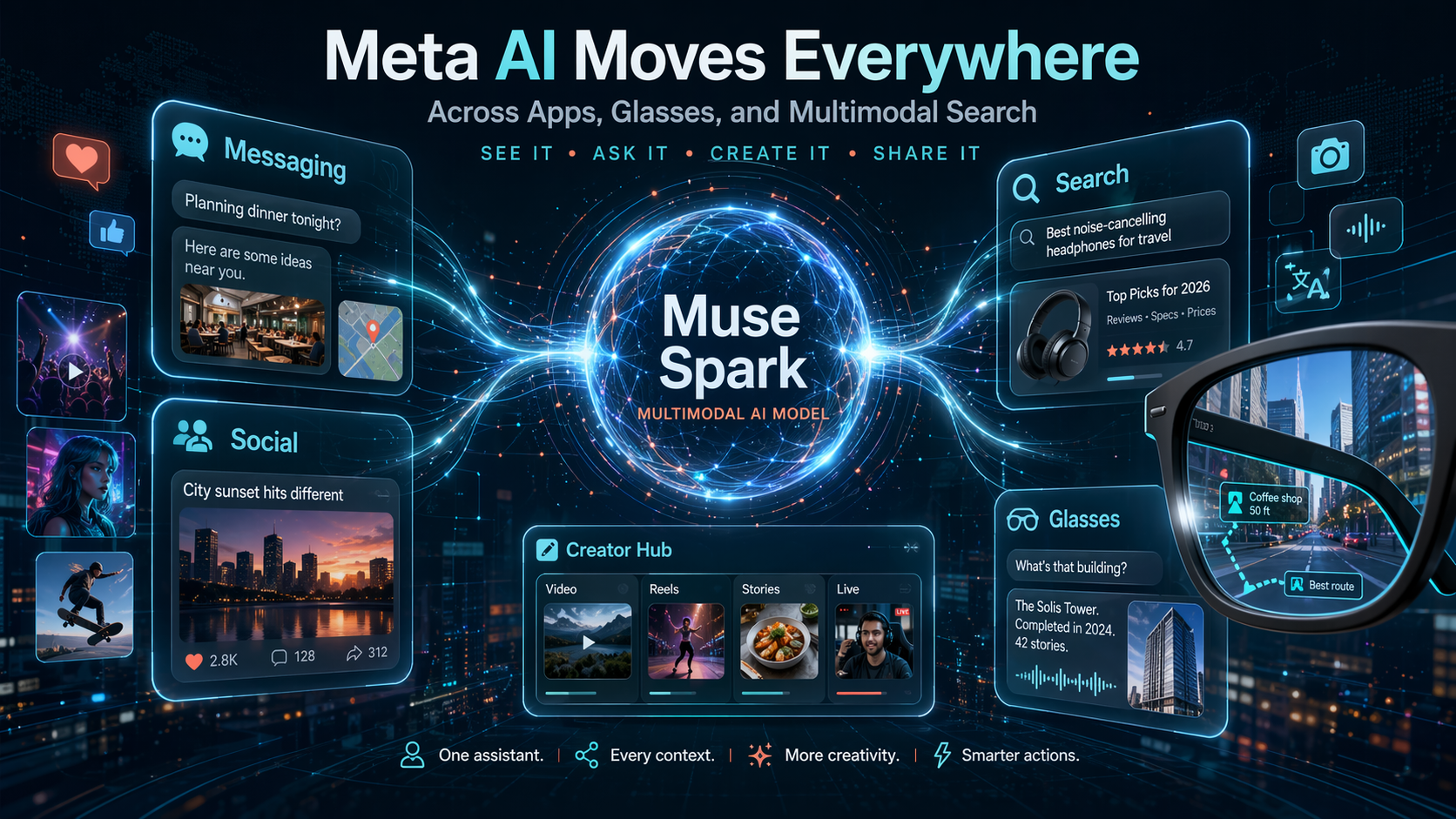
- Strategic Evolution: Meta has officially unveiled "Spaces" alongside its proprietary "Muse" agent framework, marking a definitive shift from isolated consumer generative AI tools to collaborative, multi-user operational environments.
- Capital Allocation & Infrastructure: The rollout underscores massive ongoing capital expenditures in cloud compute architecture and specialized silicon, directly impacting Meta’s valuation multiples and free cash flow projections.
- Enterprise & Monetization Impact: By targeting asynchronous workflow management and real-time team synchronization, Meta is positioning itself to challenge legacy enterprise software incumbents and capture high-margin enterprise SaaS revenue streams.
- Risk & Regulatory Scrutiny: As autonomous agents gain deeper execution capabilities within shared spaces, regulatory compliance, data privacy silos, and operational risk mitigation remain paramount concerns for institutional adopters.
SAN FRANCISCO & NEW YORK — In an aggressive move to redefine how digital productivity and artificial intelligence intersect, Meta Platforms has formally introduced "Spaces," a collaborative virtual and operational environment engineered to interface directly with its proprietary "Muse" agent ecosystem. Unveiled amid surging enterprise demand for autonomous workflows, the launch represents a critical inflection point in Meta's broader strategy to monetize generative AI beyond consumer-facing chatbots.
For financial markets, enterprise CIOs, and Silicon Valley competitors alike, the debut of Spaces and the Muse agent architecture signals a high-stakes recalibration of capital allocation. For years, Meta has absorbed staggering infrastructure costs to build out its foundational large language models. Now, under the leadership of CEO Mark Zuckerberg and top-tier product executives, the social media titan is pivoting from compute-heavy training phases toward high-yield application deployment. The core thesis: transforming AI from a solitary query-and-response tool into a persistent, multi-agent collaborator embedded directly into daily operations.
The Catalytic Shift: Moving from Standalone Chatbots to Persistent Collaboration
Test Our Free AI & Tech Utilities Suite
Calculate LLM API token costs, analyze article dwell-time, or simulate tech DCA returns.
The generative AI boom of 2023 and 2024 was defined by isolated interactions—single users querying standalone models in closed chat windows. While effective for drafting emails or summarizing documents, this paradigm failed to capture the collaborative, multi-threaded nature of modern enterprise workflows. Meta’s introduction of Spaces is a direct structural answer to this limitation.
At its core, a "Space" functions as a persistent, secure digital workspace where human teams and autonomous "Muse" agents co-exist. Unlike traditional project management tools where AI is merely an integrated plugin, Muse agents within Spaces operate as active participants capable of monitoring project lifecycles, synthesizing cross-functional data streams, executing routine administrative tasks, and proactively flagging workflow bottlenecks.
According to internal technical briefings reviewed by industry analysts, the Muse agent architecture leverages advanced reasoning engines trained on multimodal datasets. This allows the agents to interpret complex visual layouts, financial spreadsheets, and conversational transcripts simultaneously within a single Space. The economic rationale is clear: by driving operational efficiencies and compressing project completion cycles, Meta aims to prove robust enterprise ROI to CFOs scrutinizing tech budgets.
Infrastructure Scalability and Cloud Compute Architecture

Deploying persistent, multi-user agent environments at Meta's unprecedented global scale requires staggering computational muscle. The underlying infrastructure supporting Spaces and Muse relies heavily on Meta’s latest custom silicon iterations—specifically the Meta Training and Inference Accelerator (MTIA)—alongside massive clusters of high-end GPUs housed in next-generation data centers.
Wall Street analysts have closely monitored Meta's capital expenditure (CapEx) guidance, noting that infrastructure investments have expanded dramatically to support generative AI ambitions. The launch of Spaces tests whether these capital-intensive data center builds can be successfully amortized through high-margin enterprise software subscriptions, API usage tiers, and enhanced ad-tech ecosystem integration.
| Strategic Metric | Legacy Consumer AI Model | Meta Spaces & Muse Architecture |
|---|---|---|
| Primary Interaction Mode | Single-user, transactional chat | Multi-user, persistent collaborative workspace |
| Agent Autonomy Level | Reactive (responds only when prompted) | Proactive (monitors workflows and executes tasks) |
| Compute Load & Architecture | Ephemerally allocated inference cycles | Continuous, state-aware cloud compute orchestration |
| Monetization Focus | Ad-supported consumer engagement | Enterprise SaaS, API monetization, productivity uplift |
The technical hurdle facing Meta’s engineering teams is maintaining low latency while managing stateful sessions across multiple active agents and human participants. Cloud compute architecture must dynamically scale to prevent performance degradation as enterprise teams scale their utilization of complex data pipelines within a single Space.
Industry and Market Implications: Who Wins and Who Loses?
The introduction of Spaces and Muse agents is poised to send shockwaves through the competitive landscape, creating clear economic winners and losers across the technology sector.
The Winners: Enterprise Productivity Enablers and Meta Shareholders
Meta is positioning itself as a formidable contender against entrenched enterprise giants like Microsoft (with its Copilot ecosystem) and Salesforce (with Agentforce). By leveraging its massive user acquisition funnel and deep pockets, Meta can aggressively undercut legacy enterprise software pricing models. For institutional investors, successful execution of Spaces could expand Meta’s valuation multiples by proving that its massive AI infrastructure spend translates directly into diversified, recurring revenue streams.
The Losers: Legacy Point-Solution SaaS Vendors
Single-feature productivity startups, project management point solutions, and rudimentary workflow automation tools face severe existential pressure. When an ecosystem like Meta Spaces offers deeply integrated, autonomous agent collaboration natively, enterprise buyers will increasingly question the utility of paying for disparate, standalone software licenses.
Risk Mitigation, Data Privacy, and Regulatory Compliance
As autonomous agents gain the capacity to execute tasks, access sensitive internal databases, and interact directly with clients within Spaces, risk mitigation becomes a critical boardroom discussion. Enterprise adoption hinges entirely on robust data governance and regulatory compliance.
Meta has emphasized that Spaces incorporates strict enterprise-grade security protocols, including end-to-end data encryption, granular permission controls, and compliance frameworks aligned with GDPR, CCPA, and SOC 2 standards. Muse agents are engineered to operate within strictly defined data perimeters, preventing proprietary corporate data from contaminating foundational training models without explicit enterprise authorization.
Nevertheless, regulatory bodies in the European Union and the United States are expected to scrutinize how Meta handles data ingestion within these collaborative environments. Antitrust watchdogs will also monitor whether Meta leverages its dominance in social media and advertising to bundle Spaces into anti-competitive enterprise packages.
Frequently Asked Questions (People Also Ask)
What exactly is Meta Spaces, and how does it integrate with Muse agents?
Meta Spaces is a persistent, collaborative digital environment designed for team workflows where human workers and Meta’s autonomous "Muse" agents collaborate in real-time. Muse agents act as active participants—managing project timelines, analyzing data, and executing tasks—rather than operating as traditional standalone chatbots.
How does Meta plan to monetize Spaces and the Muse agent ecosystem?
While Meta continues to leverage its core advertising ecosystem, Spaces represents a direct push into enterprise software monetization. Meta plans to generate revenue through tiered enterprise SaaS subscriptions, advanced API access, and value-added productivity features tailored for corporate clients seeking measurable enterprise ROI.
What security and privacy measures protect enterprise data within Spaces?
Meta has implemented enterprise-grade security protocols, including strict data privacy silos, end-to-end encryption, and role-based access controls. Muse agents operate within bounded data perimeters to ensure proprietary corporate information is not utilized for public model training without explicit institutional consent.
How does Meta Spaces compete against existing tools like Microsoft Copilot and Google Workspace?
Unlike traditional document-centric assistants, Spaces focuses heavily on multi-agent autonomy and shared, state-aware operational environments. By combining Meta’s advanced multimodal reasoning models with collaborative workspace architecture, Spaces aims to offer deeper workflow automation and team synchronization than legacy office suite integrations.
Future Outlook: Milestones and Strategic Watchpoints
The commercial rollout of Meta Spaces and Muse agents is merely the opening salvo in a broader corporate strategy. Over the next twelve to eighteen months, market analysts will closely monitor several key operational and financial milestones:
- Enterprise Adoption Rates: Tracking the conversion velocity of Fortune 500 pilot programs into paid, long-term enterprise contracts.
- CapEx Efficiency & ROI: Evaluating whether the revenue generated from enterprise SaaS and API tiers justifies Meta’s unprecedented data center and custom silicon capital expenditures.
- Regulatory Developments: Monitoring potential antitrust challenges and cross-border data privacy rulings from regulators in the EU and North America regarding multi-agent autonomous systems.
- Ecosystem Integrations: Observing third-party developer adoption as Meta opens up APIs for custom Muse agent creation and external software integrations.
As Meta pushes deeper into the enterprise software echelon, the success of Spaces and Muse will test whether a consumer-giant can effectively capture high-margin B2B market share. For financial markets and industry competitors, the evolution of Meta's collaborative AI strategy will remain one of the most critical macroeconomic and technological narratives to watch.