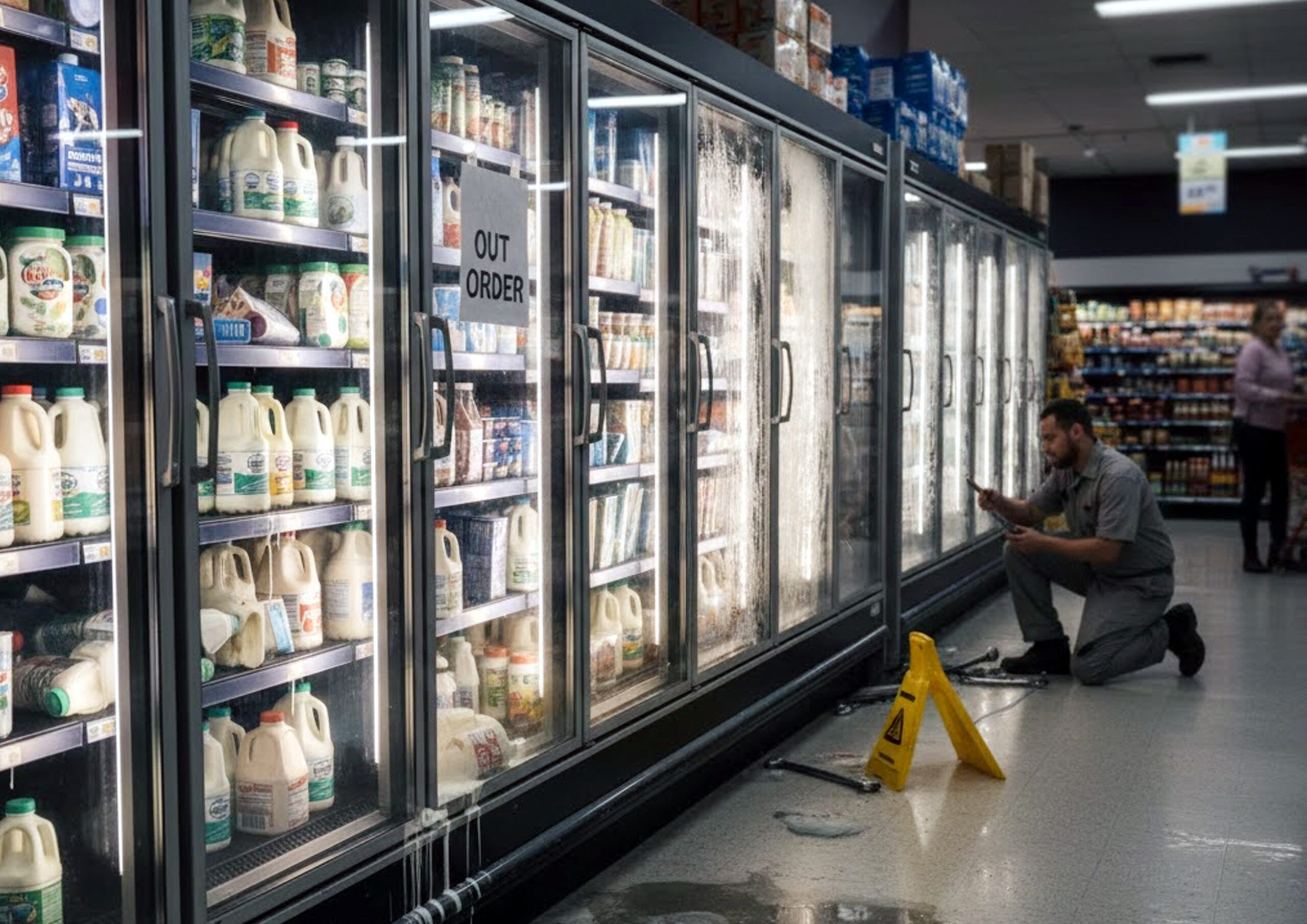
LONDON — In the quiet hours before dawn, a sophisticated digital intrusion did not empty bank vaults or lock corporate databases; instead, it turned off the chill. Across hundreds of retail locations spanning Western Europe, remote attackers altered programmable logic controllers (PLCs) governing commercial cold-storage units. The resulting temperature spikes silently spoiled millions of dollars in dairy, meat, and fresh produce, thrusting the vulnerabilities of the continent’s grocery supply chain into stark, alarming relief.
This coordinated campaign represents a dangerous evolution in cyber warfare. For years, cybersecurity analysts warned about the convergence of enterprise IT and industrial OT. Today, that theoretical risk has materialized as a devastating reality. According to intelligence compiled across multiple cybersecurity firms and corroborated by retail executives, threat actors are leveraging lax vendor access points and outdated firmware to compromise Building Management Systems (BMS), weaponizing refrigeration units against major retail brands.
The Anatomy of the Attack: From IT Perimeters to OT Cores
The operational mechanics of these incidents follow a calculated pattern. Rather than deploying ransomware that encrypts hard drives—a disruption that allows operators to restore from backups—these attacks target the sensory and regulatory layers of industrial cooling. By manipulating the set-points of industrial compressors and overriding automated alarm systems, perpetrators create a scenario where internal cabinet temperatures rise past safe thresholds without immediately triggering localized staff alerts.
For enterprise grocers operating on razor-thin profit margins, the financial fallout is immediate and severe. Food safety regulations demand total destruction of perishable stock if cold-chain integrity is compromised even briefly. Consequently, loading docks have become staging grounds for mass disposal operations, forcing retailers to write off entire inventories while absorbing reputational damage among consumers.
Financial analysts tracking the retail sector note that these incidents threaten valuation multiples. As institutional investors factor operational resilience into equity pricing, companies unable to demonstrate robust risk mitigation strategies face capital cost penalties. "We are seeing a fundamental repricing of operational risk," explains a senior equities analyst covering European consumer staples. "When a cyber incident translates directly into physical destruction of goods and immediate top-line contraction, the market ceases to view cybersecurity as an IT line item and recognizes it as an existential threat to enterprise value."
Regulatory Reckoning: The Impact of NIS2 and Compliance Costs
The timing of this cyber offensive coincides with the enforcement phase of the European Union’s Network and Information Security Directive (NIS2). Under NIS2, retail and food distribution sectors are classified as essential or important entities, subjecting corporate boards to stringent regulatory compliance standards and substantial administrative fines for cybersecurity negligence.
Chief Information Security Officers (CISOs) across Europe are now facing intense board-level pressure to overhaul legacy cloud compute architecture. Many modern refrigeration units rely on IoT (Internet of Things) connectivity to facilitate predictive maintenance and remote diagnostics by third-party vendors. However, these same vendor portals frequently serve as lateral movement vectors for threat actors. Securing these architectures requires a massive capital expenditure cycle, forcing firms to reallocate budgets away from expansion projects and toward foundational defensive hardening.
| Metric / Parameter | Pre-Crisis Standard | Current Industry Reality | Financial & Strategic Impact |
|---|---|---|---|
| Vendor Access Protocol | Always-on remote cloud connectivity | Strictly audited, zero-trust tunnels | Increased operational friction; lower vulnerability |
| Inventory Write-Off Exposure | Isolated mechanical failure baseline | Multi-site simultaneous spoilage spikes | Immediate cash flow contraction and margin pressure |
| Regulatory Exposure | Standard GDPR / Basic Data Privacy | NIS2 Directives & Critical Infrastructure Penalties | Potential fines up to 2% of global annual turnover |
| IT/OT Capital Allocation | Under 5% of total tech budget | Projected 18% to 25% allocation surge | Compression of near-term enterprise ROI |
Market Implications: Winners, Losers, and Supply Chain Realignment
As grocers scramble to fortify their facilities, the macroeconomic ripples are extending across adjacent industries. Cybersecurity vendors specializing in industrial control systems (ICS) and OT network segmentation are experiencing unprecedented demand. Firms capable of deploying real-time anomaly detection software across legacy cooling hardware are securing lucrative enterprise contracts.
Conversely, regional supermarket operators lacking the balance sheet strength to absorb sudden inventory losses or fund comprehensive infrastructure upgrades face acute consolidation pressures. Industry consolidation is expected to accelerate as weaker players find the cost of regulatory compliance and cyber defense economically unsustainable.
Furthermore, insurers underwriting commercial property and casualty (P&C) policies are rapidly rewriting contract terms. Cyber-physical attacks that result in physical damage or spoilage are increasingly being subjected to stringent exclusions or higher premiums, forcing risk managers to explore captive insurance models and alternative risk transfer mechanisms.
Frequently Asked Questions (People Also Ask)
Frequently Asked Questions
How do cyberattacks on supermarket refrigeration systems actually work?
Attackers typically compromise third-party HVAC/R (Heating, Ventilation, Air Conditioning, and Refrigeration) vendor credentials or exploit unpatched vulnerabilities in Building Management Systems (BMS). Once inside the network, they manipulate programmable logic controllers (PLCs) to alter temperature set-points or disable automated alarms, causing food to spoil without immediate physical signs of hardware failure.
Are these attacks classified as ransomware or state-sponsored sabotage?
Intelligence agencies and private cybersecurity investigators are currently examining multiple threat vectors. While some incidents display characteristics of financially motivated extortion, others exhibit advanced techniques reminiscent of state-sponsored infrastructure probing, aiming to test systemic resilience in Western food distribution networks.
What financial impact do these food spoilage incidents have on major retailers?
Beyond the immediate write-off of millions of euros in perishable inventory, retailers face heightened supply chain friction, increased insurance premiums, regulatory fines under frameworks like the EU's NIS2 directive, and potential erosion of consumer trust that can depress market valuation multiples.
How are supermarkets responding to prevent future refrigeration attacks?
Enterprise grocers are rapidly implementing zero-trust network architectures, air-gapping critical refrigeration loops from corporate IT environments, mandating multi-factor authentication (MFA) for all vendor access, and deploying real-time OT anomaly detection tools to catch unauthorized temperature manipulations early.
Future Outlook: Milestones and Strategic Imperatives
The unfolding crisis in European retail refrigeration marks a watershed moment for critical infrastructure security. As threat actors refine their capabilities against industrial control systems, corporate boards can no longer treat operational technology as an isolated engineering concern. Over the next twelve to twenty-four months, market watchers will monitor key milestones, including the formal adoption rates of the NIS2 directive across member states, the emergence of specialized OT cyber insurance products, and the velocity at which major grocery chains restructure their vendor ecosystems.
Ultimately, long-term market liquidity and investor confidence will depend on how swiftly retailers can transition from reactive incident management to proactive, end-to-end resilience. In the modern interconnected economy, safeguarding the cold chain is no longer merely a logistical challenge—it is the ultimate test of corporate governance and digital defense.