Executive Takeaways
- Immediate Cost Escalation: Channel checks indicate NVIDIA is preparing an aggressive pricing adjustment for its flagship GeForce RTX 50-Series GPUs, with premium SKUs facing upward revisions of up to $500 effective this week.
- Macroeconomic Drivers: The sudden repricing is fueled by compounding pressures, including escalating advanced-node wafer costs at TSMC, tightening supply chains, and fierce competition for semiconductor capital allocation against enterprise AI accelerators.
- Market Liquidity & Margin Pressures: Consumer hardware retailers and system integrators brace for compressed margins, while downstream PC gaming enthusiasts face structural affordability barriers.
- Enterprise Substitution Effect: The blurring lines between consumer-grade gaming architecture and data center workloads continue to distort standard supply-demand equilibria, forcing a reassessment of valuation multiples across the PC component ecosystem.
NEW YORK — In a development that threatens to send seismic shockwaves through the consumer electronics and gaming sectors, industry supply chain insiders and tier-1 retail distributors confirm that NVIDIA Corporation is poised to implement a sweeping price hike of up to $500 on its highly anticipated GeForce RTX 50-Series graphics processing units. This dramatic fiscal realignment, scheduled to take effect across global distribution channels this week, underscores the escalating economic realities of advanced semiconductor manufacturing and the relentless dominance of enterprise artificial intelligence infrastructure.
For months, the global technology press and financial markets have tracked the developmental trajectory of NVIDIA’s next-generation architecture, codenamed "Blackwell" for consumer implementation. However, as initial production batches transition from silicon foundries to commercial assembly lines, the convergence of macroeconomic headwinds, geopolitical supply chain friction, and unprecedented competition for sub-nanometer fabrication capacity has forced a radical pivot in pricing strategy. What began as industry speculation has now solidified into actionable distribution notices sent to major original equipment manufacturers (OEMs) and regional system builders.
The Catalyst: Margin Compression and Advanced Node Economics
Test Our Free AI & Tech Utilities Suite
Calculate LLM API token costs, analyze article dwell-time, or simulate tech DCA returns.
To understand the mechanics behind this week’s anticipated price surge, one must examine the capital expenditure (CapEx) realities governing modern semiconductor fabrication. NVIDIA relies almost exclusively on Taiwan Semiconductor Manufacturing Company (TSMC) for the production of its bleeding-edge dies. The RTX 50-Series utilizes a customized, highly dense fabrication node designed to maximize transistor density, ray-tracing throughput, and tensor core efficiency.
However, securing high-yield wafer allocations on TSMC’s most advanced nodes has become an ultra-competitive zero-sum game. Hyperscale cloud providers and enterprise AI heavyweights—fueled by robust corporate spending on large language model (LLM) training infrastructure—have demonstrated an almost limitless appetite for silicon. This insatiable enterprise demand has driven up wafer costs, creating a severe opportunity cost for TSMC. Consequently, consumer GPU lines must now compete directly on economic merit against high-margin enterprise accelerators like the H100, H200, and Blackwell B200 data center units.
For NVIDIA, maintaining previous consumer price points in the face of escalating input costs would result in severe gross margin compression. By adjusting MSRPs upward by margins ranging from $150 to $500 depending on the specific SKU, Jensen Huang’s leadership team is executing a classic risk mitigation strategy to protect shareholder value and preserve industry-leading profitability metrics.
Detailed Breakdown: Anticipated MSRP Adjustments
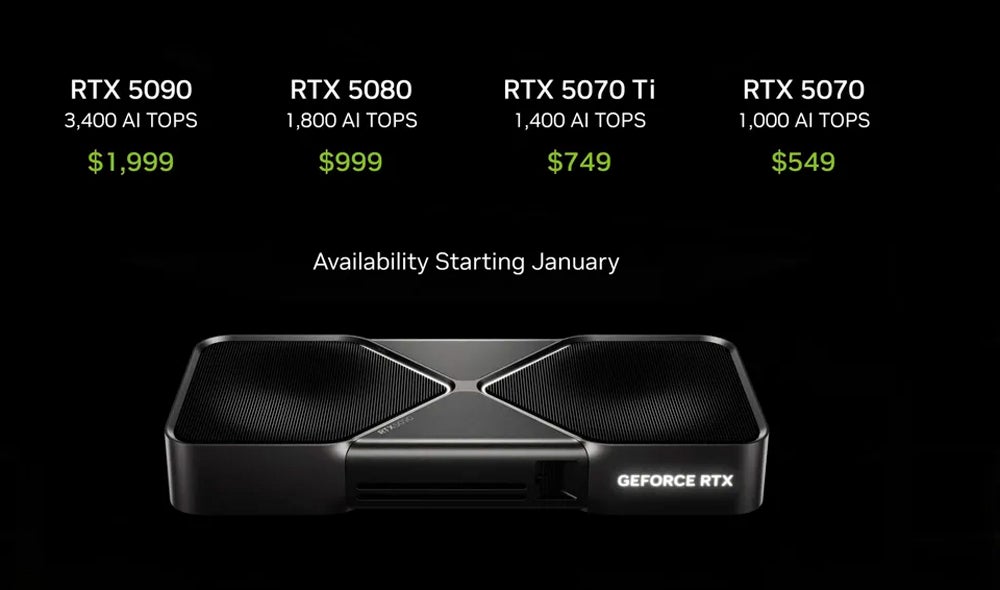
Channel checks and confidential briefings with European and North American distributors reveal a tiered adjustment structure. While entry-level and mid-tier SKUs are expected to experience moderate upward drift, the absolute apex of the consumer lineup—specifically the flagship enthusiast cards—will absorb the maximum $500 premium.
| GeForce RTX 50-Series Tier | Projected Price Increase | Primary Driving Factor | Market Impact |
|---|---|---|---|
| Flagship Enthusiast (e.g., RTX 5090 Tier) | Up to $500 | Extreme silicon die size, GDDR7 memory costs, TSMC node competition. | Niche luxury pricing; shifts addressable market toward high-net-worth enthusiasts and boutique creators. |
| High-End Performance (e.g., RTX 5080 Tier) | $300 – $400 | Advanced packaging (CoWoS) constraints and board partner cost pass-through. | Stretches consumer budgets, prompting longer hardware refresh cycles. |
| Mainstream Enthusiast (e.g., RTX 5070 Tier) | $150 – $250 | General inflationary pressures, logistics, and component scarcity. | Heightened competition from previous-gen inventory clearance. |
Industry & Market Implications: Winners, Losers, and Economic Ripple Effects
The impending price restructuring is not occurring in a vacuum; it carries profound structural implications for the broader technology ecosystem, influencing everything from retail liquidity to corporate capital allocation.
The Winners
-
<NVIDIA Shareholders: By successfully transferring rising input costs to the end consumer, NVIDIA protects its operating margins and reinforces its pricing power, validating bullish valuation multiples on Wall Street.
- Enterprise AI Dominance: With consumer hardware pricing increasingly reflecting true silicon opportunity costs, NVIDIA ensures that fab capacity remains economically optimized toward high-yield data center deployments.
- Secondary and Resale Markets: Previous-generation RTX 40-Series inventory is expected to experience a stabilization in residual value, as budget-conscious consumers balk at inflated entry points for the new generation.
The Losers
- PC Gaming Enthusiasts & Content Creators: The barrier to entry for high-performance computing continues to rise, alienating core demographics and driving down adoption rates for cutting-edge graphical features like path tracing and neural rendering.
- Independent System Integrators (SI) and AIB Partners: Add-in board (AIB) partners such as ASUS, MSI, and Gigabyte face difficult choices regarding margin absorption versus volume loss as retail prices climb.
- Retail Channel Liquidity: Higher price points inherently slow inventory turnover, tying up working capital for regional distributors and consumer electronics retailers.
Frequently Asked Questions (People Also Ask)
Why are NVIDIA GeForce RTX 50-Series GPUs experiencing a price increase?
The price adjustments are primarily driven by soaring advanced-node manufacturing costs at TSMC, intense competition for silicon wafer allocation against enterprise AI data center hardware, and rising expenditures associated with next-generation memory standards like GDDR7 and advanced packaging technologies.
When will the new RTX 50-Series pricing take effect?
Industry distribution schedules indicate that updated price sheets and wholesale directives are rolling out to regional distributors, system integrators, and retail partners starting this week.
Will this price hike affect all RTX 50-Series models equally?
No. The most severe increases—approaching the $500 threshold—are concentrated on flagship enthusiast-tier cards featuring massive monolithic dies and complex board designs. Mainstream and mid-tier SKUs will see more modest, though still notable, upward revisions.
How does enterprise AI demand impact consumer graphics card prices?
Because consumer GPUs and enterprise AI accelerators (like NVIDIA’s data center chips) compete for the exact same limited fabrication capacity at foundries like TSMC, the immense profitability of AI hardware sets a high economic baseline. Consumer GPUs must match these opportunity costs to justify their allocation of factory floor space.
Future Outlook & Strategic Milestones
As the market digests this week's structural repricing, industry analysts will closely monitor several critical key performance indicators (KPIs) to gauge the health of the consumer GPU ecosystem. First, sell-through rates over the coming fiscal quarter will reveal whether consumer demand remains elastic in the face of premium pricing. Second, observers will track TSMC’s quarterly capacity reports to determine if node bottlenecks begin to ease by the second half of the year.
Ultimately, NVIDIA’s calculated gamble highlights a definitive turning point in the semiconductor industry. The era of predictable generation-over-generation price-to-performance scaling has yielded to an era dictated by enterprise AI dominance and the unforgiving economics of advanced silicon. For market participants, navigating this new paradigm will require rigorous financial discipline, strategic inventory management, and a fundamental reassessment of what constitutes consumer value in the age of accelerated computing.