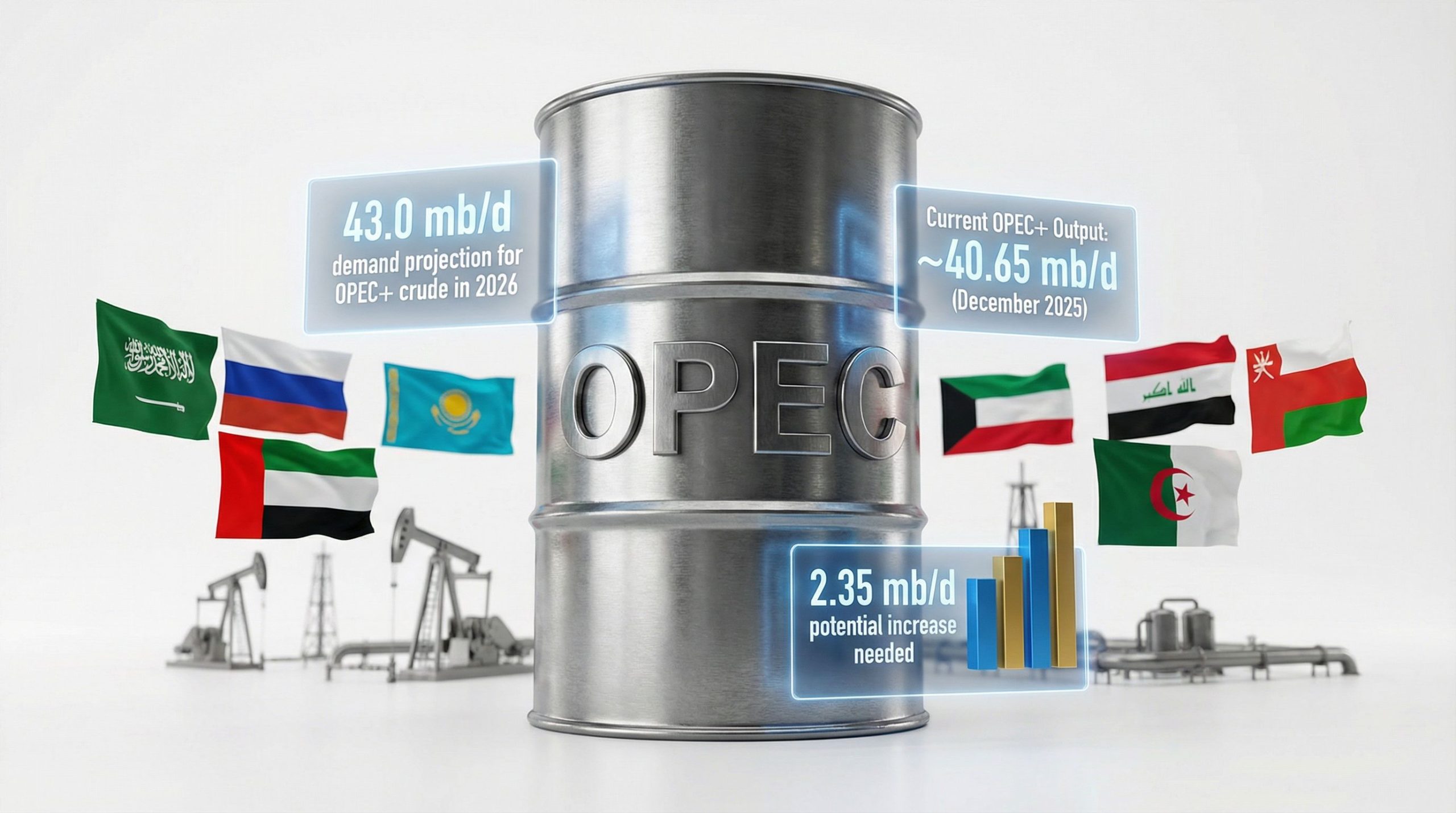
LONDON, NEW YORK, & DUBAI — In a high-stakes compromise forged across virtual ministerial sessions and late-night backchannel diplomacy, the Organization of the Petroleum Exporting Countries and its allies, collectively known as OPEC+, have formally agreed to maintain their current December oil output targets. The decision, engineered to stabilize market liquidity and prevent unmitigated inventory builds through the final weeks of the fiscal year, papers over deepening internal fractures regarding capital allocation, production baselines, and member-state compliance. Yet, beneath the veneer of short-term policy continuity, energy markets and sovereign wealth funds are already pricing in a far more volatile horizon. Global energy strategists warn that today’s stabilization maneuver is merely a temporary ceasefire ahead of a structurally treacherous strategic pivot point: setting the definitive production architecture for 2027.
For institutional investors, hedge fund macro desks, and corporate enterprise leaders navigating volatile energy input costs, the implications stretch far beyond immediate West Texas Intermediate (WTI) and Brent crude spot prices. As capital expenditure (CapEx) cycles tighten and balance sheets are scrutinized for valuation multiples and risk mitigation, the cartel’s inability to forge a unified long-term consensus threatens to destabilize global inflation forecasts and corporate earnings projections. This investigative report breaks down the mechanics of the December rollover, evaluates the structural vulnerabilities threatening the 2027 framework, and analyzes the macroeconomic fallout for energy markets worldwide.
Executive Takeaways
Test Our Free AI & Tech Utilities Suite
Calculate LLM API token costs, analyze article dwell-time, or simulate tech DCA returns.
- December Targets Maintained: OPEC+ delegates confirmed that production quotas will remain steady through December, keeping voluntary output cuts intact to defend price floors amid sluggish macroeconomic growth in Asia and Europe.
- The 2027 Precipice: The true battleground centers on baseline adjustments and quota redistribution for 2027—a contentious review process pitting major Middle Eastern producers against African and Latin American member states demanding higher capacity allowances.
- Capital Allocation & Risk Mitigation: Energy majors and enterprise consumers must recalibrate their hedging strategies and supply chain infrastructure scalability against the backdrop of brittle cartel cohesion and lingering geopolitical flashpoints.
- Compliance and Quota Slippage: Persistent overproduction by key recalcitrant members continues to undermine collective market management, raising questions regarding the long-term viability of voluntary supply management frameworks.
The Anatomy of the December Decision: Balancing Deficits and Demand Destruction

The decision to keep December production targets steady was not arrived at lightly. Over the preceding fortnight, the Joint Ministerial Monitoring Committee (JMMC) convened behind closed doors to assess conflicting macroeconomic signals. On one hand, persistent supply tightness in refined products and geopolitical friction across the Middle East and Eastern Europe provided theoretical support for higher oil prices. On the other hand, softening manufacturing PMIs in the Eurozone, a protracted real estate slowdown in China, and surging non-OPEC supply—anchored by aggressive Permian Basin shale productivity and deepwater Brazilian production—threatened to swamp global balances.
For financial institutions and corporate treasurers, this dynamic underscores a complex balancing act. Enterprise ROI calculations across heavy industry, logistics, and aviation depend heavily on predictable fuel price stability. By freezing quotas for December, the cartel’s leadership—principally steered by Riyadh and Moscow—aims to prevent speculative short-selling and maintain a firm price floor around the $70–$75 Brent threshold. However, this defensive posture carries a severe opportunity cost: ceding global market share to non-aligned producers who are aggressively scaling up infrastructure and expanding output to capture high-margin market share.
Furthermore, compliance policing remains a persistent thorn in the side of cartel leadership. Several member nations have consistently exceeded their mandated ceilings, citing domestic fiscal imperatives and the sunk costs of unutilized upstream infrastructure. This friction has eroded internal trust, forcing OPEC+ kingpins to expend substantial diplomatic capital just to maintain the status quo.
Verified Data & Metrics Breakdown
To understand the magnitude of the upcoming 2027 strategic shift, market participants must examine the core metrics governing current cartel policy versus historical benchmarks. The table below outlines key variables influencing institutional positioning and valuation models:
| Metric / Indicator | Current Status (Q4 2024 / Q1 2025) | Projected Horizon (2026–2027) | Macroeconomic Impact |
|---|---|---|---|
| Total Voluntary Cuts | ~2.2 Million Barrels Per Day (bpd) | Subject to Phased Phase-Out | Potential downward pressure on spot prices if reintroduced abruptly. |
| Global Demand Growth | ~1.0 to 1.2 Million bpd (Forecast) | Moderating toward sub-1.0m bpd | Reflects structural deceleration in energy intensity and EV adoption. |
| Non-OPEC+ Supply Growth | ~1.4 Million bpd (US, Guyana, Brazil) | Sustained expansion (~1.0m bpd) | Erodes OPEC+ market share and tests pricing power. |
| Key Structural Debate | Baseline Capacity Verifications | Formal 2027 Quota Redistribution | High risk of member defection and quota non-compliance. |
The 2027 Horizon: A Harder Call for Cartel Unity
While the December freeze provides immediate calm, industry insiders emphasize that the real storm is gathering around the framework for 2027. The central point of contention involves the methodology used to calculate production baselines—the maximum sustainable capacity figures that dictate individual member quotas.
In recent years, several African member states have argued that their historical baselines are artificially depressed, penalizing domestic investments in upstream exploration and infrastructure scalability. Conversely, Gulf heavyweights, having invested billions of dollars into boosting maximum sustainable capacity (MSC) to 13 million bpd and beyond, demand higher output allotments to monetize their heavy capital investments before long-term energy transition mandates erode fossil fuel demand valuation multiples.
This structural divergence creates a zero-sum mathematical dilemma. If OPEC+ accommodates demands for higher baseline quotas from developing member states without compensatory cuts elsewhere, total aggregate production will surge, triggering a potential supply glut. If the cartel enforces strict parity, disgruntled nations may unilaterally abandon the agreement, reprising the destructive price wars of the past. For corporate risk mitigation desks, this institutional fragility represents a primary systemic variable that must be hedged against via options overlays and long-term futures contracts.
Industry & Market Implications: Winners, Losers, and Systemic Risk
The ripples of OPEC+ policy management cascade through multiple layers of the global economy, directly impacting equity valuations, debt markets, and operational margins.
Winners
- Non-OPEC E&P Operators: Independent shale producers in the Permian Basin and offshore operators in Guyana and Brazil benefit from OPEC+ price floors while capturing incremental market share.
- Energy Trading Desks: Volatility surrounding ministerial meetings, compliance audits, and quota renegotiations provides high-frequency and macro hedge funds with lucrative arbitrage opportunities across the futures curve.
- Enterprise Consumers with Agile Hedging: Downstream industrial corporations that utilize sophisticated financial instruments to lock in energy costs gain a structural cost advantage over competitors caught flat-footed by spot market spikes.
Losers
- Sovereign Budgets of Developing Producers: Member states heavily reliant on oil revenues to fund public sector payrolls face severe fiscal deficits if quotas remain suppressed while their domestic production capacity sits idle.
- Airlines and Freight Logistics: Transport operators face persistent fuel cost uncertainty, complicating long-term capital allocation and margin expansion plans.
- Emerging Market Importers: Developing nations dependent on dollar-denominated oil imports continue to grapple with imported inflation and foreign exchange reserve depletion.
Frequently Asked Questions (People Also Ask)
Why did OPEC+ decide to keep December oil output targets steady?
OPEC+ opted to maintain December targets to prevent inventory oversupply amid sluggish global economic growth, particularly in China and Europe. By keeping voluntary production cuts in place, the cartel aims to defend a price floor and maintain stability in financial markets through the end of the fiscal year.
What makes the upcoming 2027 policy decision so contentious?
The 2027 strategic framework involves complex negotiations over production baselines and quota redistribution. Major Middle Eastern producers want higher allowances to reflect their massive investments in maximum sustainable capacity, while other members argue for higher caps to support domestic development, creating deep internal friction over market share.
How does the OPEC+ decision impact enterprise risk management and corporate hedging?
Persistent uncertainty regarding cartel cohesion and future supply levels forces corporate treasurers and procurement executives to implement robust risk mitigation strategies. This includes utilizing derivative overlays, diversifying supply chains, and factoring energy price volatility directly into operational capital allocation models.
Are individual member states complying with current production quotas?
Compliance has been uneven. Several member nations have consistently exceeded their mandated caps due to domestic fiscal pressures and unutilized upstream capacity. This ongoing quota slippage remains a central challenge for cartel leadership as they attempt to enforce collective discipline.
Future Outlook: Strategic Milestones to Monitor
As financial markets look past the immediate December rollover, attention is shifting rapidly toward the milestones that will define the 2027 policy architecture. Analysts and institutional investors should monitor the following critical indicators:
1. Independent Capacity Audits: Keep a close watch on third-party assessments of member-state production capacities, which will serve as the empirical foundation for any 2027 baseline adjustments.
2. Global Demand Trajectories: Track real-time macroeconomic data out of major consumer hubs, specifically Chinese industrial stimulation measures and OECD refining margins, to gauge true consumption health.
3. Non-OPEC CapEx Cycles: Monitor capital expenditure announcements by North American shale producers and offshore operators to gauge whether non-cartel supply growth will offset potential OPEC+ market management.
4. Ministerial Summit Communiqués: Analyze upcoming JMMC meetings for early rhetoric regarding the unwinding of voluntary cuts and structural quota reforms.
Ultimately, while today’s decision successfully buys the cartel a temporary reprieve, the underlying structural tensions remain unresolved. For institutional stakeholders, navigating the path to 2027 will demand rigorous scenario planning, agile portfolio management, and an acute awareness that the era of effortless cartel price defense is rapidly giving way to a volatile, hyper-competitive new energy paradigm.