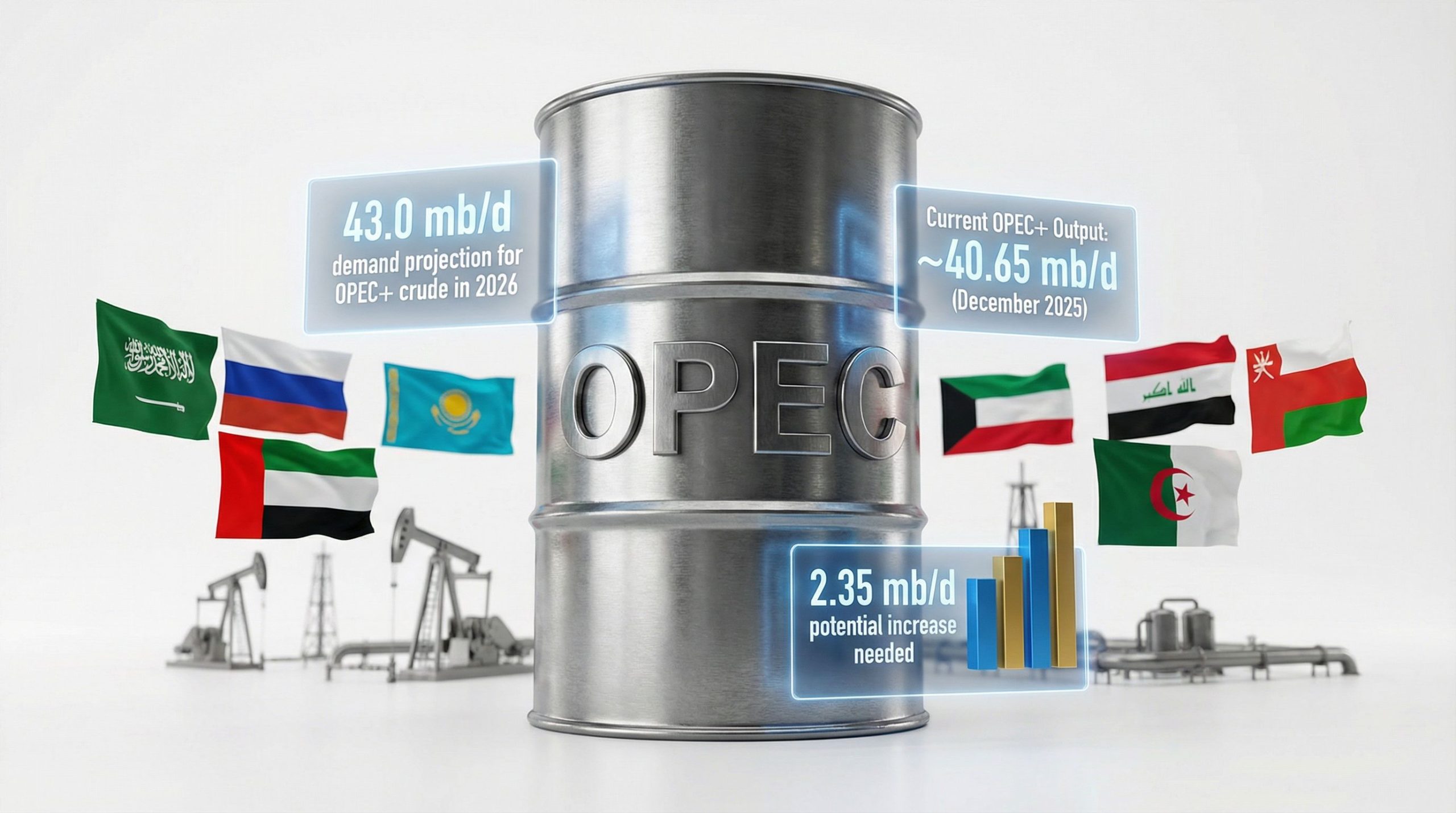
VIENNA/RIYADH/LONDON — In a high-stakes compromise designed to calm an increasingly volatile global crude market, the Organization of the Petroleum Exporting Countries and its allies, collectively known as OPEC+, have officially decided to keep their December oil output targets steady. The unanimous decision, hammered out during closed-door ministerial sessions and verified by senior cartel insiders, offers a temporary reprieve to energy traders grappling with macroeconomic uncertainty. Yet, beneath the veneer of policy continuity lies a sobering reality: the cartel is merely kicking the structural can down the road, buying time before facing an existential reckoning over production quotas, baseline adjustments, and structural market imbalances heading into 2027.
For institutional investors, corporate treasurers, and downstream industrial operators, this decision carries profound implications for enterprise risk mitigation, capital allocation strategies, and global valuation multiples. As energy input costs remain a primary determinant of corporate operating margins and inflation trajectories, the delicate balancing act executed by Saudi Arabia and Russia underscores the precarious nature of contemporary petro-diplomacy. This investigative report breaks down the mechanics of the December agreement, analyzes the underlying structural pressures driving the 2027 showdown, and provides a granular assessment of market liquidity and sector-wide winners and losers.
Executive Takeaways
Test Our Free AI & Tech Utilities Suite
Calculate LLM API token costs, analyze article dwell-time, or simulate tech DCA returns.
- Near-Term Output Freeze: OPEC+ has formally agreed to maintain its current production quotas through December, defying bearish projections and signaling a unified front against speculative short-selling.
- The 2027 Horizon: The postponement of deeper baseline structural reviews sets the stage for a contentious policy collision by 2027, driven by rising non-OPEC supply and slowing secular demand growth.
- Capital Allocation & Valuation Impacts: Energy majors must recalibrate their long-term capital expenditure cycles, balancing shareholder returns against shifting regulatory compliance and infrastructure scalability demands.
- Market Liquidity Dynamics: Brent and WTI futures curves remain range-bound, though algorithmic traders and macro hedge funds are actively pricing in long-tail volatility risks associated with future quota compliance.
The Anatomy of the December Decision: Calibrating Supply Against Macro Headwinds

The path to maintaining December output targets was paved with intense diplomatic friction. Over the preceding weeks, technical committees evaluated conflicting economic indicators: persistent manufacturing slowdowns across the Eurozone and China contrasted with resilient consumer demand in the United States. Furthermore, non-OPEC+ production—led by relentless shale output growth in the Permian Basin, alongside surging production from Guyana, Brazil, and Canada—has continued to chip away at the cartel’s historical market share.
Faced with these competing forces, the leadership in Riyadh and Moscow opted for market stabilization over aggressive price targeting. By keeping the spigots steady, OPEC+ aims to prevent an inventory glut during the seasonally softer end-of-year demand window while avoiding the panic that could ensue from a premature unwinding of voluntary production cuts. However, this strategy requires flawless internal discipline. Historical precedent demonstrates that quota compliance among member states often frays when prices drift toward the lower end of fiscal break-even thresholds required to balance national budgets.
Financial markets have responded with cautious ambivalence. While the avoidance of an unexpected supply surge averted an immediate downward re-pricing of crude, sophisticated market participants recognize that the status quo is fundamentally unsustainable over a multi-year horizon. Energy equity valuations continue to reflect a risk discount, as institutional asset managers demand higher free cash flow yields to compensate for medium-term regulatory and geopolitical uncertainty.
Verified Data & Metrics Breakdown
To contextualize the scale of the current agreement and the magnitude of the upcoming 2027 policy transition, the following comparative data matrix outlines key production metrics, compliance benchmarks, and macroeconomic variables:
| Metric / Indicator | Current Baseline (2024-2025) | Projected Outlook (2027 Horizon) | Strategic Implications |
|---|---|---|---|
| OPEC+ Total Cut Volume | ~5.86 Million barrels per day (mbpd) | Subject to phased unwinding / reset | Direct impact on global inventory balances and spot market liquidity. |
| Non-OPEC Supply Growth | ~1.5 mbpd annual growth | Sustained growth via Americas & offshore | Dilutes cartel market share and intensifies pricing pressure. |
| Global Demand Growth Rate | ~1.0 to 1.2 mbpd per year | Plateauing velocity due to EV adoption | Forces structural adjustments in long-term capital expenditure. |
| Fiscal Break-Even (Key Producers) | $75 - $85 / barrel (Brent equivalent) | Varies by domestic economic diversification | Dictates national budgetary resilience and production appetite. |
The 2027 Challenge: Why the Next Policy Cliff Looms Large
While holding December targets steady provides short-term market tranquility, the structural architecture of OPEC+ is hurtling toward a major stress test by 2027. Several converging factors explain why industry veterans view the upcoming multi-year transition as a historic inflection point:
- Baseline Disputes and Member Capacity: Several African and Middle Eastern member states have consistently contested their assigned production baselines, arguing that their actual capacity exceeds current allowances. As investments in enhanced oil recovery (EOR) and field development mature, domestic pressure to monetize reserves will intensify, threatening internal cartel cohesion.
- The Secular Peak Demand Debate: Long-term forecasters, including the International Energy Agency (IEA) and internal OPEC research desks, are modeling the deceleration of transportation fuel demand growth. The aggressive deployment of electric vehicle (EV) infrastructure, commercial fleet electrification, and efficiency mandates across OECD economies mean that volume expansion is shifting definitively toward petrochemical feedstocks rather than internal combustion engine fuels.
- Capital Expenditure Deficits: Decades of underinvestment in upstream exploration relative to historical norms create a dual-edged sword. On one hand, it prevents catastrophic oversupply; on the other hand, it limits the flexibility of member states to rapidly ramp up production should sudden geopolitical supply shocks materialize.
Industry & Market Implications: Winners and Losers
In the complex ecosystem of global energy markets, policy decisions by OPEC+ generate immediate ripple effects across corporate balance sheets, supply chains, and investment portfolios.
The Winners
Low-Cost Upstream Producers: National oil companies with ultra-low extraction costs—most notably Saudi Aramco and key Middle Eastern peers—retain maximum optionality, successfully defending revenue floors while maintaining robust balance sheets.
Non-OPEC Independent Operators: Permian Basin shale producers, offshore Brazilian operators, and Atlantic basin explorers benefit from predictable price bands without being encumbered by self-imposed production caps, allowing them to optimize enterprise ROI and reward shareholders.
The Losers
Energy-Intensive Manufacturing Sectors: Chemical producers, heavy industrials, and global logistics enterprises face persistent input cost volatility. While a price collapse is averted, the lack of downward price discovery prevents margin relief.
Fiscal-Dependent Emerging Market Importers: Developing nations that rely heavily on imported petroleum face continued pressures on foreign exchange reserves and current account balances, complicating domestic monetary policy compliance and inflation targeting.
Frequently Asked Questions (People Also Ask)
Why did OPEC+ decide to keep December oil output targets steady?
OPEC+ maintained its December production targets to stabilize global crude prices amidst fluctuating macroeconomic indicators, softening industrial demand in key regions, and rising non-OPEC supply. By keeping output steady, the cartel aims to prevent seasonal inventory accumulation while avoiding abrupt price shocks that could destabilize financial markets.
What makes the 2027 policy outlook so challenging for the cartel?
The 2027 horizon represents a complex policy junction driven by disputed production baselines among member states, mounting pressure to monetize upgraded extraction capacities, and the secular deceleration of transport fuel demand growth due to EV adoption and efficiency gains. Reconciling these competing internal and external pressures will require a major overhaul of output allocation frameworks.
How do production quotas impact global market liquidity and energy trading?
Quotas directly dictate physical crude availability, which in turn influences futures curve backwardation or contango. Strict adherence to production caps compresses available spot supply, prompting algorithmic traders and macro hedge funds to reprice volatility risk and adjust positions across Brent and WTI derivative contracts.
What are the implications of this decision for corporate capital allocation?
For energy corporations, steady output targets reinforce the need for disciplined capital allocation. Rather than funding aggressive, high-risk exploration campaigns, management teams are prioritizing balance sheet de-leveraging, technological infrastructure scalability, and sustainable dividend distributions to satisfy institutional valuation multiples.
Future Outlook: Milestones and Strategic Watchpoints
As the market digests the implications of the December output freeze, executive leadership teams and market analysts must monitor several critical forward-looking milestones over the next 24 to 36 months:
- Quarterly Ministerial Compliance Audits: Tracking actual production figures against official quotas will provide immediate insight into internal cartel discipline, particularly regarding historically over-producing members.
- Non-OPEC Supply Velocity: Continuous assessment of rig counts, completion data, and capital expenditure disclosures from North American shale operators and offshore mega-projects in South America and West Africa.
- Global Macroeconomic & Monetary Shifts: Evaluating central bank rate trajectories in the US, Eurozone, and emerging markets, as monetary policy easing or tightening directly dictates industrial energy consumption patterns.
- Pre-2027 Framework Negotiations: Monitoring official communiqués from Vienna regarding technical committees tasked with redesigning production baselines and long-term quota distribution formulas ahead of the 2027 transition.
Ultimately, while the December output stability offers a temporary anchor for a restless market, it serves primarily as a tactical pause in a much larger strategic war. The structural realities of shifting energy demand, technological disruption, and internal quota friction mean that the ultimate test for OPEC+ leadership is not simply managing the next month—but surviving the impending 2027 reality check.