For two decades, the narrative surrounding Palantir Technologies was defined almost exclusively by its deep, symbiotic entanglement with the U.S. intelligence community and defense apparatus. From hunting high-value targets in shadowy geopolitical theaters to powering predictive policing frameworks, the Denver-headquartered data analytics titan was built as the digital backbone of national security. That paradigm has officially fractured.
In a landmark financial inflection point that has sent ripples across Wall Street, Palantir has reported that its U.S. commercial revenue has officially surpassed its government sector earnings for the first time in the company's history. This structural pivot is not merely a statistical anomaly on a quarterly balance sheet; it represents a profound validation of the firm's commercial go-to-market strategy, spearheaded by the explosive adoption of its Artificial Intelligence Platform (AIP). As enterprise software buyers aggressively seek quantifiable enterprise ROI rather than theoretical machine learning promises, Palantir has successfully engineered a metamorphosis from a specialized defense contractor into an indispensable commercial software conglomerate.
Executive Takeaways
Test Our Free AI & Tech Utilities Suite
Calculate LLM API token costs, analyze article dwell-time, or simulate tech DCA returns.
- The Commercial Tipping Point: U.S. commercial revenue outpaced government contracts for the first time, driven by unprecedented domestic enterprise adoption.
- The AIP Catalyst: Palantir’s Artificial Intelligence Platform (AIP) bootcamp strategy compressed sales cycles and dramatically accelerated customer conversion rates.
- Valuation Multiples & Capital Allocation: The revenue mix shift is forcing institutional analysts to reevaluate Palantir’s valuation multiples, aligning it closer to high-growth SaaS peers than traditional defense primes.
- Market Re-rating: Enterprise buyers are increasingly prioritizing robust infrastructure scalability and strict data governance over legacy business intelligence tools.
The Catalytic Shift: Decoding the Numbers
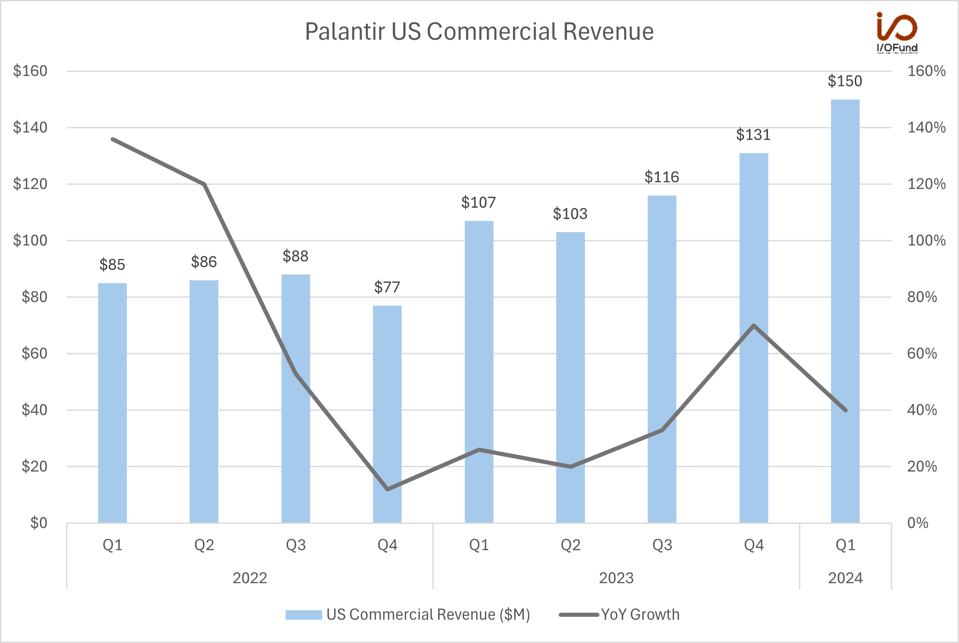
To understand the gravity of Palantir’s recent financial disclosure, one must examine the historical architecture of the firm’s revenue streams. Founded in 2003 by Alex Karp, Peter Thiel, Stephen Cohen, Joe Lonsdale, and Nathan Gettings, Palantir spent its formative years operating in relative obscurity, funded initially by In-Q-Tel—the venture capital arm of the Central Intelligence Agency. For years, the company’s Gotham platform, designed for defense and intelligence analysts, generated the lion's share of cash flow. Even after the launch of Foundry—its commercial data integration layer—growth in the private sector was notoriously sluggish, plagued by high-touch, expensive deployment models and long enterprise sales cycles.
That friction evaporated with the launch of AIP. By introducing "bootcamps" rather than passive software demonstrations, Palantir allowed prospective enterprise clients to build operational workflows on their own proprietary data within days, sometimes hours. This aggressive go-to-market pivot compressed capital allocation timelines for Chief Information Officers (CIOs) and Chief Technology Officers (CTOs) looking to operationalize Large Language Models (LLMs) securely behind corporate firewalls.
The resulting financial velocity has been staggering. Domestic commercial customer count has scaled exponentially, pushing U.S. commercial revenue past the federal government threshold. This milestone is particularly striking given that federal spending includes multi-million dollar, sticky defense contracts with agencies such as the Department of Defense (DoD), Immigration and Customs Enforcement (ICE), and the intelligence apparatus. That the private sector has outstripped these monolithic defense budgets signals a seismic shift in corporate software spending priorities.
Verified Data & Metrics Breakdown
| Metric Category | Historical Baseline | Current Performance | Strategic Significance |
|---|---|---|---|
| U.S. Commercial Revenue Share | Minority contributor (< 40%) | Outpaces U.S. Government segment | Validates enterprise pivot and reduces federal budget dependency. |
| Customer Acquisition Velocity | Slow, high-friction custom deployments | Rapid conversion via AIP Bootcamps | Lowers customer acquisition costs (CAC) and accelerates cash flow generation. |
| Enterprise Net Dollar Retention | Moderate expansion rates | Expanding cohort spend | Demonstrates high stickiness and deep workflow integration. |
| Market Liquidity & Valuation | Defense-tech multiple discount | SaaS-premium re-rating | Attracts institutional capital and index inclusion inflows. |
Industry & Market Implications: Who Wins, Who Loses
The broader economic impact of Palantir’s commercial supremacy extends far beyond its own balance sheet, sending shockwaves through the enterprise software ecosystem.
The Winners
Enterprise End-Users: Fortune 500 companies operating in heavily regulated sectors—such as healthcare, financial services, manufacturing, and logistics—are the primary beneficiaries. Palantir’s ability to guarantee regulatory compliance, robust data governance, and secure cloud compute architecture allows legacy enterprises to deploy cutting-edge generative AI without compromising proprietary intellectual property or falling foul of data privacy mandates.
Cloud Infrastructure Providers: Hyperscalers such as Amazon Web Services (AWS), Microsoft Azure, and Google Cloud Platform (GCP) stand to capture downstream infrastructure scalability revenue. As Palantir deploys its ontology layer across massive enterprise datasets, underlying cloud consumption surges.
The Losers
Legacy Business Intelligence & CRM Giants: Traditional enterprise software vendors that offer siloed reporting tools and disjointed analytics dashboards are facing an existential threat. Palantir’s ontology-driven approach bridges the gap between raw data storage and operational execution, rendering legacy reporting tools obsolete for executives demanding real-time operational decision-making.
Skeptic Institutional Shorts: Wall Street short-sellers who long categorized Palantir as an overvalued consulting firm masquerading as a product company have been forced to capitulate. The commercial revenue inflection proves that the company possesses genuine product-led growth mechanics.
Frequently Asked Questions (People Also Ask)
Why is Palantir’s U.S. commercial revenue surpassing government revenue such a big deal?
Historically, Palantir was viewed as a defense contractor dependent on government budgets, which limited its valuation multiple among institutional investors. By proving that its commercial software (Foundry and AIP) can outpace its federal business in the domestic market, Palantir has validated its transition into a mainstream enterprise software titan, unlocking higher SaaS-like valuation multiples and diversifying its revenue streams against geopolitical budgetary risks.
What role has AIP (Artificial Intelligence Platform) played in this growth?
The Artificial Intelligence Platform has been the primary catalyst for Palantir's commercial acceleration. By introducing immersive "bootcamps" that allow prospective enterprise clients to build functional AI applications on their own data within days, Palantir drastically shortened its sales cycles. This hands-on approach converted skeptical Chief Information Officers into paying subscribers at an unprecedented rate.
How does Palantir’s software differ from traditional cloud data warehouses?
While cloud data warehouses store and query structured and unstructured data, Palantir builds an "ontology"—a semantic digital twin of an organization's operations, linking data points to real-world business processes, objects, and decisions. This allows enterprises not just to view analytics, but to execute automated operational workflows and deploy secure generative AI models directly atop their enterprise infrastructure.
What are the risks associated with Palantir’s commercial scaling?
Key risks include intensifying competition from hyperscalers offering native AI orchestration tools, potential macroeconomic tightening that could delay enterprise software budgets, and the continuous need to maintain rigorous regulatory compliance across diverse international and domestic regulatory frameworks.
Future Outlook: Strategic Milestones to Watch
As Palantir consolidates its position as a dominant force in commercial enterprise software, market watchers and institutional analysts will focus on several key operational metrics over the next four to eight quarters. The primary indicator of sustained momentum will be the expansion rate of existing commercial cohorts—specifically, whether net dollar retention continues to accelerate as mature clients deploy AIP across deeper departmental silos.
Furthermore, international commercial expansion represents the next logical frontier. While domestic enterprise adoption has successfully outpaced government contracts, replicating the bootcamp sales velocity across European and Asian markets—where data sovereignty laws and corporate procurement cycles differ significantly—will test the scalability of Palantir’s operational playbook.
Ultimately, Palantir has crossed a psychological and financial Rubicon. By proving that its proprietary ontology and AI orchestration tools can command the private sector just as effectively as the intelligence community, the company has rewritten its corporate destiny. For enterprise tech investors, the message is clear: Palantir is no longer just a weapon of national security; it has become a fundamental operating system for modern commerce.