Executive Takeaways
- A Historic Lift Capacity Milestone: The Indian Space Research Organisation (ISRO) successfully deployed the AST SpaceMobile BlueBird Block-2 satellite via the LVM3-M6 mission from Sriharikota, marking the heaviest commercial payload (exceeding 6,400 kilograms) ever launched from Indian soil.
- Commercial Realignment via NSIL: Executed under NewSpace India Limited (NSIL), the commercial arm of India's Department of Space, the launch establishes India as an indispensable, high-reliability commercial launch partner amid severe global launch manifest bottlenecks.
- Direct-to-Cell Disruption: The deployment accelerates AST SpaceMobile’s commercial timeline to provide space-based cellular broadband directly to unmodified smartphones, unlocking multi-billion-dollar enterprise ROI for global telecom consortiums including AT&T, Verizon, and Vodafone.
- Geopolitical Arbitrage: By securing a non-SpaceX commercial heavy-lift pathway, global satellite operators are mitigating supply-chain concentration risks, exploiting ISRO’s hyper-efficient capital allocation model to lower orbital deployment expenditures per megabit.
The Liftoff at Sriharikota: Breaking Launch Mass Records

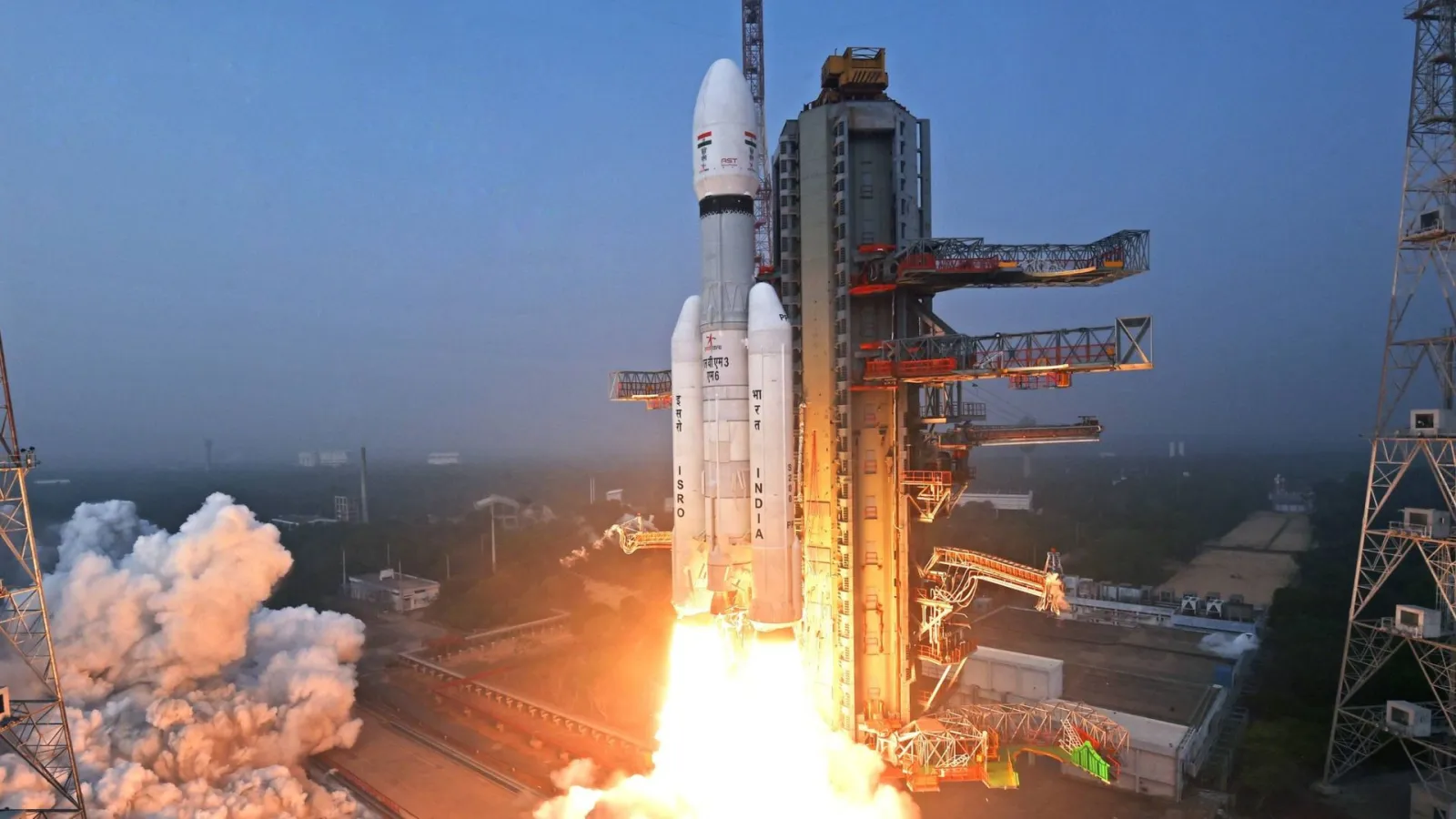
In the predawn hours over the Bay of Bengal, the Indian Space Research Organisation’s (ISRO) Launch Vehicle Mark 3 (LVM3-M6) surged from the Second Launch Pad at the Satish Dhawan Space Centre (SDSC-SHAR), Sriharikota. Encapsulated within the rocket's five-meter-diameter payload fairing was the BlueBird Block-2 satellite—a monstrous next-generation telecommunications spacecraft built by Texas-based AST SpaceMobile. Tipping the scales at roughly 6.4 metric tons, the payload officially shattered the domestic record for the heaviest operational satellite ever injected into orbit from Indian soil.
The mission represents a profound inflection point. Historically, India’s domestic space program was celebrated primarily for cost-effective scientific expeditions—such as the lunar Chandrayaan-3 and Mars Orbiter missions—or mid-mass domestic telecommunications payloads, while its heaviest satellites (such as the GSAT series) were routinely outsourced to Arianespace’s Ariane rockets in French Guiana. The LVM3-M6 deployment reverses this flow of capital and hardware entirely: Western deep-tech capital is now flowing directly into Sriharikota to procure heavy-lift orbital access that Western aerospace incumbents are currently struggling to deliver at scale.
Propelled at liftoff by its twin S200 solid rocket boosters—each packed with 207 tonnes of hydroxyl-terminated polybutadiene (HTPB) propellant—the LVM3 cleared its launch tower with 10,000 kilonewtons of thrust. The core L110 liquid stage, powered by twin high-pressure Vikas engines burning unsymmetrical dimethylhydrazine (UDMH) and nitrogen tetroxide (N2O4), carried the stack through Max-Q. The critical burn fell upon the indigenous C25 cryogenic upper stage, powered by the CE-20 engine consuming liquid hydrogen and liquid oxygen. The CE-20’s flawless, extended-duration burn precisely injected the multi-tonne BlueBird spacecraft into its targeted Low Earth Orbit (LEO) at an inclination engineered to maximize orbital passes over high-density commercial markets.
The Direct-to-Cell Enterprise Race: What Was Aboard LVM3-M6
The strategic core of this mission is not merely the rocketry, but the radical economics of the payload itself. AST SpaceMobile’s BlueBird Block-2 is not an ordinary commercial relay satellite. It features the largest commercial phased-array antenna ever unfurled in Low Earth Orbit—spanning nearly 2,400 square feet when fully deployed. This architecture is designed to bypass the traditional intermediate infrastructure of satellite ground dishes, proprietary terminals, and fixed transceivers, delivering direct-to-device (D2D) 4G and 5G cellular broadband connectivity directly to standard, unmodified commercial smartphones.
For enterprise telecommunications operators who have poured hundreds of billions into terrestrial spectrum licenses, terrestrial infrastructure scalability has hit geographic and economic ceilings. Dead zones persist across maritime channels, rural agricultural corridors, military operational zones, and disaster-prone hinterlands. BlueBird Block-2 functions essentially as a cell tower in the sky, capable of supporting voice, full-speed data streaming, and critical internet-of-things (IoT) applications at processing bandwidths reaching up to 120 Mbps per beam cell.
The deployment allows AST SpaceMobile to accelerate regulatory compliance milestones mandated by the U.S. Federal Communications Commission (FCC) and satisfy commercial service agreements with blue-chip tier-1 mobile network operators. By deploying these massive arrays, enterprise partners can achieve continuous global roaming architecture without committing capital to billions in unamortized ground-based cellular towers.
Global Launch Bottlenecks: ISRO's Commercial Disruption Window
The timing of the LVM3-M6 flight exposes the precarious state of the global commercial space supply chain. The private satellite sector is currently confronting a structural launch deficit that threatens commercial viability across multiple sub-sectors:
- The Falcon Manifest Squeeze: SpaceX’s Falcon 9 infrastructure is operating at near-maximum operational tempo, yet its internal launch manifest is increasingly consumed by the deployment of its own proprietary Starlink mega-constellation, as well as institutional NASA and national security missions. Third-party commercial constellation developers face long lead times and acute scheduling risk.
- Western Fleet Attrition: The retirement of Europe's Ariane 5 left a multi-year gap before Ariane 6 achieved its inaugural flight, and its commercial order book is backlogged through the late 2020s. United Launch Alliance’s (ULA) Vulcan Centaur is heavily committed to the U.S. Space Force and Amazon’s Project Kuiper.
- Geopolitical Exclusion: Russia’s invasion of Ukraine permanently removed the Soyuz rocket—historically a primary workhorse for Western commercial constellations—from the addressable commercial launch market due to sweeping Western sanctions regimes and compliance mandates.
Into this vacuum steps NewSpace India Limited (NSIL). Following structural reforms introduced by the Government of India under the 2020 Space Sector Liberalization policies and the formalized Indian Space Policy 2023, NSIL was empowered to commercially market ISRO’s operational launch vehicles to foreign entities. The dual OneWeb commercial missions conducted in 2022 and 2023 demonstrated the LVM3's reliability for Western mega-constellations. The successful orbital deployment of AST SpaceMobile’s heaviest payload cements the LVM3’s position as a viable alternative for heavy-lift LEO commercial insertion.
Verified Data / Metrics Breakdown: Heavy-Lift Commercial Landscape
| Parameter / Specification | ISRO LVM3-M6 (India) | SpaceX Falcon 9 (USA) | Arianespace Ariane 62 (Europe) |
|---|---|---|---|
| Mission Focus Payload | AST SpaceMobile BlueBird Block-2 (~6,400 kg) | Starlink / Mixed Commercial Constellations | Commercial / Institutional Payloads |
| Max Payload to LEO | ~8,000 kg (Demonstrated continuous envelope) | ~22,800 kg (Expendable) / ~17,500 kg (Reusable) | ~10,350 kg (Ariane 62 configuration) |
| Propulsion Stages | 2x Solid (S200) + Liquid Core (L110) + Cryo (C25) | 2-Stage Liquid (LOX / RP-1 Rocket Propellant) | 2x Solid Boosters (P120C) + Cryo Core + Upper |
| Estimated Cost per LEO Launch | ~$60M – $65M (Commercial contract terms) | ~$67M (List price, non-volume) | ~$75M – $85M |
| Primary Commercial Operator | NewSpace India Limited (NSIL) | SpaceX Direct | Arianespace |
| Reliability Track Record (LVM3) | 100% Mission Success Rate (Operational flights) | >98% Mission Success Rate | Early flight operations / Scaling production |
Industry & Market Implications: Winners, Losers, and Capital Allocation
The ripple effects of this launch extend far beyond the technical cadre at ISRO’s liquid propulsion facilities in Mahendragiri. It recalibrates the strategic risk calculus across equity markets, commercial telecommunications, and defense procurement networks.
The Winners
- AST SpaceMobile (NASDAQ: ASTS): The successful orbital injection mitigates catastrophic program execution risk. By securing early commercial constellation density, ASTS strengthens its valuation multiples, protects its liquidity position, and edges closer to generating recurring free cash flow from its network deployment agreements.
- Indian High-Tech Aerospace Supply Chains: Sovereign contract execution by ISRO directly monetizes India’s domestic aerospace tier-1 supply base. Public-private consortia—anchored by industrial heavyweights like Hindustan Aeronautics Limited (HAL) and Larsen & Toubro (L&T)—are absorbing institutional know-how, laying the bedrock for privatization of LVM3 manufacturing.
- Global Telecom Operators: Enterprise mobile operators gain crucial leverage against SpaceX’s vertically integrated Starlink direct-to-cell ambitions (partnered with T-Mobile). A multi-vendor satellite ecosystem prevents monopoly pricing in space-based backhaul and connectivity services.
The Losers & Pressured Incumbents
- Legacy Geosynchronous Fleet Operators: Traditional satellite telecom operators relying on high-latency Geostationary Orbit (GEO) satellites face accelerated asset write-downs. As low-latency direct-to-device LEO arrays come online, enterprise and consumer reliance on legacy satellite phone terminals (e.g., Iridium, Inmarsat) will face severe customer churn.
- European Small/Medium Launch Startups: Early-stage European launch vehicle developers hoping to capture orbital rideshare spillover face intense price and reliability pressure from India’s battle-tested medium-to-heavy workhorse.
Frequently Asked Questions (People Also Ask)
What makes the LVM3-M6 launch historic for the Indian space program?
The LVM3-M6 mission deployed the BlueBird Block-2 satellite, weighing approximately 6,400 kilograms, making it the heaviest satellite ever launched into orbit from an Indian launch pad. Previously, satellites exceeding 4 to 5 tonnes required ISRO to purchase launch services from overseas launch providers like Arianespace. This mission establishes India's capability to independently manage foreign heavy-lift commercial payloads.
What is AST SpaceMobile’s BlueBird Block-2 satellite designed to do?
BlueBird Block-2 is a commercial telecommunications satellite engineered to provide space-based cellular broadband directly to standard, off-the-shelf smartphones without requiring specialized ground equipment or modified hardware. By deploying a massive phased-array antenna in Low Earth Orbit, it connects directly into commercial cellular bands, bridging rural and remote cellular coverage gaps globally for partner telecom operators.
How does ISRO’s commercial arm, NSIL, compete with SpaceX?
While SpaceX dominates global launch volume through the reusable Falcon 9, the commercial launch market is experiencing a massive capacity deficit. NSIL competes by providing dedicated, reliable launch slots without the risk of commercial prioritization conflicts seen on SpaceX rideshares (where Starlink payloads often take precedence). Furthermore, ISRO's operational cost structures and pristine flight safety record offer significant enterprise risk mitigation for Western constellation operators seeking supply-chain diversification.
Will ISRO be able to increase the launch frequency of the LVM3?
Yes. To expand infrastructure scalability, the Indian government has initiated the transfer of LVM3 production to a domestic industry consortium led by Hindustan Aeronautics Limited (HAL) and Larsen & Toubro (L&T). Privatizing the assembly and supply-chain logistics allows ISRO to shift its internal resources toward deep-space R&D while scaling LVM3 commercial launch cadences to 4–6 missions per year by 2026–2027.
Future Outlook: The Road to Reusability and the Next-Gen Launch Vehicle
While the LVM3-M6 mission cements India’s heavy-lift credentials today, ISRO’s strategic horizon is fixed on maintaining long-term unit-economics competitiveness. The existing expendable architecture of the LVM3 limits its ultimate cost-per-kilogram reduction potential. To counter this, the Indian Department of Space is concurrently executing two strategic roadmaps.
First, ISRO is finalizing the integration of the semi-cryogenic SCE-200 engine, designed to replace the twin Vikas liquid-propellant engines in the L110 core stage. The kerosene-and-LOX-powered SCE-200 will augment the LVM3's payload capacity to LEO from its current ceiling up to roughly 10 metric tons, expanding its addressable commercial payload market to even heavier institutional and commercial assets.
Second, active capital allocation has begun for the Next-Gen Launch Vehicle (NGLV), internally codenamed "Soorya." The NGLV is envisioned as a three-stage, cost-optimized, partially reusable launch vehicle utilizing methane-LOX staged-combustion propulsion, designed to drive LEO launch costs down toward $1,500 to $2,000 per kilogram. With an anticipated payload capacity of 30 metric tons to LEO in expendable configuration and 20 metric tons in reusable mode, NGLV represents India’s long-term answer to the megaconstellation era.
For institutional investors and enterprise infrastructure leaders, the takeaway from Sriharikota is unmistakable: India’s space industry has decisively shifted from a frugality-driven domestic research entity into an agile commercial heavyweight capable of capturing market liquidity and shifting the axis of the high-stakes commercial space race.