Executive Takeaways
- Capital Allocation & Scale: Applied Materials’ landmark $5 billion commitment anchors SEMICON India 2026, signaling a structural pivot in global semiconductor supply-chain diversification.
- Geopolitical Risk Mitigation: India's state-backed financial incentives and streamlined regulatory compliance are rapidly transforming the subcontinent into a viable alternative to East Asian fabrication hubs.
- <Infrastructure Scalability: The influx of Tier-1 equipment makers forces rapid ecosystem development, testing enterprise ROI, logistics networks, and specialized talent pipelines.
- Market Valuation Impact: Domestic and international equipment suppliers face re-rated valuation multiples as India transitions from a design outpost to a manufacturing powerhouse.
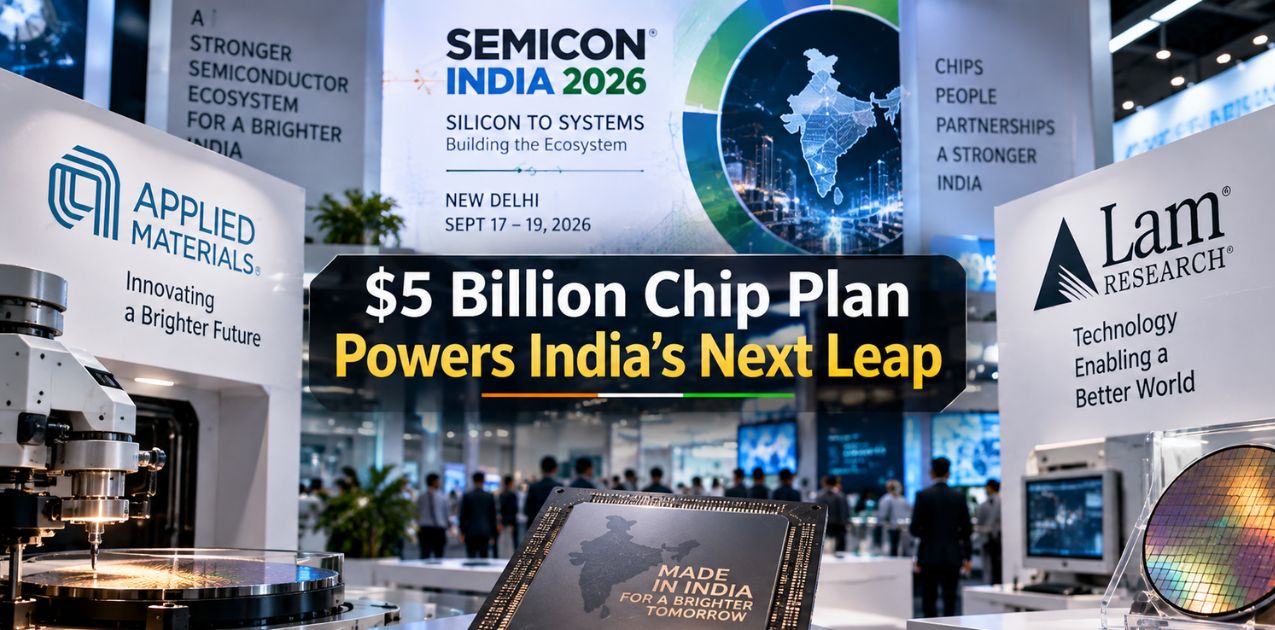
NEW DELHI — The geopolitical architecture of the global semiconductor supply chain shifted perceptibly on a brisk Thursday morning as SEMICON India 2026 officially commenced. Anchored by a staggering $5 billion capital commitment from Silicon Valley equipment titan Applied Materials, the conference floor transformed from a regional trade showcase into the epicenter of a multi-billion-dollar race to secure the world's most critical manufacturing node.
Drawing on exclusive reporting from Open Magazine wire contexts and deep-dive industry intelligence, this investigation explores the mechanics behind Applied Materials’ massive deployment. We examine how New Delhi’s aggressive fiscal policies, combined with corporate imperatives for risk mitigation, are re-engineering capital expenditure across the technology sector.
The Catalyst: Applied Materials’ $5-Billion Blueprint
For years, institutional investors and enterprise strategists viewed India's semiconductor ambitions through a skeptical lens, citing historical friction around regulatory compliance, bureaucratic inertia, and a deficit in domestic infrastructure scalability. However, Applied Materials' announcement at SEMICON India 2026 recalibrates these risk assessments.
The $5 billion initiative is not merely a localized sales pitch; it represents a comprehensive blueprint designed to build advanced engineering centers, collaborate on collaborative research and development (R&D) initiatives, and establish robust domestic packaging and deposition equipment ecosystems. By integrating local academic institutions with global engineering standards, Applied Materials is engineering a self-sustaining talent pipeline that addresses the industry's chronic shortage of specialized nanotech personnel.
Macroeconomic Drivers and Supply-Chain Resilience
The timing of SEMICON India 2026 underscores a broader macroeconomic reality: enterprise risk mitigation has superseded pure cost-optimization. With continuous geopolitical friction in traditional manufacturing corridors, boardroom discussions across major fabless design houses and foundries now center on geographic diversification.
India’s Production Linked Incentive (PLI) schemes and state-level semiconductor policies have radically altered corporate calculus. By offering subsidized capital expenditures and tax holidays, the Indian government has effectively lowered the threshold for market entry. This proactive regulatory stance ensures that liquidity flows freely into greenfield fabrication and Outsourced Semiconductor Assembly and Test (OSAT) facilities.
Comparative Metrics: India’s Semiconductor Evolution
| Metric / Parameter | 2022 Baseline | SEMICON India 2026 Outlook | Strategic Implication |
|---|---|---|---|
| Committed FDI & CapEx | ~$10 Billion | $25+ Billion (Led by Applied Materials) | Accelerated infrastructure scalability |
| Ecosystem Focus | Design & EDA Outposts | Full Fab, OSAT, and Equipment R&D | Vertical integration across the supply chain |
| Government Subsidy Support | Initial PLI Drafts | Disbursed, Streamlined Incentives | Minimized initial capital expenditure drag |
| Talent Pool Pipeline | ~20,000 Engineers | Targeting 85,000+ Specialized Personnel | Mitigation of operational wage inflation |
Industry Implications: Winners, Losers, and Market Realignment
The entry of Applied Materials with a $5 billion war chest triggers a domino effect across global financial and industrial markets. Dissecting the competitive landscape reveals distinct structural winners and losers:
- Winners — Equipment & Materials Vendors: Global tool manufacturers that align with India’s localized supply-chain mandates are capturing high-margin service and installation contracts. Their forward-looking valuation multiples are experiencing upward revisions.
- Winners — Domestic Engineering Talent: Specialized semiconductor engineers, material scientists, and cloud compute architecture experts in India are witnessing record compensation growth and unprecedented career mobility.
- Losers — Legacy Regional Hubs Lacking Incentives: Established manufacturing locations that fail to offer competitive tax structures or struggle with bureaucratic friction risk losing prospective greenfield investments to India's aggressive fiscal packages.
- Losers — Under-Capitalized Competitors: Smaller component suppliers lacking the balance-sheet liquidity to scale operations rapidly in emerging ecosystems risk being squeezed out by tier-one consolidation.
Frequently Asked Questions (People Also Ask)
What is the core objective of Applied Materials’ $5 billion commitment at SEMICON India 2026?
Applied Materials' $5 billion investment is targeted at building advanced collaborative engineering centers, scaling domestic semiconductor equipment manufacturing, and establishing robust supply-chain infrastructure. The initiative aims to support India’s burgeoning semiconductor ecosystem by fostering local talent and providing cutting-edge deposition and etching tools essential for modern chip production.
How do India’s semiconductor policies impact enterprise ROI for global chipmakers?
India’s Production Linked Incentive (PLI) schemes and financial subsidies significantly reduce initial capital expenditure burdens for global chipmakers. By absorbing a substantial portion of facility setup costs, these policies accelerate enterprise ROI, mitigate geopolitical supply-chain risks, and shorten the payback period for multi-billion-dollar fabrication projects.
What infrastructure challenges remain for India as a semiconductor manufacturing hub?
While fiscal incentives and capital investments are robust, India continues to navigate challenges related to uninterrupted ultra-pure water supplies, stable high-voltage power grids, and specialized logistics for hazardous chemical transport. Continued state and federal collaboration is required to ensure seamless infrastructure scalability.
How does SEMICON India 2026 alter global valuation multiples for tech suppliers?
The successful launch of high-capital projects at the conference validates India’s long-term market liquidity and manufacturing viability. Consequently, equipment suppliers and design firms positioned to capture market share in the region are seeing positive revisions in their valuation multiples from institutional investors.
Future Outlook: Milestones and Strategic Horizons
As the curtains close on the inaugural sessions of SEMICON India 2026, the litmus test for the subcontinent's semiconductor ambitions shifts from executive announcements to operational execution. Over the next 18 to 36 quarters, market watchers and institutional analysts will monitor several critical milestones:
- Groundbreaking and Facility Construction: The physical ground-breaking and tool-in dates for Applied Materials' engineering and R&D facilities.
- Supply-Chain Localization Ratios: The percentage of raw materials and sub-components sourced locally versus imported from traditional East Asian suppliers.
- Talent Deployment Metrics: The rate at which domestic engineering universities produce industry-ready graduates capable of managing sub-nanometer node machinery.
- Regulatory Adaptability: Continued government adherence to transparent, frictionless regulatory compliance and expedited customs clearance for sensitive semiconductor machinery.
Ultimately, Applied Materials’ $5 billion investment at SEMICON India 2026 marks the definitive crossing of the Rubicon. India is no longer an ancillary market in the global technology discourse; it has cemented its position as a central pillar in the future architecture of global semiconductor manufacturing.