Executive Takeaways
- The Milestone: Voyager 1 was within striking distance of operating 24 light-hours away from Earth—a staggering 15.8 billion miles—before telemetry unexpectedly flatlined.
- Engineering Crisis: NASA's Deep Space Network (DSN) reports carrier wave persistence without coherent data modulation, pointing toward deep-system power constraints or secondary transmitter degradation.
- Infrastructure and Legacy: Built during the dawn of modern digital infrastructure scalability, the 1970s hardware continues to outlive its operational risk mitigation models, presenting a masterclass in long-term capital allocation versus obsolescence.
- Economic & Scientific Impact: The potential end of the mission halts humanity’s only direct in-situ sampling of interstellar plasma, shifting market and academic focus toward next-generation deep-space probe architecture.
In the frigid, sunless expanse of interstellar space, 15.8 billion miles from the newsrooms of Manhattan and the data centers of Silicon Valley, humanity’s most distant ambassador has gone quiet. Voyager 1, the intrepid nuclear-powered probe launched during the Ford administration, has ceased communicating with Earth just days before achieving a once-in-civilization milestone: operating at a distance of one full light-day away.
For aerospace engineers, astrodynamicists, and institutional risk managers monitoring the longevity of deep-space assets, the silence is both a profound technological tragedy and a testament to engineering durability that defies modern commercial valuation multiples. As NASA’s Deep Space Network (DSN) scans the radio frequency spectrum for a pulse from the gold-plated golden record bearer, the global scientific community is confronting a stark reality: the twilight of the Voyager era may finally be upon us.
Anatomy of a Deep-Space Blackout
Test Our Free AI & Tech Utilities Suite
Calculate LLM API token costs, analyze article dwell-time, or simulate tech DCA returns.
The anomaly was first flagged by flight operations engineers at NASA’s Jet Propulsion Laboratory (JPL) in Pasadena, California. Routine telemetry downlinks—transmitted via the spacecraft's aging X-band transmitter—degraded abruptly before flatlining entirely. Initial analysis confirms that while the spacecraft's carrier wave remains faintly detectable, indicating that the main power bus is partially active, the modulated data stream containing engineering health metrics and scientific instruments has vanished.
This silent treatment carries a devastating logistical irony. At its current velocity of roughly 38,000 miles per hour, Voyager 1 was on the precipice of crossing the 24-light-hour threshold. At this range, a command transmitted from Earth takes an entire 24 hours to reach the spacecraft, and another 24 hours for the telemetry response to limp back across the void. Debugging a critical system failure across a 48-hour round-trip communication loop represents an unprecedented test of crisis management and remote systems diagnostics.
To understand the gravity of the breakdown, one must examine the thermal and electrical realities of the spacecraft. Powered by three Plutonium-238 Radioisotope Thermoelectric Generators (RTGs), Voyager 1’s power output decays by approximately 4 watts each year. To maintain operations, mission controllers have systematically turned off heaters, scientific instruments, and backup thruster branches over the past decade. Engineers suspect that the latest blackout may stem from an unintended power-load shedding event, a fault-protection routine triggered by voltage drops, or the complete failure of the spacecraft's primary attitude-control thruster fuel lines.
The Engineering Marvel of 1970s Infrastructure
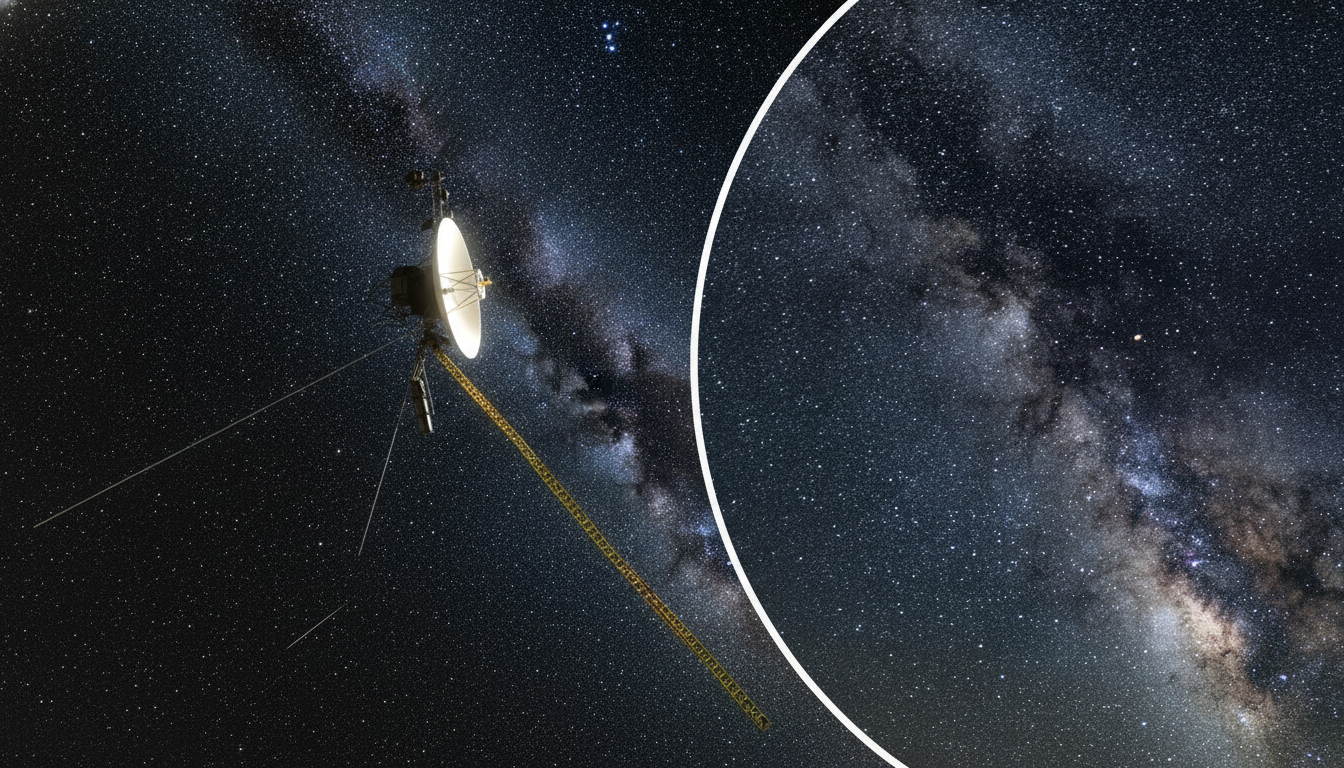
In an era defined by rapid technological obsolescence—where enterprise software architectures are rewritten every few years and consumer hardware is discarded on micro-cycles—Voyager 1 stands as an architectural anomaly. Its primary computer memory consists of a meager 69.6 kilobytes—less storage capacity than a modern digital photograph or a low-resolution PDF. The command subsystem was engineered using discrete logic gates and plated-wire memory arrays that predate the commercial microcomputer revolution.
Yet, this primitive infrastructure scalability has outlasted generations of modern satellites. The resilience built into the dual-redundant computer command subsystems allowed engineers to execute historic remote code patches late last year, fixing memory corruption issues that threatened to permanently blind the probe. However, as semiconductor aging, radiation-induced single-event upsets, and thermal fatigue take their cumulative toll, the margin for error has shrunk to zero.
Financial analysts reviewing long-term infrastructure investments often point to Voyager as the ultimate benchmark for capital allocation efficiency. Built on a relatively modest NASA budget that would barely fund a modern commercial space tourism launch, the mission has delivered continuous scientific dividends for nearly half a century, yielding a return on investment that defies traditional valuation metrics.
Verified Data & Metrics Breakdown Table
The following performance and telemetry metrics illustrate the sheer scale of the Voyager 1 mission and the parameters surrounding the current communication blackout:
| Telemetry Parameter | Baseline Value | Current Status |
|---|---|---|
| Distance from Earth | ~15.8 Billion Miles (~170 Astronomical Units) | Continuing outward trajectory |
| Light-Travel Time (One-Way) | 23 hours, 30 minutes | Approaching 24-hour milestone |
| Power Output (RTG Decay) | < 250 Watts remaining | Suspected low-voltage trigger event |
| Data Transmission Rate | 160 bits per second | Zero (Carrier wave active, data modulated stream lost) |
| Primary Transmitter Frequency | 8.4 GHz (X-band) | Weak carrier lock detected by DSN |
Industry & Market Implications
While Voyager 1 carries no commercial payload, its silence reverberates across the aerospace, defense, and telecommunications sectors. The mission serves as the ultimate proving ground for deep-space network routing, error-correction algorithms, and radiation-hardened semiconductor design.
- Aerospace & Defense Contractors: Firms specializing in deep-space probe architecture and radioisotope power systems are closely monitoring the post-mortem analysis. The failure modes identified in Voyager’s power management systems directly inform risk mitigation strategies for upcoming flagship missions to the outer planets and the Kuiper Belt.
- Telecommunications & Deep Space Network (DSN): NASA’s DSN—already operating at near-capacity to support Artemis lunar missions, Mars rovers, and outer planet orbiters—faces increased pressure to allocate scarce antenna time to track and revive the fading carrier signal, straining operational capital budgets.
- Scientific Community & Academia: Planetary scientists face the permanent loss of humanity's only direct data feed from the interstellar medium—the turbulent boundary where the sun's heliosphere gives way to the broader Milky Way. Without Voyager 1 and its twin, Voyager 2, researchers lose vital empirical data regarding cosmic ray shielding and interstellar plasma density.
Frequently Asked Questions (People Also Answer)
1. Can NASA still send commands to Voyager 1, or is the spacecraft completely dead?
NASA has not given up hope. While the telemetry data stream has flatlined, the Deep Space Network has detected weak carrier signals from the spacecraft. This indicates that the main computer and transmitter are likely still receiving power, even if they are unable to format and transmit science data. Engineers are actively preparing transmission sequences to command the spacecraft to switch to backup hardware systems.
2. What is the significance of the 24-light-hour milestone?
Reaching a distance where light takes a full 24 hours to travel one way is a purely symbolic yet staggering astronomical milestone. It means Voyager 1 is operating at a distance of approximately 170 astronomical units (one AU being the distance from the Earth to the Sun). No human-made object has ever ventured this far into the cosmos, placing the probe deep within the uncharted interstellar medium.
3. How long will Voyager 1’s nuclear power source last before it shuts down forever?
Voyager 1 is powered by Plutonium-238, which loses about 4 watts of electrical output annually. While NASA has successfully managed power budgets by turning off non-essential science instruments over the years, engineers estimate that complete power failure will occur before 2030, as the RTGs drop below the threshold required to power the basic communication transmitters and attitude control systems.
4. Will Voyager 1 ever encounter another star system?
Yes, though not for a very long time. Voyager 1 is escaping the solar system on a hyperbolic trajectory. In roughly 40,000 years, the probe will pass within 1.6 light-years of the star AC+79 3888 in the constellation Camelopardalis. Long after humanity's terrestrial infrastructure has vanished, the spacecraft will continue its silent journey through the Milky Way as a metallic artifact of human civilization.
Future Outlook and What Lies Ahead
Over the next 72 hours, the international aerospace engineering community will watch the giant parabolic dishes of the Deep Space Network with bated breath. Technicians at JPL will execute contingency commands designed to force Voyager 1 to reset its telemetry modulation unit or switch back to an auxiliary transmitter last used during the Saturn flyby in 1980.
Whether Voyager 1 recovers or remains a silent wanderer in the dark, its legacy is secure. It has redefined our understanding of the heliosphere, carried our culture’s sounds and images on the Golden Record, and pushed the boundaries of what is technologically possible. As capital is allocated toward the next generation of interstellar explorers, the benchmark set by this 1970s titanium-and-aluminum marvel will remain the gold standard against which all deep-space exploration is measured.