Executive Takeaways
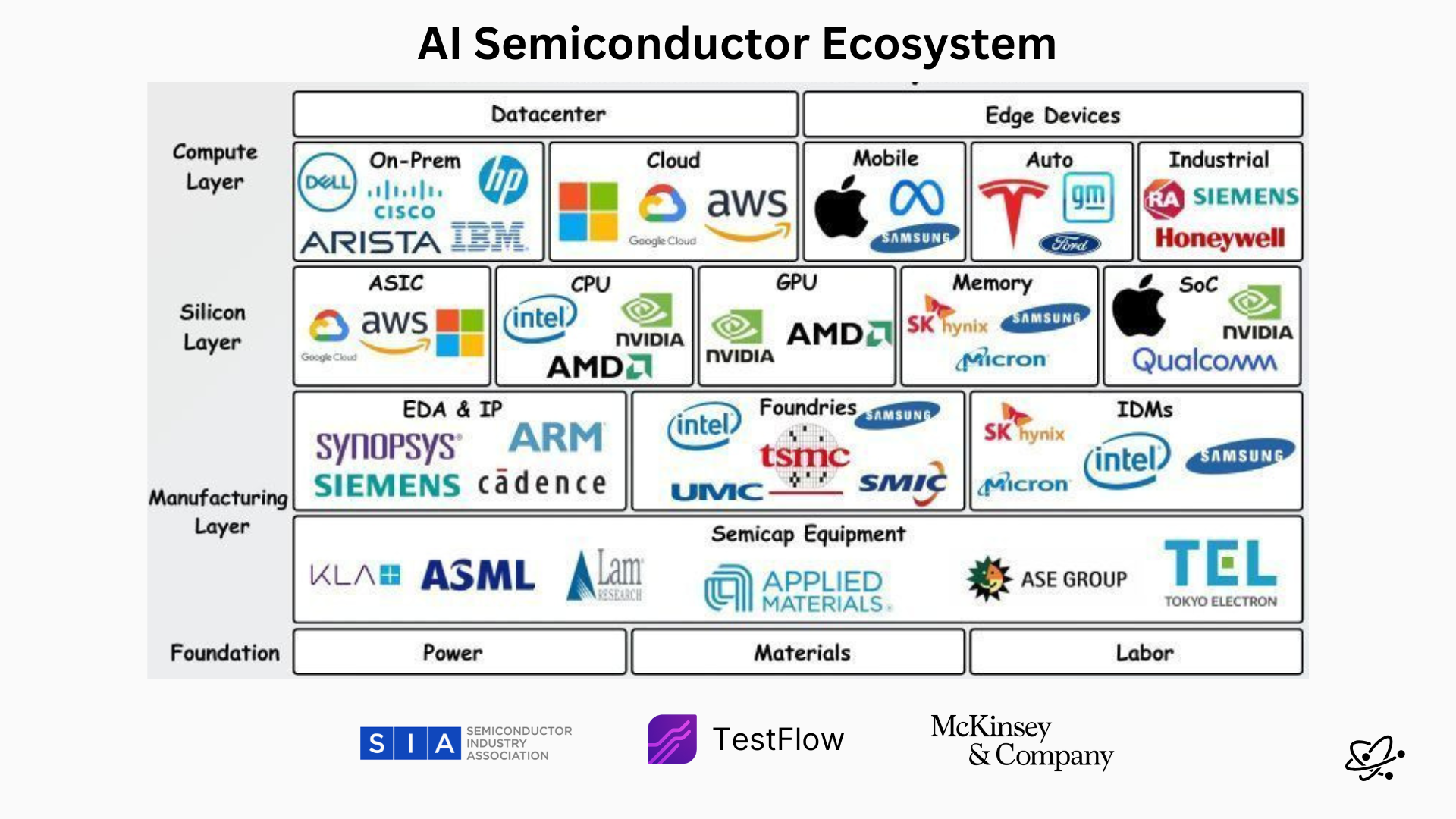
- NVIDIA’s Unprecedented Moat: Despite a sprawling field of over 30 competitors, NVIDIA commands an estimated 70% to 80% market share of the AI hardware ecosystem, anchored not just by silicon, but by the CUDA software lock-in.
- Capital Expenditure Shifts: Hyper-scalers (Microsoft, Alphabet, Amazon, Meta) are aggressively allocating multi-billion-dollar capital expenditures toward custom application-specific integrated circuits (ASICs) to mitigate supplier concentration risk and compress infrastructure costs.
- The Architectural Divergence: The semiconductor industry is splintering into three distinct battlegrounds: General-Purpose Graphics Processing Units (GPGPUs), domain-specific ASICs, and neuromorphic/edge-optimized chips designed for decentralized enterprise deployment.
For the past four decades, the semiconductor industry operated on a predictable, cyclical cadence dictated by Moore's Law and PC-era replacement cycles. Today, that playbook is obsolete. The generative AI gold rush has transformed silicon into the most geostrategically vital commodity on earth. At the epicenter of this tectonic shift stands NVIDIA, a company that anticipated the parallel computing revolution a decade before Wall Street blinked. Yet, as enterprise ROI demands shift from experimental proofs-of-concept to sprawling, production-grade enterprise deployments, a formidable cohort of over 30 challengers is mounting a multi-front assault.
Drawing from recent intelligence from AIMultiple and deep-dive industry reporting, this investigative dossier unpacks the geopolitical, financial, and architectural realities of the global AI chip landscape. We examine how NVIDIA maintains its stratospheric valuation multiples, how hyper-scalers are executing risk mitigation through custom silicon, and which emerging chipmakers are positioned to disrupt the status quo.
The Anatomy of NVIDIA’s Hegemony: Hardware Meets Software Moat
To understand why NVIDIA remains the undisputed titan among AI chip makers, one must look beyond raw floating-point operations per second (FLOPS). While architectures like the Hopper H100 and the newer Blackwell B200 series deliver jaw-dropping performance benchmarks, NVIDIA's true competitive advantage lies in its software architecture: CUDA (Compute Unified Device Architecture).
Introduced in 2006, CUDA allowed developers to program GPUs for general-purpose processing. Over nearly two decades, virtually every foundational machine learning framework—PyTorch, TensorFlow, and JAX—has been optimized natively for CUDA libraries. This creates a formidable barrier to entry. Chief Technology Officers evaluating enterprise infrastructure scalability quickly realize that migrating away from NVIDIA introduces technical debt, migration friction, and unpredictable latency penalties.
However, this concentration of market power has triggered aggressive capital allocation strategies across the technology sector. Cloud service providers (CSPs) and enterprise consumers are acutely aware of the supply chain vulnerabilities and pricing power wielded by a single hardware vendor. Consequently, the pursuit of semiconductor diversification has become board-level priority number one.
The Challenger Landscape: Mapping the 30+ Competitors
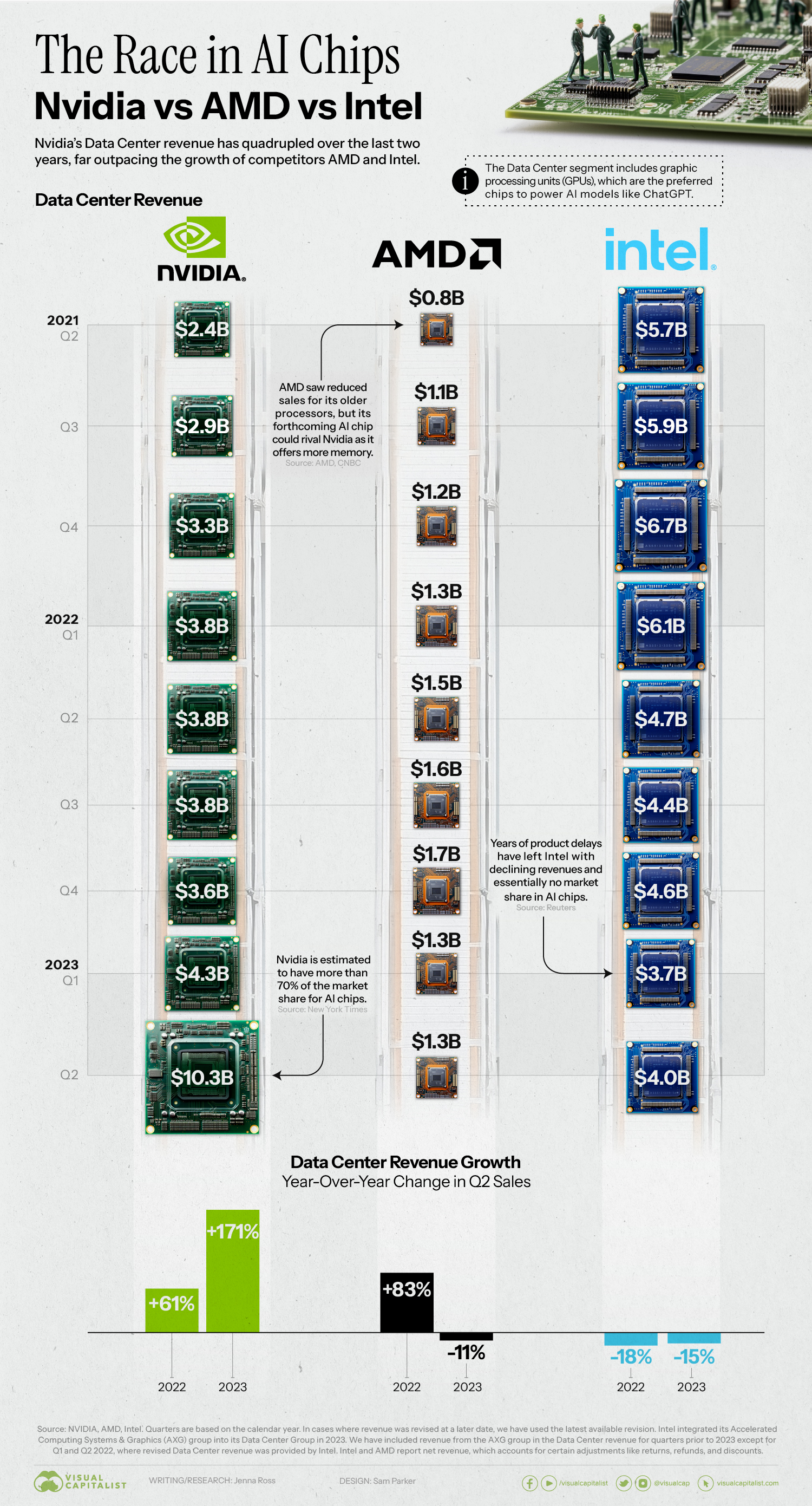
The global race for AI hardware supremacy is divided into three distinct competitive tiers, each targeting specific vulnerabilities in NVIDIA’s armor:
1. The Enterprise Hyperscaler ASICs (Google, Amazon, Meta, Microsoft)
To curb ballooning cloud compute architecture costs, the world's largest technology conglomerates are designing proprietary silicon. Google’s Tensor Processing Unit (TPU)—currently iterating through advanced versions like the TPU v5p—powers internal workloads and is increasingly rented out via Google Cloud Platform to external enterprise clients. Similarly, Amazon Web Services (AWS) champions its Trainium and Inferentia chips, while Meta has rolled out its Meta Training and Inference Accelerator (MTIA). These application-specific integrated circuits (ASICs) offer superior energy efficiency and lower total cost of ownership (TCO) for specific, fixed algorithmic workloads, bypassing the generalized versatility—and high price tag—of NVIDIA GPUs.
2. Traditional Semiconductor Heavyweights (AMD and Intel)
Advanced Micro Devices (AMD) has positioned its MI300 series as the primary merchant-silicon alternative to NVIDIA’s Hopper and Blackwell lines. By combining high-bandwidth memory (HBM3) with aggressive pricing and open-source software initiatives via ROCm, AMD has secured notable design wins with major cloud providers. Intel, meanwhile, is attempting a dual-pronged turnaround: leveraging its Gaudi accelerators (inherited via the Habana Labs acquisition) while simultaneously positioning its foundry services (Intel Foundry) to manufacture chips for fabless AI startups.
3. Venture-Backed Pure-Play Innovators (Groq, Cerebras, Tenstorrent, SambaNova)
A restless wave of venture-backed startups is rewriting the rules of silicon architecture. Groq has discarded the traditional cache-heavy design in favor of a Deterministic Tensor Streaming Processor, drastically reducing inference latency for Large Language Models (LLMs). Cerebras Systems takes a radical monolithic approach, engineering the Wafer-Scale Engine—a chip the size of an entire dinner plate that houses trillions of transistors on a single piece of silicon, eliminating inter-chip communication bottlenecks. Meanwhile, Jim Keller’s Tenstorrent is licensing modular RISC-V processor intellectual property, offering hardware customization that appeals to sovereign nations and enterprises seeking supply chain sovereignty.
Verified Data & Metrics Breakdown: Leading AI Chip Architectures
| Manufacturer / Chip | Architecture Type | Primary Market Focus | Key Competitive Advantage |
|---|---|---|---|
| NVIDIA Blackwell (B200) | GPGPU | Training & Massive Inference | CUDA ecosystem lock-in, unmatched raw compute performance. |
| AMD Instinct MI300X | Accelerated APU/GPU | Enterprise LLM Training | Superior memory bandwidth and aggressive pricing relative to NVIDIA. |
| Google TPU v5p | Custom ASIC | Cloud-Native Workloads | Optimized specifically for TensorFlow/JAX at hyperscale. |
| Groq LPU | Tensor Streaming Processor | Ultra-Low Latency Inference | Deterministic execution model removing on-chip cache bottlenecks. |
| Cerebras WSE-3 | Wafer-Scale Processor | High-Speed Scientific & AI Training | Monolithic die design eliminating inter-chip communication latency. |
Industry & Market Implications: Winners, Losers, and Capital Allocation
The aggressive expansion of the AI chip ecosystem is reshaping financial markets and corporate balance sheets. As chief financial officers scrutinize capital expenditure efficiency, several broader economic dynamics are taking shape:
- The Compression of Gross Margins: While NVIDIA has enjoyed historic gross margins exceeding 75%, increased competition from AMD and custom ASICs will inevitably force pricing pressure, particularly in the high-volume inference market where cost-per-token is king.
- Geopolitical Realignment & Regulatory Compliance: Export controls, semiconductor subsidies (such as the U.S. CHIPS Act and European equivalents), and national sovereignty initiatives are forcing chip makers to regionalize manufacturing footprints. Companies capable of navigating complex regulatory compliance while securing foundry capacity at TSMC, Samsung, or Intel will capture outsized market liquidity.
- The Software Layer Battleground: Hardware without software is inert. The ultimate winners among the 30+ challengers will not be those with the highest transistor count, but those who successfully abstract hardware complexity through open-source compilation stacks that make migration frictionless for enterprise developers.
Frequently Asked Questions (People Also Ask)
Why is NVIDIA so dominant in the AI chip market?
NVIDIA’s dominance is built on a dual foundation of superior hardware engineering and an entrenched software ecosystem. By launching CUDA in 2006, NVIDIA enabled developers to utilize GPUs for parallel computing long before the generative AI boom. Today, virtually all machine learning frameworks are optimized for CUDA, creating a massive software moat that deters enterprise customers from switching to alternative hardware.
What are AI ASICs, and how do they differ from GPUs?
Application-Specific Integrated Circuits (ASICs) are custom chips designed to perform a specific set of computational tasks—in this case, neural network training and inference. Unlike General-Purpose GPUs (GPGPsUs), which can handle a wide variety of parallel workloads, ASICs are custom-built for maximum energy efficiency and lower cost per operation when running specific machine learning models.
Can AMD realistically challenge NVIDIA’s market share?
AMD represents the most credible merchant-silicon alternative to NVIDIA through its Instinct MI300 series. While AMD is successfully securing design wins with major cloud providers by offering competitive memory bandwidth and open-source software (ROCm), closing NVIDIA’s massive software ecosystem advantage will require sustained, multi-year engineering and developer-relations investments.
How are hyper-scalers reducing their reliance on NVIDIA?
Major cloud providers including Google, Amazon, Microsoft, and Meta are aggressively designing and deploying proprietary custom silicon (such as Google TPUs and AWS Trainium). By building internal chips, these enterprises reduce procurement costs, protect themselves against supply chain bottlenecks, and optimize infrastructure specifically for their proprietary workloads.
Future Outlook: Key Milestones to Watch
As the AI hardware arms race enters its next phase, industry observers and institutional investors should monitor three critical inflection points over the next 12 to 24 months:
- The Inference Tipping Point: As enterprise AI transitions from model training to large-scale deployment, watch for market share shifts toward specialized inference chips and ASICs that optimize power consumption and cost-per-query.
- Foundry Consolidation and Packaging Innovation: Advanced packaging technologies—such as Chip-on-Wafer-on-Substrate (CoWoS)—remain a severe manufacturing bottleneck. Breakthroughs in packaging capacity by TSMC, Intel Foundry, and Samsung will dictate how quickly chip makers can fulfill multi-billion-dollar backlogs.
- Open-Source Software Maturation: The velocity at which alternative compilation frameworks (like MLIR, Triton, and AMD’s ROCm) mature will determine whether enterprise buyers can successfully adopt multi-vendor hardware strategies without sacrificing development velocity.