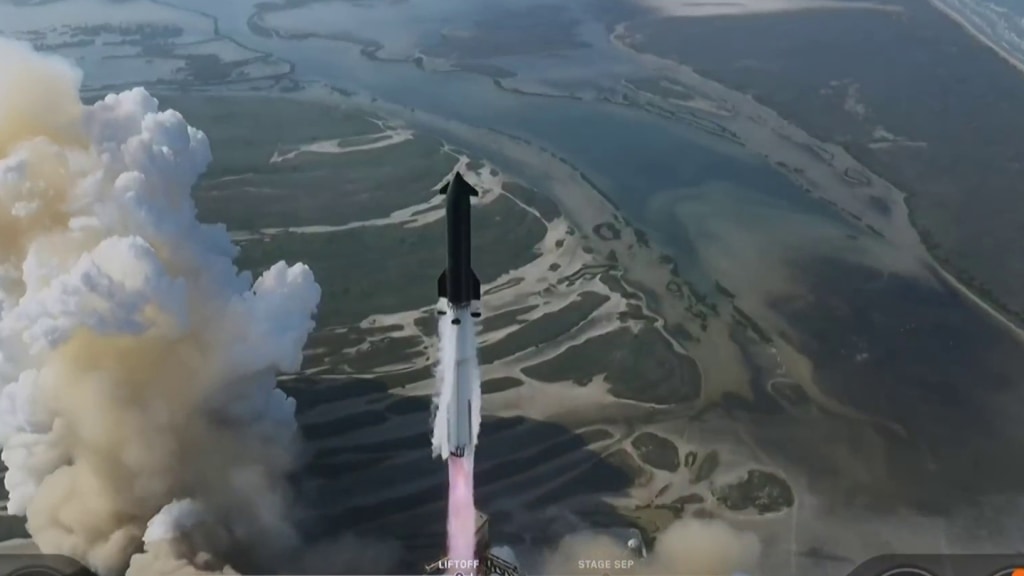
MUSK’S MONSTER ROCKET FLIES: SpaceX Clinches Historic Starship Prototype Launch, Redefining the Space Race and Global Satellite Markets
BOCA CHICA, Texas — In a triumph of engineering and sheer capital force, Elon Musk’s SpaceX has successfully launched its latest heavy-lift Starship prototype, marking a pivotal milestone that could decisively tilt the scales of the multi-trillion-dollar global space economy. The successful flight, first reported by NBC News, represents a critical leap forward not just for deep-space exploration, but for the immediate commercialization of low-Earth orbit (LEO).
As the massive stainless-steel vehicle cleared the launch pad at Starbase in South Texas, the rumble of its Raptor engines signaled a paradigm shift. For Wall Street and international defense sectors, this launch is more than a technical achievement—it is the opening salvo of an era characterized by drastically lowered costs to orbit, threatening to render legacy launch systems obsolete overnight.
The Ascent: How SpaceX Secured Its Most Critical Milestone Yet
The early morning launch of the Starship prototype went off under clear skies, following weeks of rigorous regulatory reviews and static-fire tests. Powered by its advanced liquid oxygen and methane-fueled Raptor engines, the prototype demonstrated flawless thrust vector control as it ascended through Max-Q—the point of maximum aerodynamic pressure—which has historically been a graveyard for experimental aerospace designs.
According to telemetry data released post-launch, the prototype successfully executed its hot-staging separation sequence, a highly complex maneuver where the upper stage ignites its engines while still attached to the booster. The vehicle reached its targeted suborbital trajectory before executing a controlled descent. Unlike previous test flights that ended in spectacular fireballs, this prototype completed its primary flight profile, proving the viability of SpaceX’s iterative "fail-fast, learn-faster" development philosophy.
"This is the holy grail of space flight," Musk remarked in a statement following the successful splashdown. "A fully and rapidly reusable rocket is the difference between being a single-planet species and a multi-planetary one. Today, we proved the foundational physics of that future are sound."
Why It Matters: The Economic and Geopolitical Ripple Effects

The successful launch of the Starship prototype is set to disrupt several high-stakes global sectors, sending ripples through aerospace boards from Seattle to Toulouse. The implications span across national security, commercial telecommunications, and sovereign space programs.
1. Upending the Commercial Satellite Market
Currently, launching commercial payloads is an expensive bottleneck. Starship’s projected capability to carry over 100 metric tons to LEO at a fraction of the cost of traditional expendable rockets will radically alter satellite deployment economics. This launch accelerates the deployment of SpaceX’s own Starlink V2 satellites, designed to deliver high-speed gigabit internet globally, potentially monopolizing the satellite broadband market before competitors like Amazon's Project Kuiper can fully get off the ground.
2. The NASA Artemis Timeline Secure
NASA has bet heavily on Starship, selecting a modified version of the vehicle as the Human Landing System (HLS) for its Artemis III and IV missions, which aim to return astronauts to the lunar surface. Today's successful prototype test alleviates mounting anxieties in Washington over delays in the Artemis timeline, validating NASA’s controversial decision to rely on commercial partners for critical deep-space infrastructure.
3. Geopolitical Dominance in Defense Logistics
The U.S. Department of Defense is watching Starship with intense interest. The Pentagon’s Rocket Cargo program envisions utilizing Starship to transport up to 100 tons of military cargo and humanitarian aid to any point on Earth in under an hour. A reliable Starship prototype establishes a logistical superiority that rivals in Beijing and Moscow currently have no capacity to match.
Executive Summary: Key Takeaways from the Launch
- Successful Flight Profile: The Starship prototype achieved key milestones, including clean hot-staging separation and a controlled trajectory.
- Unmatched Payload Scale: Once fully operational, Starship will carry up to 150 metric tons in fully reusable configuration, dwarf-ing any rocket currently in service.
- Crushing Cost Dynamics: SpaceX aims to bring the cost per launch down to under $10 million, effectively destroying the pricing power of legacy providers like United Launch Alliance (ULA) and Arianespace.
- Geopolitical Leverage: The successful test cements the U.S. commercial sector's dominance in the modern space race, directly supporting NASA's lunar ambitions.
The Launch Landscape: How Starship Compares
To understand the disruptive scale of the Starship platform, one must compare its specifications and projected economics against the leading heavy-lift vehicles in the market today.
| Launch Vehicle | Developer | Payload to LEO (Metric Tons) | Reusability Status | Estimated Cost Per Launch |
|---|---|---|---|---|
| Starship | SpaceX | 100 - 150 | Fully Reusable | < $15 Million (Projected Target) |
| Falcon Heavy | SpaceX | 63.8 | Partially Reusable | $97 Million |
| Space Launch System (SLS) | NASA / Boeing | 95 - 130 | Expendable (Zero Reusability) | $2 Billion+ |
| New Glenn | Blue Origin | 45 | Partially Reusable | $68 Million (Estimated) |
Wall Street's Verdict: The Trillion-Dollar Valuation
Market analysts are already recalculating the valuation of SpaceX, which was recently pegged at $180 billion in secondary market transactions. With Starship now demonstrating tangible flight viability, analysts at Morgan Stanley suggest the company’s valuation could soar past $250 billion, driven by the dual engines of Starlink's global expansion and Starship’s launch monopoly.
"Starship is the enabler of industries that do not yet exist," said a senior aerospace equity analyst. "We are talking about orbital manufacturing, asteroid mining, and rapid point-to-point Earth transport. The hardware validated today is the foundation of a new industrial revolution."
While technical hurdles remain—specifically regarding long-duration orbital refueling and thermal protection systems for high-energy atmospheric reentry—today's successful flight proves that SpaceX’s rapid prototyping methodology continues to outpace the traditional, bureaucratic procurement models of its competitors. The space race is no longer just about national pride; it is a race for absolute commercial dominance, and SpaceX has just taken a commanding lead.
Frequently Asked Questions (FAQ)
What makes the Starship prototype launch different from previous tests?
Unlike earlier tests that focused on low-altitude hops or resulted in catastrophic failures during landing, this prototype successfully completed its high-altitude ascent, executed a critical hot-staging separation, and demonstrated controlled maneuverability during descent. This represents a mature integration of both hardware and software systems, bringing the vehicle closer to operational commercial deployment.
How does Starship's success affect everyday consumers?
The immediate impact will be felt through the expansion of Starlink. Starship is the only vehicle large enough to launch the massive Starlink V2 satellites in high volume. These satellites are designed to connect directly to standard cell phones, eliminating dead zones worldwide. Over the longer term, the drastic reduction in launch costs will foster new satellite-based technologies, improving global weather tracking, agricultural monitoring, and global disaster response.