
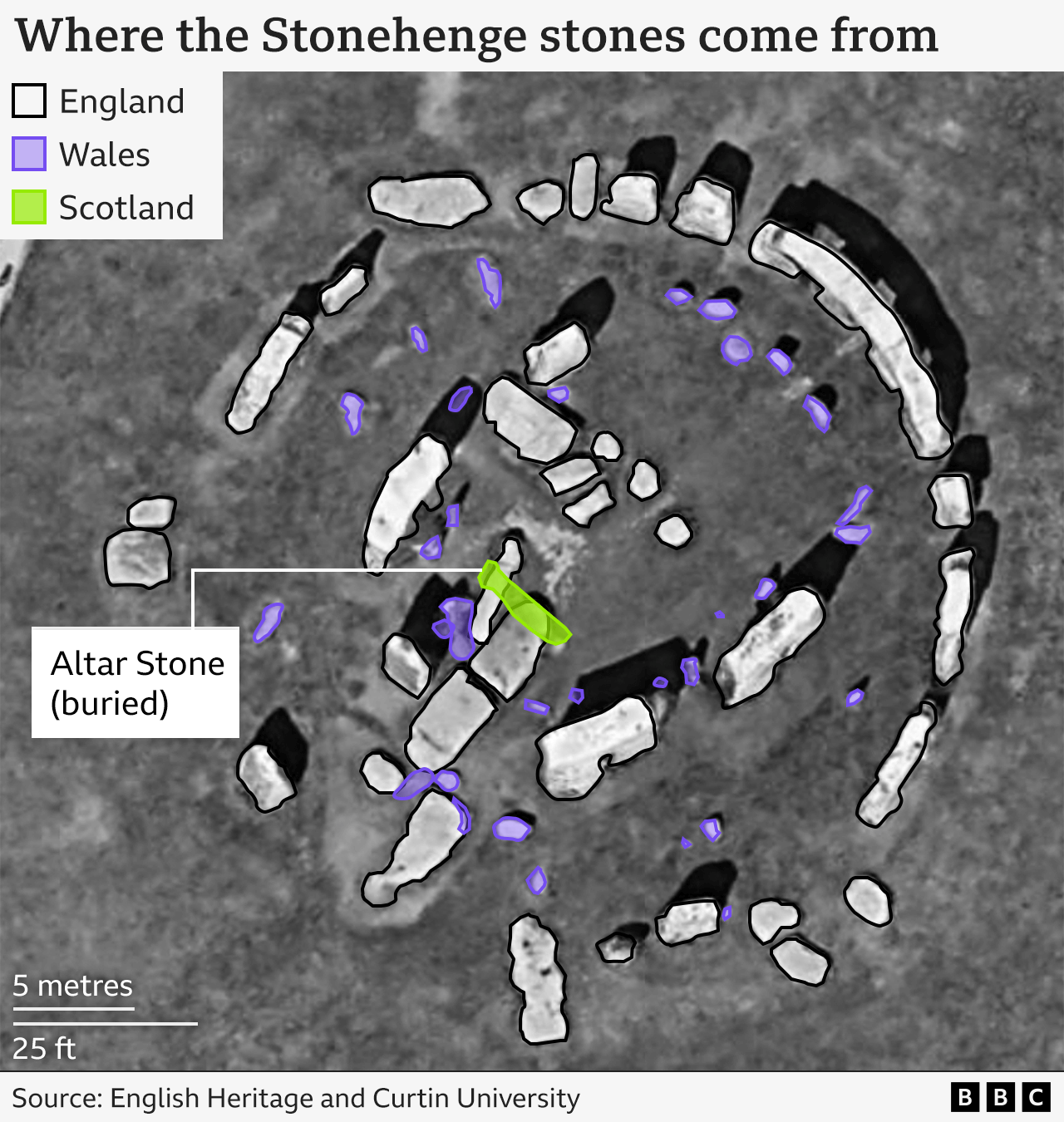
Executive Takeaways
- Geographical Pivot: Advanced geochemical profiling has definitively ruled out Wales as the source of the iconic six-ton Altar Stone, pointing instead to the Orcadian Basin in the far north of Scotland—over 450 miles away.
- Logistical Enigma: The monumental transport of a six-ton monolith across prehistoric Britain challenges conventional archaeological frameworks of Neolithic supply chains, infrastructure scalability, and societal capital allocation.
- Commercial and Tourism Impact: As heritage tourism operators and regional economies recalibrate capital allocation around the updated narrative, academic institutions are securing new grant funding for high-precision mineralogical mapping.
- Methodological Breakthrough: The deployment of automated mineralogy and uranium-lead dating on zircon crystals marks a watershed moment in non-destructive cultural heritage analysis and risk mitigation for fragile antiquities.
For centuries, the silent sentinels of Salisbury Plain have guarded a profound geological secret. While the provenance of Stonehenge’s smaller "bluestones" has long been traced to the Preseli Hills of Pembrokeshire, Wales, the colossal central monolith—known to modern archaeology as the Altar Stone—has remained an outlier. Recent, groundbreaking geochemical analyses have shattered decades of academic consensus, shifting the search vector from the rolling hills of West Wales to the rugged, wind-swept landscapes of northern Scotland.
This seismic shift in archaeological research not only rewrites the textbook understanding of prehistoric British geography but also forces a radical reassessment of Neolithic logistical capabilities. As interdisciplinary research teams narrow their focus on specific stratigraphic formations in the Orcadian Basin, the investigation transitions from a broad academic inquiry into a high-stakes search for ancient trade networks, social centralization, and prehistoric resource management.
The Catalytic Discovery: Dismantling the Welsh Paradigm
Test Our Free AI & Tech Utilities Suite
Calculate LLM API token costs, analyze article dwell-time, or simulate tech DCA returns.
For generations, standard archaeological dogma maintained that all of Stonehenge's non-local stones—collectively termed bluestones—shared a unified point of origin in South Wales. However, a landmark study published by an international team of geologists and archaeologists applied high-precision mass spectrometry and mineralogical fingerprinting to fragment samples harvested from the Altar Stone. The results were unequivocal: the chemical composition of the six-ton slab bore no resemblance to Welsh bedrock.
Instead, the high concentration of barium and distinctive radiometric signatures in the stone's zircon and apatite crystals pointed toward the Old Red Sandstone supergroup of northeast Scotland. This revelation upended established models of prehistoric migration and exchange. Transporting a monolith weighing approximately six metric tons over a distance exceeding 450 miles during the third millennium BCE implies an unprecedented level of organizational complexity, resource mobilization, and inter-regional cooperation.
In economic and operational terms, the movement of the Altar Stone represents a prehistoric analog to modern enterprise supply chain restructuring. Just as multinational corporations must optimize infrastructure scalability and risk mitigation when sourcing raw materials across continents, Neolithic communities engaged in capital allocation of labor, ritual value, and social currency on a scale previously thought impossible for the era.
Deconstructing the Monolith: Mineralogical Profiles and Methodology

To understand how researchers narrowed the search, one must examine the rigorous analytical methodologies deployed in modern geoarchaeology. The Altar Stone is not a uniform block; it is composed of coarse-grained sandstone rich in mica. By isolating microscopic accessory minerals—specifically zircon grains—scientists can utilize uranium-lead (U-Pb) geochronology to determine the exact geological age when the minerals crystallized.
The radiometric clock of the Altar Stone's zircon grains matched a narrow window of geological formations found primarily in the Orcadian Basin of Scotland, stretching across parts of Caithness, Orkney, and the Moray Firth. This technological breakthrough bypassed visual inspection, relying instead on empirical data that eliminated false positives across hundreds of potential quarry sites throughout Britain.
| Metric / Parameter | Traditional Consensus (Pre-2023) | Current Findings & Data |
|---|---|---|
| Hypothesized Provenance | Preseli Hills, Pembrokeshire, Wales | Orcadian Basin / Far North Scotland |
| Estimated Transport Distance | Approx. 140 to 180 miles | 450+ miles (Overland and Coastal) |
| Primary Analytical Technique | Petrographic thin-section microscopy | U-Pb dating, ICP-MS, automated mineralogy |
| Estimated Stone Weight | Approx. 6 metric tons | Approx. 6 metric tons (Lying horizontally) |
Broader Industry, Economic, and Cultural Implications
The narrowing of the search parameters for the Altar Stone extends far beyond academic circles, triggering ripples across heritage tourism, regional economic development, and cultural valuation:
- Cultural Heritage Tourism: Regional tourism boards in northern Scotland are experiencing a surge in exploratory interest. Local councils are evaluating capital allocation strategies to build interpretive centers that capitalize on the Scottish-Stonehenge connection, boosting local market liquidity and hospitality revenues.
- Academic Funding and Grants: Research institutions specializing in geoarchaeology are witnessing increased corporate sponsorship and government grant allocations. The commercial application of non-destructive mineral testing is finding crossover utility in high-end materials science and regulatory compliance for extractive industries.
- Public-Private Partnerships: Heritage management organizations, such as English Heritage and Historic Environment Scotland, are forging collaborative frameworks to protect fragile prospective quarry sites from unregulated artifact hunting and uncoordinated amateur excavation.
Frequently Asked Questions (People Also Ask)
Frequently Asked Questions
Unlike the upright sarsens, which are local to the Marlborough Downs, or the smaller bluestones sourced from Wales, the Altar Stone is a massive, flat-lying slab of micaceous sandstone. Its unique mineralogy and central placement within the monument have long suggested a distinct ritual purpose and a separate geographical origin.
While archaeologists debate the exact mechanics, prevailing theories suggest a combination of robust maritime cabotage—moving the heavy monolith along coastal sea routes using advanced skin-boats or rafts—and arduous overland transport via roller systems, timber sledges, and organized human labor forces.
Researchers utilized automated mineralogy, scanning electron microscopy, and uranium-lead dating of zircon and rutile crystals. These techniques measure the radioactive decay of uranium into lead within microscopic crystals, establishing a definitive geological fingerprint that matches Scottish bedrock rather than Welsh formations.
Geologists are conducting high-resolution field surveys across targeted outcrops within the Orcadian Basin of northeast Scotland. By matching subtle variations in mineral chemistry and sedimentary structures, teams aim to pinpoint the exact coastal or inland ledge from which the monolith was quarried around 5,000 years ago.
Future Outlook and Strategic Milestones to Watch
As the investigation enters its next phase, the primary objective for field geologists is to transition from a regional basin-wide search to the identification of an exact quarry face. Success in this endeavor will rely on continued cross-border collaboration between Scottish and English heritage bodies, alongside the deployment of drone-mounted magnetometers and portable X-ray fluorescence (pXRF) spectrometers.
For investors, stakeholders, and cultural institutions, the ongoing unraveling of the Stonehenge mystery underscores the enduring commercial and educational value of deep scientific inquiry. As upcoming peer-reviewed excavations publish further data on maritime transport routes of the Neolithic era, market analysts anticipate heightened engagement with cultural heritage sectors, paving the way for advanced technological integrations in archaeological preservation and public education.


