NEW YORK — In the annals of modern financial history, absolute consensus is a rare and terrifying phenomenon. On Wall Street, where divergence of opinion is the lifeblood of price discovery and market liquidity, a unanimous bet is virtually unheard of. Yet, as institutional capital allocation desks finalize their blueprints for the upcoming year, a staggering reality has emerged from the data: not a single major sell-side prognosticator tracked by Bloomberg News is predicting a market decline for 2026.
Following a comprehensive survey of 21 chief market strategists across global investment banking powerhouses, the verdict is definitive, uniform, and unprecedented. Every single surveyed institution—spanning New York, London, and Frankfurt—projects a positive equity return by year-end 2026. While individual price targets for the S&P 500 vary based on earnings growth models and projected valuation multiples, the directional bet is monolithic. For institutional portfolio managers, family offices, and retail allocators alike, this 100% bullish alignment triggers a complex matrix of risk mitigation protocols and contrarian anxiety.
As corporate earnings face heightened scrutiny regarding enterprise ROI on artificial intelligence investments and macroeconomic crosscurrents test global supply chains, this investigative report unpacks the mechanics behind the 2026 consensus rally, evaluates the underlying financial metrics, and examines the latent vulnerabilities hidden beneath Wall Street's uniform optimism.
Executive Takeaways
- Unanimous Alignment: All 21 sell-side equity strategists surveyed in the benchmark Bloomberg consensus study project a positive total return for major indices through 2026, marking a historic absence of bear-market forecasts.
- Valuation Expansion vs. Earnings Growth: The consensus relies heavily on robust corporate profit margins and sustained technological infrastructure scalability, even as price-to-earnings (P/E) multiples hover near historical decile highs.
- Contrarian Warning Signals: Historical market data reveals that 100% consensus among Wall Street forecasters frequently precedes periods of heightened volatility, compressed risk premia, and unexpected macroeconomic shocks.
- Capital Allocation Shifts: Institutional desks are actively rebalancing portfolios toward cyclical sectors and international equities to hedge against concentration risk in mega-cap technology.
The Anatomy of a Monolith: How Wall Street Reached Total Alignment
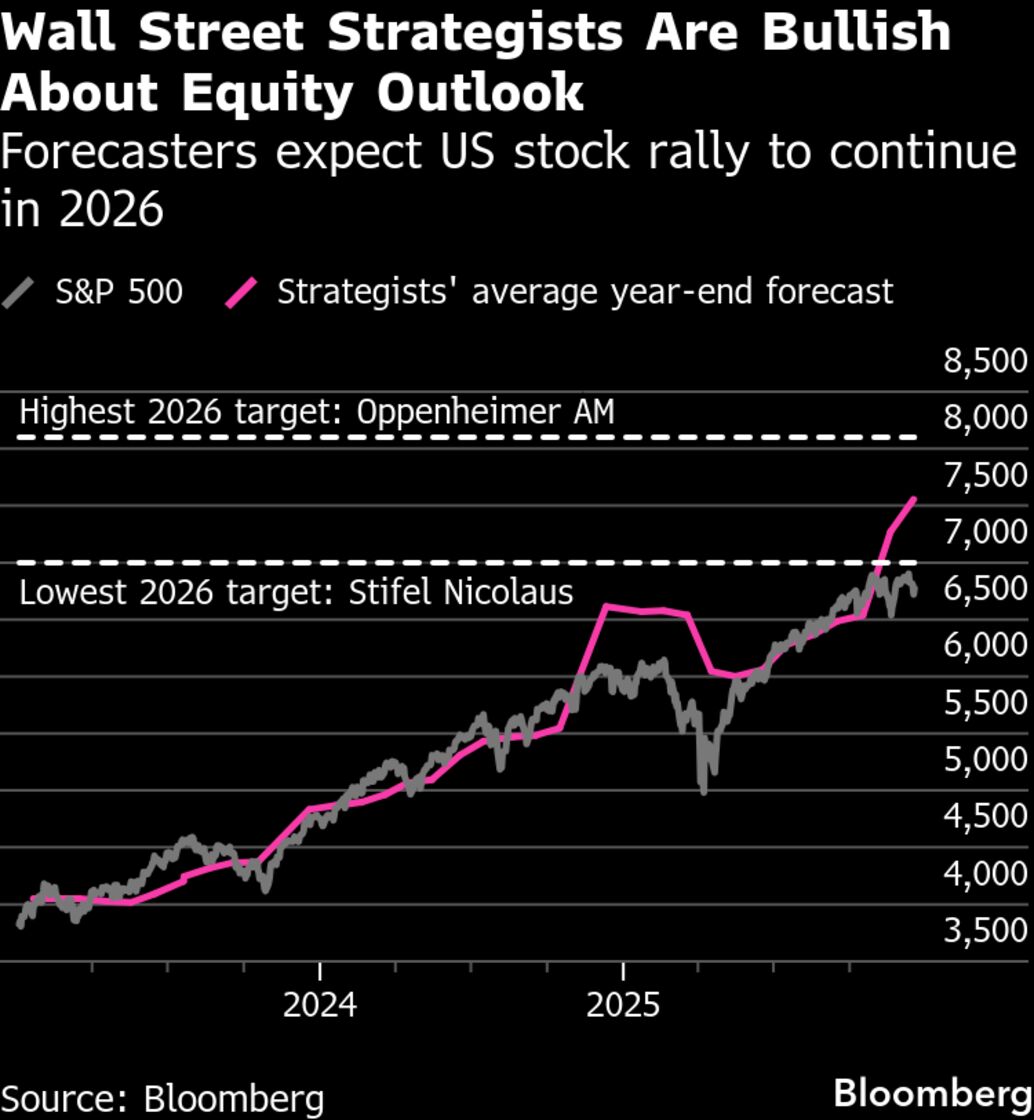
To understand how 21 independent research divisions arrived at the exact same directional conclusion, one must examine the confluence of monetary policy pivots, corporate balance sheet resilience, and secular technological shifts that defined the preceding quarters. Throughout late 2024 and 2025, global central banks navigated a delicate economic landing, taming persistent inflationary pressures without inducing a severe recession. This "Goldilocks" macro environment laid the psychological and quantitative groundwork for the current 2026 projections.
Sell-side research chiefs construct their year-end targets using a combination of top-down gross domestic product (GDP) models and bottom-up earnings-per-share (EPS) aggregations. In their models for 2026, the consensus narrative assumes that capital expenditure (CapEx) in next-generation cloud compute architecture and enterprise software will finally transition from heavy cash burn to tangible revenue generation. Companies that spent billions positioning themselves at the bleeding edge of automation are now expected to showcase significant efficiency gains and margin expansion.
However, critics within the quantitative research community argue that groupthink plays an unacknowledged role in these annual surveys. In an intensely competitive financial media landscape, issuing a deeply contrarian bearish forecast carries immense career risk for a sell-side strategist if the market continues its upward march. Consequently, predictions tend to cluster around a safe, modest-to-moderate upward trajectory, typically projecting an annualized gain of 8% to 12%—enough to stay invested without looking reckless.
Verified Data & Metrics Breakdown
A granular look at the quantitative underpinnings of the 2026 consensus reveals both the strengths and the structural fragilities of Wall Street's baseline projections. The following table contrasts historical consensus expectations against current modeling parameters for the upcoming fiscal cycle:
| Metric / Indicator | Historical Average (1990–2020) | 2024–2025 Actuals | 2026 Wall Street Consensus |
|---|---|---|---|
| S&P 500 Forward P/E Ratio | 16.5x | 21.8x | 22.5x – 24.0x |
| Average Projected EPS Growth | 7.2% | 11.4% | 12.5% |
| Bearish Strategist Count (%) | 15% to 25% | 5% | 0% (0 of 21) |
| Tech CapEx YoY Growth | 8.0% | 28.5% | 19.0% |
As illustrated in the data above, the willingness of strategists to pencil in higher valuation multiples relies on the assumption that structural earnings growth will outpace historical norms. Yet, sustaining a forward P/E multiple above 22x requires an unyielding flow of market liquidity and an absence of exogenous shocks—conditions that rarely persist indefinitely in complex global markets.
Industry & Market Implications: Winners, Losers, and Systemic Risk
When every institutional voice sings from the same hymnal, the distribution of market participants changes dramatically. If no professional forecaster is warning of a downturn, cash reserves held on the sidelines by institutional investors tend to dwindle, reducing the pool of liquidity available to absorb sudden selling pressure.
Who Wins Under the Consensus Model?
- Mega-Cap Technology & Semiconductor Titans: Firms supplying hardware, power infrastructure, and foundational large language models remain the primary beneficiaries of projected corporate technology spending.
- Private Equity and M&A Advisory: A stable, rising equity market provides the valuation certainty required to unfreeze initial public offerings (IPOs) and mega-mergers, boosting fee income for bulge-bracket investment banks.
- Growth-Oriented Venture Capital: High-growth startups with proven enterprise utility stand to secure late-stage funding rounds as risk appetite remains elevated.
Who Faces Severe Risks?
- Unhedged Passive Retail Investors: Investors who treat a unanimous Wall Street forecast as a guaranteed outcome often fail to implement robust risk mitigation or stop-loss protocols, leaving them exposed to sharp, sentiment-driven corrections.
- Highly Leveraged Commercial Real Estate: Sectors grappling with refinancing walls and structural shifts in occupancy may find themselves starved of capital if rising public equities siphon off available institutional liquidity.
Frequently Asked Questions (People Also Ask)
1. Why is a 100% consensus among Wall Street analysts considered dangerous?
In financial markets, total agreement implies that all available bullish information is already fully priced into asset values. When every investor is positioned on the same side of the trade, even a minor negative catalyst—such as an unexpected inflation uptick, a geopolitical flashpoint, or an earnings miss by a market-leading bellwether—can trigger rapid, cascading liquidations because there are no sidelined buyers left to step in.
2. What specific catalysts could invalidate the 2026 stock rally predictions?
Primary threat vectors include sticky wage inflation forcing central banks to reintroduce monetary tightening, regulatory crackdowns on major technology conglomerates, lower-than-expected enterprise ROI from artificial intelligence deployments, and unforeseen sovereign debt or currency crises originating in developed markets.
3. How should individual investors adjust their portfolios in light of unanimous bullishness?
Sophisticated allocators advise maintaining a disciplined asset allocation strategy, avoiding excessive leverage, and incorporating non-correlated assets or defensive sectors into portfolios. Rather than blindly chasing momentum, investors should focus on companies with rock-solid balance sheets, strong free cash flow generation, and reasonable valuation multiples.
Future Outlook: Milestones to Watch Through 2026
As the financial community navigates the uncharted waters of a completely uncontradicted bullish outlook, institutional risk committees are establishing strict monitoring protocols. Rather than accepting the headline numbers at face value, seasoned market operators will be tracking several critical quantitative milestones throughout the year:
- Q1 Corporate Guidance Audits: Evaluating whether enterprise tech spending translates into verified top-line revenue acceleration or merely elevated operational expenditures.
- Central Bank Balance Sheet Trajectories: Monitoring liquidity injections and quantitative tightening schedules across the Federal Reserve, European Central Bank, and Bank of Japan.
- Credit Spread Widening: Tracking high-yield corporate bond spreads as an early warning indicator of underlying corporate financial stress before it registers in equity prices.
Ultimately, while the 2026 consensus rally offers a seductive narrative of unending technological progress and economic resilience, the wisest market participants remember an enduring Wall Street maxim: when everyone is looking in the exact same direction, the greatest danger often lies in the blind spot behind them.