Executive Takeaways
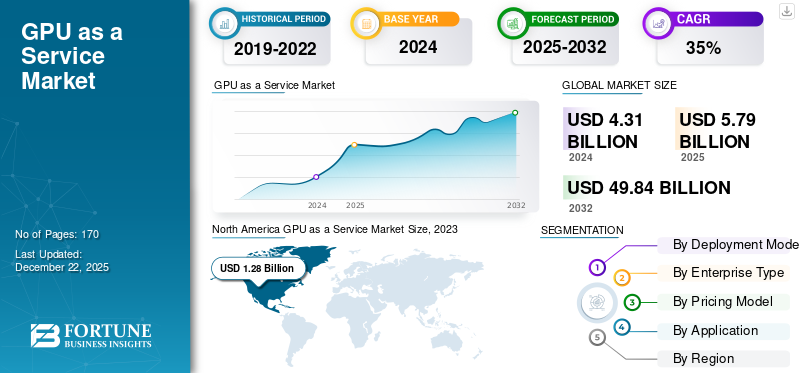
- Explosive Growth Trajectory: According to benchmark industry data from Fortune Business Insights, the global GPU-as-a-Service (GPUaaS) market is projected to surge from $8.66 billion in 2026 to an astonishing $162.54 billion by 2034.
- Unprecedented CAGR: The market expansion is defined by a massive compound annual growth rate (CAGR), driven by relentless enterprise demand for generative AI, large language model (LLM) training, and complex data simulation.
- Capital Allocation Shift: Corporate balance sheets are rapidly pivoting away from capital-heavy on-premises data center construction toward flexible, opex-driven cloud compute architecture to optimize enterprise ROI.
- Ecosystem Realignment: Hyperscalers, specialized neocloud providers, and semiconductor giants are locked in a high-stakes race for market share, infrastructure scalability, and supply chain dominance. >
The modern enterprise landscape is undergoing a structural paradigm shift unlike anything seen since the advent of multi-tenant cloud computing in the late 2000s. At the epicenter of this transformation is the GPU-as-a-Service market—a hyper-growth sector that is redefining how global corporations handle heavy computational workloads, machine learning engineering, and real-time analytics. As artificial intelligence transitions from experimental proofs-of-concept to mission-critical operational infrastructure, access to high-performance parallel processing units has become the definitive currency of corporate survival.
Fresh data released by Fortune Business Insights maps out a staggering financial trajectory: the global GPUaaS market is slated to expand from $8.66 billion in 2026 to a towering $162.54 billion by 2034. This aggressive upward curve reflects an urgent corporate scramble to secure cloud compute architecture without incurring the punishing capital expenditure (CapEx) associated with purchasing, housing, and cooling proprietary silicon clusters.
The Genesis of the GPUaaS Boom: Catalytic Forces and Market Pressures
To understand the unprecedented valuation multiples and capital allocation strategies currently dominating Wall Street and Silicon Valley, one must examine the supply-demand imbalances that catalyzed the GPUaaS model. For decades, traditional CPU-centric cloud services provided by hyper-scale operators sufficed for enterprise workloads like relational databases, enterprise resource planning (ERP) systems, and standard web hosting. However, the emergence of transformer-based neural networks and massive generative AI models exposed a critical structural bottleneck in legacy data center designs.
Training an enterprise-grade foundational model requires tens of thousands of specialized graphics processing units operating in synchronous parallel arrays over high-speed, low-latency interconnect fabrics like InfiniBand. Purchasing these systems outright is financially prohibitive for all but the world's most capitalized technology titans. A single top-tier AI server rack can cost upwards of hundreds of thousands of dollars, accompanied by punishing electricity demands, specialized liquid-cooling requirements, and a notoriously short hardware depreciation lifecycle.
This reality created a massive market opening for GPU-as-a-Service providers. By abstracting the underlying physical hardware and offering flexible, pay-as-you-go consumption models, GPUaaS platforms have democratized access to extreme computational power. Chief Information Officers (CIOs) and Chief Technology Officers (CTOs) can now spin up thousands of virtual GPUs in minutes, execute complex LLM fine-tuning or computer vision training jobs, and spin them down just as quickly—optimizing cash flow and mitigating the risk of stranded physical assets.
Deconstructing the Financial Trajectory: From $8.66B to $162.54B
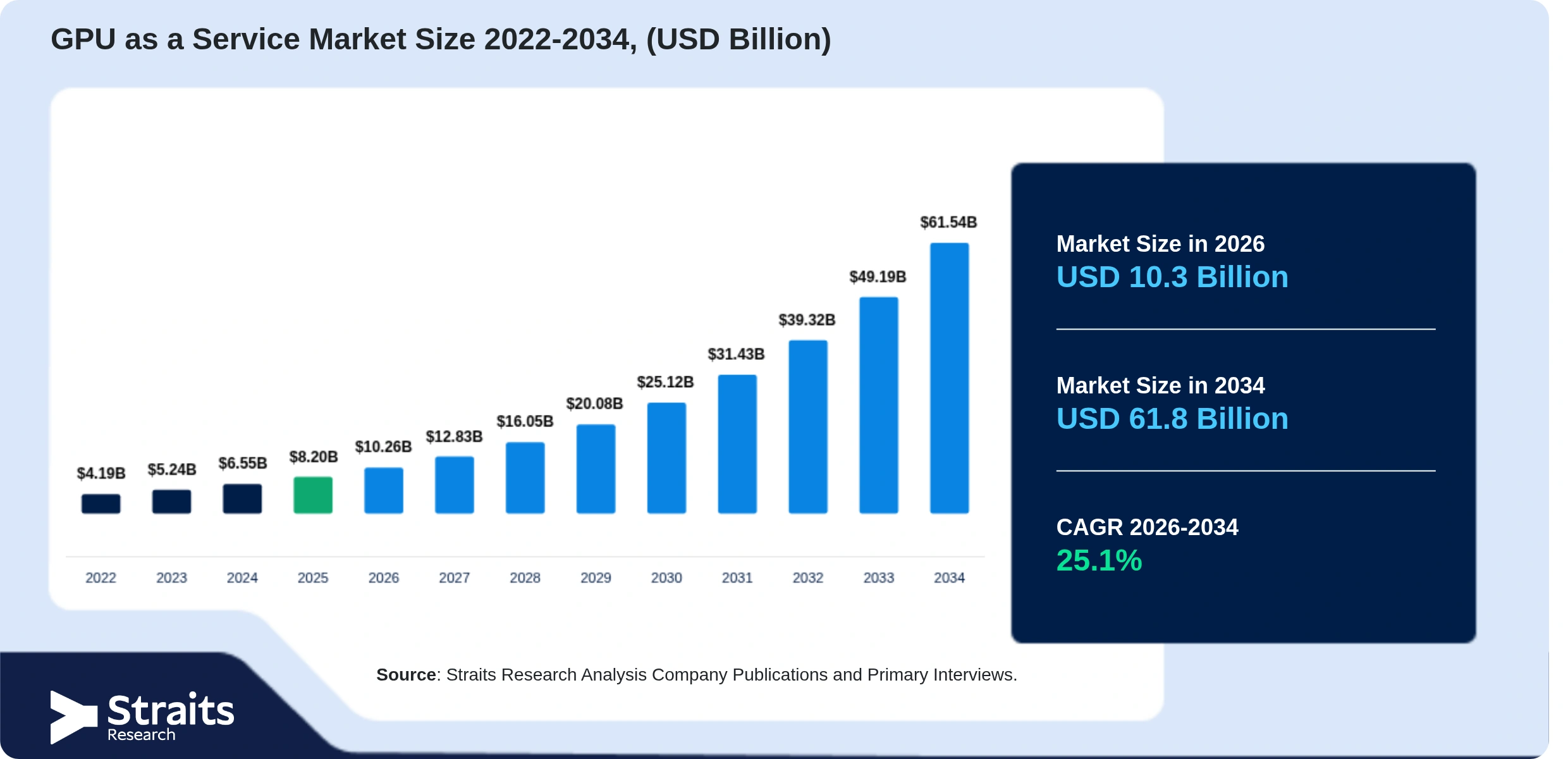
A closer look at the trajectory from 2026 to 2034 reveals distinct phases of market maturity, technological adoption, and infrastructure scalability. The initial phase, anchored by the 2026 baseline of $8.66 billion, represents the early mainstream adoption era. During this window, early-adopter enterprises, venture-backed AI startups, and specialized research institutions laid the foundational workflows for cloud-native machine learning.
As the market scales toward the mid-2030s, growth acceleration will be fueled by traditional Fortune 500 enterprises across heavily regulated sectors such as finance, healthcare, pharmaceuticals, and industrial manufacturing. These legacy institutions, constrained by strict regulatory compliance frameworks and legacy infrastructure, are gradually migrating proprietary datasets to secure, sovereign GPU cloud environments. This broader enterprise migration will inject billions of dollars in recurring revenue into the GPUaaS ecosystem, compressing deployment cycles and driving exponential valuation growth.
Verified Market Metrics & Projections
| Metric Dimension | 2026 Baseline | 2034 Projection | Strategic Implication |
|---|---|---|---|
| Global Market Valuation | $8.66 Billion | $162.54 Billion | Massive long-term capital inflow and structural expansion. |
| Primary Growth Driver | AI/ML Startup Scale-up | Enterprise Generative AI & Simulation | Shift from experimental pilots to core operational infrastructure. |
| Cost Structure Focus | CapEx Minimization | OpEx Efficiency & ROI Maximization | Intense focus on unit economics and compute cost reduction. |
Industry & Market Implications: Winners, Losers, and Economic Realignments
The seismic shift toward GPU-as-a-Service is redrawing competitive boundaries across the global technology stack. Market liquidity is increasingly concentrating around entities that control either the underlying silicon supply chain, proprietary cloud orchestration software, or massive hyperscale data center footprints.
The Winners: Hyperscalers, Neoclouds, and Specialized Infrastructure
Major cloud service providers—alongside agile, venture-backed "neocloud" startups purpose-built for AI—are capturing the lion's share of market liquidity. By securing direct allocation deals with semiconductor manufacturers, these providers offer guaranteed compute capacity at scale. Furthermore, providers offering advanced workload orchestration, automated cluster management, and integrated data pipelines are commanding premium pricing power and robust gross margins.
The Vulnerable: Legacy IT and On-Premises Hardware Vendors
Conversely, traditional enterprise hardware vendors that rely on selling standalone servers and on-premises data center infrastructure face mounting strategic headwinds. As corporate boards demand flexible opex models and instant infrastructure scalability, legacy IT procurement cycles are experiencing severe compression. Firms that fail to pivot toward hybrid-cloud management or managed GPU hosting services risk commoditization and declining market share.
Frequently Asked Questions (People Also Ask)
Q: What is GPU-as-a-Service (GPUaaS), and why is demand surging?
GPUaaS is a cloud computing model that delivers virtualized graphics processing units over the internet on a pay-as-you-go basis. Demand is surging because training and deploying generative AI models, large language models, and deep learning algorithms require massive parallel processing power that is otherwise prohibitively expensive to purchase and maintain in-house.
Q: How much is the GPU-as-a-Service market projected to grow by 2034?
According to data compiled by Fortune Business Insights, the global GPUaaS market is projected to expand from $8.66 billion in 2026 to $162.54 billion by 2034, reflecting exceptional compound annual growth driven by enterprise digital transformation and AI adoption.
Q: What are the primary enterprise benefits of adopting GPUaaS over physical hardware acquisition?
Key benefits include elimination of massive upfront capital expenditures (CapEx), instant infrastructure scalability, reduction of hardware depreciation risks, and the ability to dynamically spin up or down computational clusters to match active workload requirements, thereby maximizing enterprise ROI.
Q: Which industries are leading the adoption of GPU-as-a-Service architectures?
Technology enterprises, financial services institutions (for algorithmic trading and risk modeling), healthcare and pharmaceutical firms (for drug discovery and genomics), and autonomous vehicle developers are currently leading market adoption.
Future Outlook: Strategic Milestones and What to Watch
As the GPU-as-a-Service market advances toward its 2034 projections, executive leadership and institutional investors must monitor several critical inflection points. First, advancements in specialized AI accelerators and custom application-specific integrated circuits (ASICs) will introduce new competitive dynamics, potentially challenging the current dominance of general-purpose GPUs.
Second, regulatory scrutiny regarding data sovereignty, energy consumption, and grid stability will intensify. Because massive GPU clusters demand unprecedented amounts of electrical power, providers that secure sustainable, green energy sources will enjoy structural cost advantages and insulate themselves from potential regulatory penalties.
Ultimately, GPUaaS has evolved far beyond a niche technological utility. It is now the foundational operating system of the artificial intelligence economy. Organizations that successfully navigate this infrastructure transition, optimize their cloud compute architecture, and execute disciplined capital allocation will define the next era of global enterprise leadership.