Executive Takeaways
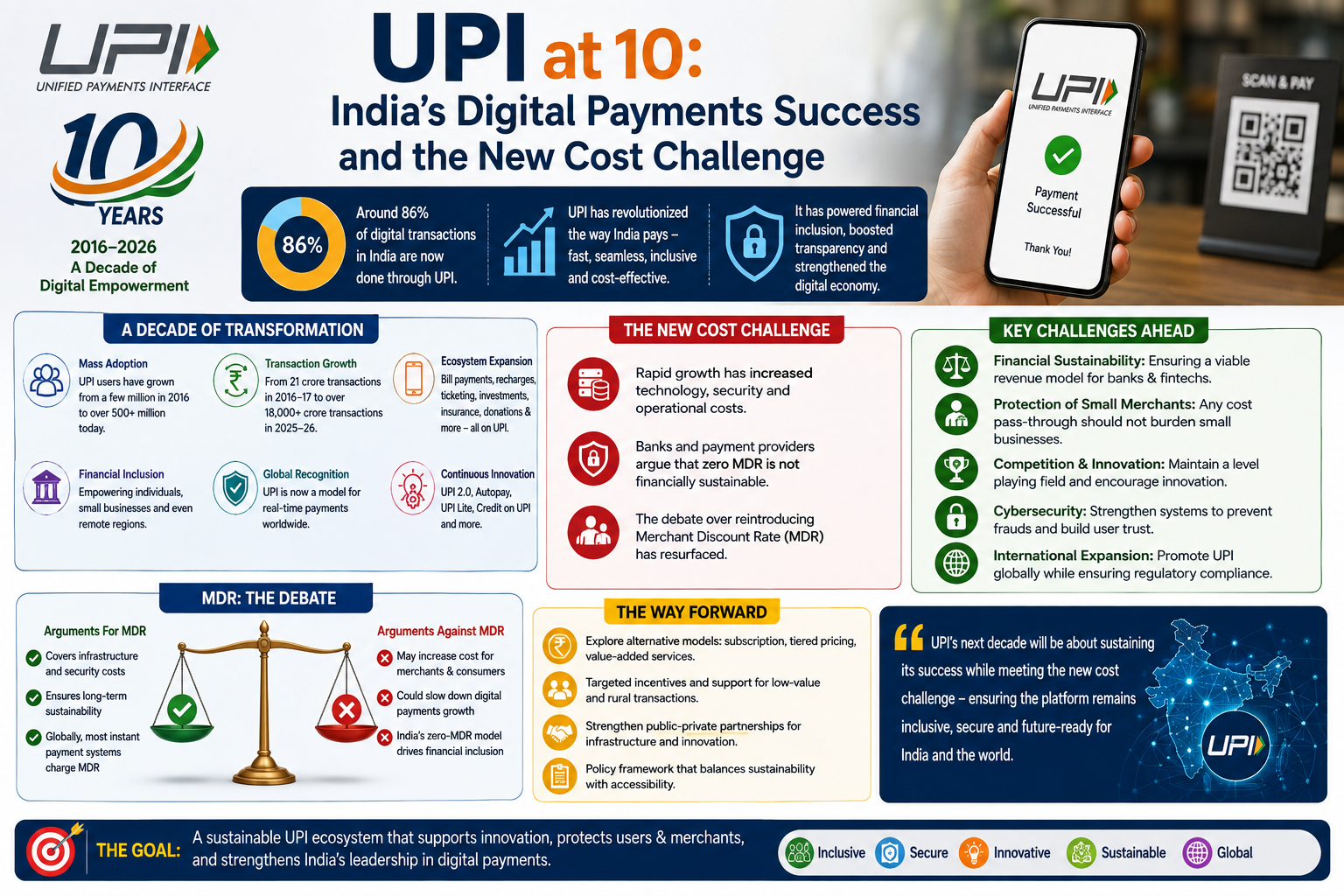
- Hyper-Concentration Risk: Walmart-backed PhonePe and Alphabet’s Google Pay control roughly 85% of transaction volume on India’s Unified Payments Interface (UPI), frustrating regulators as the National Payments Corporation of India (NPCI) repeatedly defers its 30% market-share ceiling amid antitrust and operational complexities.
- The Zero-MDR Conundrum: A government-enforced zero Merchant Discount Rate (MDR) policy has democratized adoption but eviscerated core unit economics for third-party application providers (TPAPs), compelling payment firms to pivot toward high-risk unsecured lending and credit-on-UPI distributions to subsidize cloud compute architecture costs.
- Infrastructure Fragility: With monthly transaction runs surpassing 15 billion tallies and annualized throughput exceeding $2.4 trillion, legacy Core Banking Systems (CBS) across tier-1 and public-sector banks face mounting system-wide latency, timeout ratios, and enterprise scalability bottlenecks.
- Advanced Threat Vectors: As transaction velocity approaches peak capacity, financial institutions face acute risk mitigation hurdles, including synthetic mule-account networks, authorized push payment (APP) exploits, and device-binding spoofing that outpace conventional algorithmic fraud detection.
Ten years after the National Payments Corporation of India (NPCI) deployed the Unified Payments Interface, the protocol stands as the preeminent triumph of India’s Digital Public Infrastructure (DPI). Conceived inside the Reserve Bank of India (RBI) and refined under the architectural oversight of technocrats like Nandan Nilekani, UPI did not merely streamline transactions; it dismantled the legacy payments cartel. By decoupling digital settlement from proprietary card rails, it turned bank accounts into instantaneous, interoperable virtual addresses.
Yet, as UPI enters its second operational decade, the engineering and economic assumptions that enabled its hyper-growth are colliding with institutional market realities. The network processes more than 80% of India’s retail digital transactions, moving the equivalent of nearly half the nation’s gross domestic product. What began as an agile consumer payment rail is now critical sovereign infrastructure. That transformation brings unhedged risks: enterprise valuation compressions stemming from state-mandated fee caps, acute concentration among foreign-owned Big Tech duopolies, legacy core banking systems straining under transaction per second (TPS) demands, and rapidly evolving cyber-fraud syndicates.
The Zero-MDR Trap: Sovereign Subsidy vs. Enterprise Unit Economics
The foundational catalyst of UPI’s ubiquity remains its price: zero. In January 2020, to accelerate tax compliance and eradicate cash reliance across small merchant tiers, the Indian Ministry of Finance eliminated the Merchant Discount Rate on UPI and domestic RuPay transactions. For consumers and micro-merchants, the policy was a masterclass in financial inclusion. For the enterprise software firms, payment aggregators, and fintech underwriters funding the client-acquisition engine, it obliterated core transactional margins.
Standard payment ecosystems—such as those operated by Visa, Mastercard, or China’s UnionPay—derive high-margin revenues by skimming 1.5% to 3.0% of gross transaction value (GTV), distributing interchange yields across acquiring banks, issuing institutions, and network gatekeepers. Under India's zero-MDR regime, payment aggregators and TPAPs absorb steep infrastructure expenditures—spanning secure cloud compute architecture, multi-zone disaster recovery setups, tokenization services, and device verification APIs—without collecting direct clearing fees from merchants.
To offset systemic losses, the Indian government has injected annual budget allocations—averaging $180 million to $250 million across recent fiscal cycles—to compensate financial institutions for operational costs. However, banking executives and private equity allocators view these subsidies as insufficient operational stopgaps rather than sustainable capital allocation models. The fiscal shortfall has severely impacted standalone fintech valuation multiples. Entities like PhonePe and One97 Communications (Paytm) have had to alter their operational strategies, turning free UPI payment flow into a distribution funnel for credit lines, micro-insurance, and mutual fund distribution.
The Reserve Bank of India’s subsequent introduction of "Credit Line on UPI" and RuPay credit card linking represents an institutional effort to introduce margin back into the network. By attaching a 2% interchange fee to merchant transactions funded via pre-approved credit lines and credit cards, the ecosystem is attempting to carve out enterprise ROI without triggering political blowback by taxing baseline savings-account-to-savings-account consumer payments.
The Engineering Bottleneck: Core Banking Systems Under Peak TPS Load

Behind the frictionless consumer interfaces designed by Palo Alto and Bengaluru product managers sits a brittle, fragmented banking spine. UPI functions as an orchestration layer, but final settlements depend entirely on the host banks' Core Banking Systems (CBS). The majority of India's public and private lenders operate their CBS on legacy stacks licensed from providers like Finacle or Oracle Financial Services, architected decades ago for low-velocity, batch-processed financial ledgers.
During holiday shopping peaks, UPI throughput routinely surges past 8,000 transactions per second. While NPCI’s central switch operates with modern, distributed computing frameworks capable of horizontal scaling, the transaction journey hits a wall at bank-side hardware. When an end-user executes a debit, the request must traverse identity layers, ping SMS/telecom gateways for two-factor verification, check available ledger balances on the bank’s CBS, post the debit, and signal the beneficiary institution to post the credit.
The resulting operational friction manifests as technical declines (TDs) and business declines (BDs). While baseline network failure rates hover below 1%, localized system failures at systemic commercial lenders have periodically caused consumer transaction timeouts to spike above 8%. To protect mission-critical operations, major commercial lenders are investing capital into decoupled middleware—often dubbed UPI Engine nodes or Shadow Balances. These cloud-native layers isolate high-frequency, low-value payment pings from the primary CBS ledger, settling micro-transactions in aggregate batches. Yet, as regulatory compliance requires strict data sovereignty and full on-premise transactional tracking, scaling this hybrid cloud compute architecture remains a major capital expense for mid-tier regional banks.
Regulatory Impasse: The 30% Market Share Paradox
UPI's commercial structure presents a stark antitrust dilemma. NPCI is a non-profit company backed by bank consortiums, but the consumer interface of its flagship platform is effectively an American tech duopoly. PhonePe (backed by Walmart) and Google Pay consistently command between 80% and 86% of monthly transaction volumes. Paytm, which once held a viable third-place counterweight, saw its share plunge following severe regulatory interventions by the RBI against its payments banking division due to persistent supervisory non-compliance.
Recognizing the systemic operational hazard of this concentration, NPCI proposed a 30% volume cap for third-party application providers in 2020. However, the enforcement date has been pushed back repeatedly, most recently extended to the end of 2024, with expectations of further leniency. The enforcement roadblock is operational: in an open-access system driven by consumer brand loyalty, how can a network operator mechanically throttle a user's transaction on Google Pay or PhonePe without driving technical decline rates up and eroding faith in digital payments?
Breaking this duopoly requires enterprise incentives that the market has so far failed to generate. Contenders like Tata Neu, Amazon Pay, and domestic banking apps like BHIM have invested capital into user-acquisition promotions without meaningfully eating into market share. Until monetization models shift, venture capital will avoid building pure-play UPI interfaces, cementing the incumbent duopoly's grip on data distribution channels.
The Evolution of Payment Vulnerabilities: From Phishing to Mule Networks
As perimeter defenses around API architectures and tokenization vaults have strengthened, financial crime has pivoted aggressively toward decentralized social engineering and authorized push payment (APP) fraud. Criminal operations have shifted tactics from crude SMS skimming to sophisticated social-engineering setups, digital-arrest scams, and synthetic identities.
A critical point of failure in modern risk mitigation is the rapid rise of "mule accounts." Fraud networks recruit low-income individuals, students, or compromised rural entities to open seemingly compliant bank accounts. Once established, these accounts serve as layered passthroughs. Stolen capital is moved across dozens of distinct UPI handles within seconds, leveraging split-second API settlement speeds to disperse funds before fraud alerts can execute an administrative account freeze.
The systemic speed that makes UPI a commercial triumph also challenges traditional investigative methods. Once a user authorizes a payment via their secret UPI PIN, the funds are irrevocably cleared. Banks are left navigating difficult liability frameworks. Under current directives, consumer negligence during an authorized push payment absolves the issuing bank of primary compensatory liability. However, rising public pressure has prompted the RBI to evaluate automated, central fraud monitoring registries with real-time risk scores, dynamic cooldown delays for anomalous cross-regional transfers, and stricter biometric binding protocols.
Comparative Metrics: The Decade of Disruption
The following audited data illustrates UPI’s rise from an experimental payments protocol into India's central transaction engine over the last decade.
| Performance Metric | FY 2016-17 (Inception Era) | FY 2020-21 (Pandemic Pivot) | Current Benchmark (Run-Rate / TTM) |
|---|---|---|---|
| Monthly Transaction Volume | ~17.9 Million | ~2.73 Billion | 15.0+ Billion |
| Monthly Transaction Value | ~$1.05 Billion (₹6,900 Cr) | ~$65.2 Billion (₹5.0 Lakh Cr) | $245+ Billion (₹20.6 Lakh Cr) |
| Annualized Clearing Run-Rate | ~$12 Billion | ~$780 Billion | $2.4+ Trillion |
| Market Concentration (Top 2 TPAPs) | Fragmented / Early Stage | ~78% (PhonePe / Google Pay) | ~85% (PhonePe / Google Pay) |
| Effective Merchant Discount Rate (MDR) | 0.25% - 0.65% (Tiered) | 0.00% (State Mandated) | 0.00% (P2M Baseline); 2.0% (Credit/RuPay Link) |
| Technical Decline (TD) Baseline | 4.5% - 7.0% | 1.2% - 1.8% | <0.65% (Consolidated Network Average) |
| Global Footprint Linkages | 0 Jurisdictions | 1 Corridor (Pilot) | 7+ Markets (UAE, Singapore, France, Mauritius, etc.) |
Industry & Market Implications: Capital Allocation Realities
UPI’s maturity has realigned competitive strategies across South Asia's financial sector, creating distinct winners, challenged incumbents, and altered capital allocation trajectories.
The Structural Winners
- Credit-Underwriting Fintechs: Entities utilizing high-velocity UPI ledger data as alternative underwriting intelligence can bypass expensive physical acquisition paths, distributing credit lines and high-yield financial products at lower costs.
- Sovereign State Entities: The Indian government has secured structural benefits: improved tax tracing, substantial reductions in cash-handling overheads, and a template for geopolitical soft power through the cross-border export of the DPI stack.
- Public-Sector Megabanks (SBI, PNB): By anchoring clearing operations, institutions like the State Bank of India have absorbed massive low-cost Current Account Savings Account (CASA) floats, cementing their structural importance to national liquidity.
Challenged Business Models and Disrupted Incumbents
- Global Card Schemes (Domestic Segments): Visa and Mastercard have lost domestic market share in India's micro-to-mid retail payment space. While they retain dominance over high-ticket cross-border, corporate, and premium credit products, their high domestic interchange revenue model has shrunk.
- Standalone Third-Party Applications: Mid-tier TPAPs and pure-play merchant aggregators face difficult unit economics. Without enterprise monetization pathways or substantial capital reserves to cross-sell financial products, burning cash on UPI user acquisition offers limited ROI.
- Legacy Point-of-Sale (PoS) Hardware Providers: Low-cost dynamic QR-code placards and soundbox voice-alert hardware have displaced expensive, traditional chip-and-PIN card terminal infrastructure across tier-2 through tier-6 retail geographies.
Frequently Asked Questions (People Also Ask)
Why is UPI completely free for merchants, and how do payment companies make money?
In January 2020, the Indian government eliminated the Merchant Discount Rate (MDR) on UPI peer-to-merchant (P2M) transactions, barring banks and application developers from charging merchant clearing fees. To stay profitable, third-party applications (TPAPs) use UPI as an acquisition channel to gather consumer spending data. They then cross-sell higher-margin, regulated enterprise financial products, including unsecured personal loans, credit line distributions, point-of-sale Soundbox monthly rentals, micro-insurance coverage, and mutual funds.
What is the NPCI 30% market share cap, and why has it been delayed?
The National Payments Corporation of India designed the 30% volume cap to prevent systemic risks from market concentration. Today, PhonePe and Google Pay process roughly 85% of all network volume. Implementing the cap has been repeatedly delayed because enforcement mechanisms would require capping user transactions on the leading platforms. This would inevitably increase technical transaction failures and disrupt consumer access, as alternative payment apps currently lack the server infrastructure and user adoption needed to handle the diverted volume.
How does "Credit on UPI" work, and does it bring systemic credit risks?
Approved by the Reserve Bank of India, "Credit on UPI" allows consumers to link pre-sanctioned bank credit lines and RuPay credit cards directly to their UPI applications, moving beyond basic savings account debits. While it restores revenue by charging a 2% interchange fee on transactions over ₹2,000, it brings underwriting risks. Because UPI transactions settle instantly, underwriting platforms must use rigorous, automated risk algorithms to avoid sudden spikes in non-performing assets (NPAs) within unsecured, short-term micro-credit portfolios.
Can UPI replace traditional global payments networks like SWIFT?
UPI is not an immediate replacement for SWIFT, which serves as a global financial messaging network for large wholesale settlements between correspondent banks. However, UPI is emerging as an efficient tool for bilateral retail cross-border transfers. Through direct integrations with domestic networks like Singapore’s PayNow and the UAE’s Jaywan system, UPI bypasses expensive correspondent banking layers, significantly cutting fees and settlement windows for personal cross-border remittances.
Future Outlook: The Next Phase of Scale and Global Interoperability
As UPI enters its second decade, its future success will depend on managing financial discipline alongside massive transaction scale. The network can no longer rely on early-stage expansion strategies; it must transition into an institutional, self-funding model that balances national service goals with market-rate infrastructure returns.
The next major milestones will focus on cross-border clearing integrations. The Reserve Bank of India and NPCI International Payments Limited (NIPL) are actively working to connect UPI with retail settlement systems across the Gulf Cooperation Council (GCC), Southeast Asia, and parts of the Eurozone. If these arrangements link up with central bank digital currency (CBDC) corridors, the platform could bypass traditional correspondent banking networks for international remittances, cutting transfer fees and settlement friction across key currency pairs.
Back home, the network's long-term health will require resolving the merchant fee issue. Regulators will likely need to adopt a tiered MDR framework—charging modest fees on large retail enterprises while leaving micro-merchants exempt—to help banks fund core banking and cybersecurity upgrades. As UPI scales toward a targeted 1 billion daily transactions, the challenge for its leadership is clear: protect the open access that drove its rapid rise, while building the financial and technological resilience needed to support India's modern digital economy.