Executive Takeaways
Test Our Free AI & Tech Utilities Suite
Calculate LLM API token costs, analyze article dwell-time, or simulate tech DCA returns.
- Beyond Fiat Wrappers: McKinsey & Company’s May 21, 2026 landmark report reveals that while private fiat-backed stablecoins cleared initial hurdles, a massive $4 trillion structural migration is underway toward institutional-grade tokenized deposits, programmable commercial bank liabilities, and wholesale CBDCs.
- Asia Leads the Sovereign Paradigm: Driven by proactive regulatory frameworks from the Monetary Authority of Singapore (MAS), Hong Kong Monetary Authority (HKMA), and Japan's FSA, Asian liquidity corridors are outpacing Western legacy payment rails, establishing multi-currency cross-border liquidity bridges that reduce intraday settlement latency to milliseconds.
- Balance Sheet & Capital Optimization: Global Tier-1 transaction banks are pivoting from external stablecoins to native tokenized liability networks, freeing up billions in locked intraday collateral and significantly optimizing Basel III Liquidity Coverage Ratios (LCR).
- The Disruption of Legacy Float Economics: Institutional market infrastructure providers and corporate treasuries are abandoning T+2 settlement windows, reallocating capital to real-time, 24/7 programmable liquidity layers that yield superior enterprise ROI and eliminate counterparty drag.
Introduction: The Limitations of Stablecoins 1.0
For nearly a decade, stablecoins served as the essential collateral bridge for digital asset markets, scaling to hundreds of billions in aggregate market capitalization. However, as global institutional finance converges with public and permissioned distributed ledger technology (DLT), the inherent limitations of private, fiat-backed stablecoins have become painfully clear to institutional risk committees and central bank governors.
According to definitive intelligence released by McKinsey & Company on May 21, 2026, titled "Beyond stablecoins: The emerging architecture of on-chain money," global capital markets have reached a critical inflection point. The financial ecosystem is executing a structural transition away from single-issuer asset-backed tokens toward a unified, multi-layered on-chain monetary architecture. This shift is not merely an incremental upgrade to payment rails; it represents a comprehensive re-architecting of the global monetary system capable of orchestrating a $4 trillion institutional liquidity transition over the next cycle.
First-generation stablecoins—while successful at establishing proof-of-concept for digital dollar transfers—present systemic frictions for enterprise capital allocation. Issuer counterparty risks, bankruptcy remoteness uncertainties, regulatory capital inefficiencies, and the lack of direct lender-of-last-resort clearing mechanisms render generic stablecoins ill-suited for large-scale institutional balance sheet settlement. The emerging paradigm shifts focus to direct tokenization of commercial bank money (tokenized deposits), regulated sovereign digital assets (wholesale CBDCs), and interoperable Regulated Liability Networks (RLN).
Deconstructing the Architecture: The Three Pillars of On-Chain Money
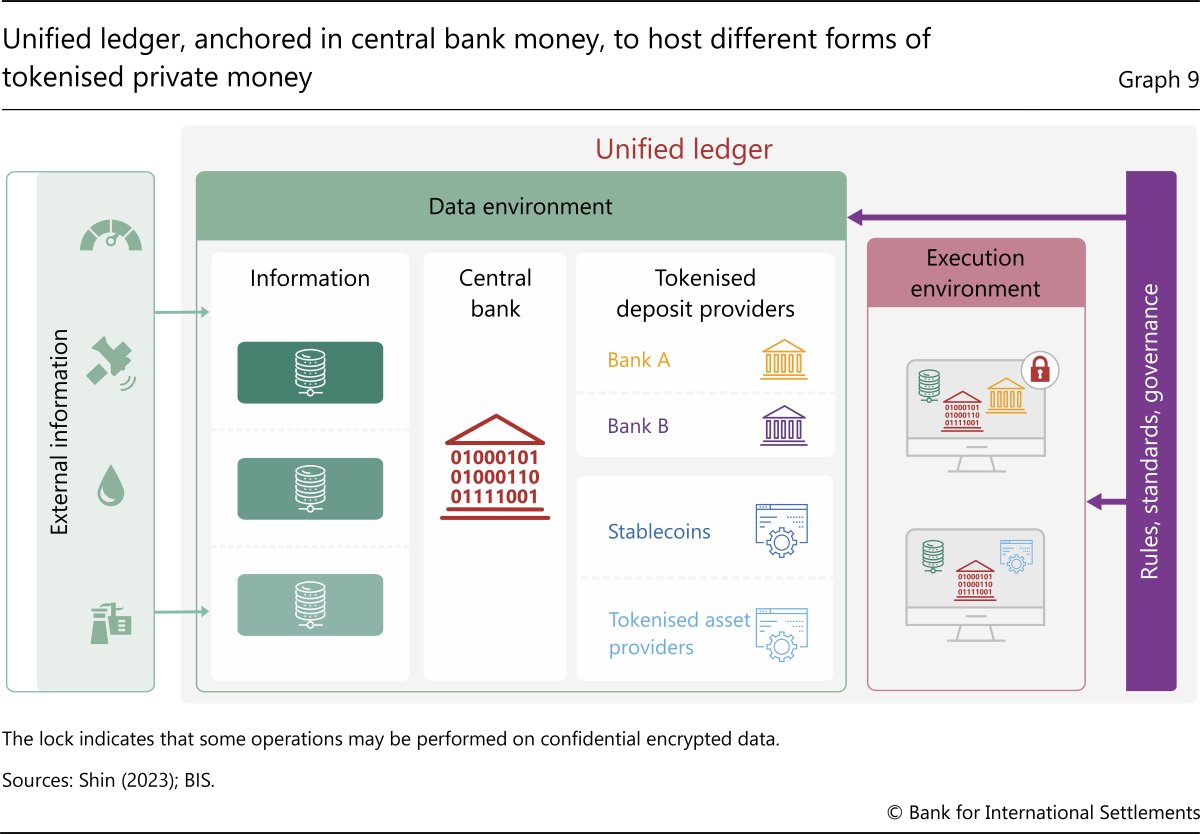
The modern on-chain ledger architecture categorizes digital liquidity into three distinct, complementary tiers, each engineered to address specific requirements regarding regulatory compliance, capital efficiency, and credit risk mitigation.
1. Tokenized Commercial Bank Money (Deposit Tokens)
Unlike third-party stablecoins—which operate as off-balance-sheet claims managed by non-bank intermediaries—tokenized deposits represent digital claims directly on the issuing commercial bank’s balance sheet. When a corporate treasury transfers $100 million via a tokenized deposit, the underlying claim transfers seamlessly within the fractional-reserve banking architecture without incurring credit transformation risks.
This structural alignment allows commercial banks to extend existing credit facilities, intraday liquidity lines, and deposit insurance protection to on-chain environments. Furthermore, tokenized deposits seamlessly interface with automated corporate cash management software via smart contracts, enabling programmable treasury functions such as dynamic zero-balance sweeps, automated tax provisioning, and continuous interest-bearing cash pooling.
2. Wholesale Central Bank Digital Currencies (wCBDCs)
Positioned at the apex of the new monetary hierarchy, wholesale CBDCs act as the ultimate risk-free settlement asset. Developed exclusively for regulated financial institutions, wCBDCs operate on high-throughput, high-security DLT corridors. By facilitating real-time atomic settlement—where the payment and delivery of assets occur simultaneously—wCBDCs eliminate Principal Risk (Herstatt Risk) in cross-border foreign exchange and securities settlement.
3. Programmable Asset and Liquidity Protocols
Connecting tokenized deposits and sovereign wCBDCs are enterprise-grade smart contract liquidity protocols. Designed with sophisticated cryptographic primitives such as Zero-Knowledge Proofs (ZKPs) and formal verification specifications, these networks ensure absolute privacy for confidential commercial transactions while retaining embedded regulatory auditability for anti-money laundering (AML) and counter-terrorist financing (CTF) compliance.
Asia’s Leadership: The Engine of Multi-Currency Settlement
A primary finding in McKinsey's analysis is the geographical imbalance in adoption. While Western jurisdictions have frequently struggled with fragmented regulatory mandates and litigation-driven policy, Asia has emerged as the global epicenter for native on-chain monetary architecture.
Initiatives such as the Monetary Authority of Singapore’s (MAS) Project Guardian and Project Orchid, alongside the Hong Kong Monetary Authority’s (HKMA) Project Ensemble, have moved decisively beyond experimental sandboxes into full commercial deployment. Asian financial hubs have established interoperable cross-border liquidity bridges that allow multi-currency atomic settlement across trade finance corridors spanning Singapore, Hong Kong, Japan, the UAE, and broader ASEAN economies.
This leadership position is largely driven by macro-economic necessity. As one of the world's most dense cross-border trading zones, Asian enterprise trade has historically suffered under the friction of legacy correspondent banking—where cross-border transfers face high fee drag, obscure FX markups, and extended T+2 or T+3 settlement latency. By adopting native multi-currency tokenized deposit networks, regional banks have unlocked unprecedented speed and cost efficiencies, driving institutional capital allocation directly into on-chain liquidity pools.
Comparative Infrastructure Analysis
To understand the magnitude of this institutional transition, the table below outlines the core technical, financial, and regulatory differences between legacy stablecoin models and the emerging institutional monetary architecture as identified in McKinsey's 2026 data.
| Architectural Metric | Stablecoins 1.0 (Fiat-Backed) | Tokenized Bank Deposits (v2.0) | Wholesale CBDCs (v3.0) |
|---|---|---|---|
| Core Issuer Type | Non-Bank Financial Intermediaries | Licensed Commercial Banks | Sovereign Central Banks |
| Credit & Counterparty Risk | Issuer default & reserve misalignment risk | Commercial bank credit (FDIC/Protected) | Zero credit risk (Sovereign backstop) |
| Regulatory Capital Treatment | Variable / Evolving compliance drag | Full Basel III alignment & leverage credit | Zero risk-weighted capital requirement |
| Settlement Velocity & Finality | Probabilistic / Delayed block finality | Deterministic atomic finality (<1 second) | Instantaneous sovereign settlement |
| Intraday Collateral Efficiency | Low (Trapped capital / Capital inefficient) | High (Enables dynamic intraday netting) | Maximum (Zero intraday haircut) |
| Primary Target Market | Retail / Crypto-native trading venues | Enterprise Treasury / B2B Trade Finance | Interbank Liquidity & FX Settlement |
Strategic Market Implications: Winners, Losers, and Macro Trends
The transformation outlined by McKinsey is generating a structural reallocation of enterprise capital across global financial services, creating distinct competitive moats for early adopters while threatening outdated business models.
The Enterprise Winners
- Global Transaction Banking Giants: Tier-1 institutions like JPMorgan Chase, HSBC, Citi, and DBS that are deploying proprietary or consortium-led tokenized deposit platforms stand to capture massive market share in corporate cash management and cross-border trade flow servicing.
- Enterprise Cloud & Infrastructure Providers: Market infrastructure entities offering secure, high-throughput, sub-second latency node infrastructure, cryptographic HSM vaults, and scalable cloud compute architecture engineered for regulated banking environments will see exponential demand.
- Institutional Liquidity Aggregators: Financial technology platforms that supply institutional liquidity routing, smart-contract risk modeling, and real-time collateral optimization services will command premium valuation multiples.
The Vulnerable Institutions
- Unlicensed Pure-Play Stablecoin Issuers: Non-bank stablecoin entities relying solely on high interest rate floats without offering native balance-sheet integration or enterprise-grade software capabilities will experience margin compression and institutional capital flight.
- Legacy Regional Correspondent Banks: Smaller institutions dependent on intermediary clearing fees and standard payment latency floats will find their margins eroded by direct, peer-to-peer bank-to-bank settlement networks.
Frequently Asked Questions (People Also Ask)
How do tokenized deposits differ fundamentally from fiat-backed stablecoins?
Tokenized deposits represent a direct claim on a commercial bank's balance sheet, integrating fully into existing fractional-reserve banking frameworks, deposit insurance, and regulatory oversight like Basel III. Conversely, fiat-backed stablecoins are issued by non-bank entities holding reserve assets off-balance-sheet. Tokenized deposits offer continuous interest generation, automated compliance, and seamless liquidity access without taking on third-party issuer credit risk.
Why is Asia outstripping North America and Europe in on-chain financial infrastructure?
Asia’s accelerated deployment is fueled by unified regulatory frameworks established by top-tier authorities like the MAS (Singapore) and HKMA (Hong Kong), alongside an urgent structural need to lower cross-border friction across diverse regional currencies. Western markets have faced fragmented state-by-state or multi-agency jurisdiction overlaps, slowing institutional production-grade deployment.
What structural role do wholesale CBDCs play alongside tokenized commercial deposits?
Wholesale CBDCs function as the risk-free base money layer for interbank liquidity and high-value foreign exchange settlement. Commercial bank tokenized deposits operate one layer above, serving end-user corporate treasuries and institutional client payments. Wholesale CBDCs act as the ultimate settlement bridge to clear liquidity balances between competing commercial bank deposit networks instantly.
How does this transition optimize enterprise ROI and working capital for global corporate treasuries?
By moving from T+2 settlement cycles to continuous, 24/7/365 real-time atomic settlement, corporate treasuries can optimize working capital usage. The ability to program automated intraday cash pooling, instant cross-border supplier payouts, and real-time FX netting significantly lowers required working capital buffers, frees up locked intraday collateral, and maximizes yield optimization on idle cash balances.
Future Outlook: The 2026-2030 On-Chain Liquidity Roadmap
As detailed in McKinsey's analysis, the journey toward a $4 trillion on-chain monetary baseline is structured across three distinct phases between now and the end of the decade:
Phase 1: Institutional Convergence (2026): Commercial banks finalize the deployment of proprietary and consortium deposit tokens, while central banks complete production testing of cross-border wholesale CBDC corridors. ISO 20022 messaging standards are natively mapped to on-chain smart contract interfaces, establishing seamless cross-network communications.
Phase 2: Multi-Asset Interoperability (2027–2028): On-chain liquidity layers expand beyond cash equivalents to tokenize sovereign debt (e.g., US Treasuries, Japanese Government Bonds), commercial paper, and high-grade corporate debt. Cross-chain messaging protocols achieve institutional security parity, allowing instant, multi-asset atomic swaps across different regulated ledgers.
Phase 3: Autonomous Treasury Operations (2029–2030): Powered by enterprise AI treasury agents operating on smart contract architectures, global corporate capital management becomes fully autonomous. Real-time dynamic liquidity routing dynamically moves cash and high-quality liquid assets (HQLA) across global yield environments, minimizing interest expense and maximizing enterprise return on capital in real time.
The era of treating on-chain money as a speculative peripheral asset class is officially over. As McKinsey & Company’s May 21, 2026 report decisively demonstrates, the future of global liquidity lies in a deeply integrated, highly regulated, enterprise-ready monetary network—redefining how capital flows across the global economy for decades to come.