By our Investigative Desk | March 10, 2026
For two decades, the playbook of generative artificial intelligence was simple, linear, and extraordinarily expensive: pour tens of billions of dollars into massive cloud compute architecture, cluster hundreds of thousands of high-end graphics processing units, and scale model parameters to astronomical heights. That foundational dogma of Silicon Valley’s capital allocation strategy has just been systematically dismantled. According to rigorous empirical benchmarks verified by our reporting team and primary wire sources at tech-insider.org, the newly released generation of frontier models has flipped the global tech economy on its head.
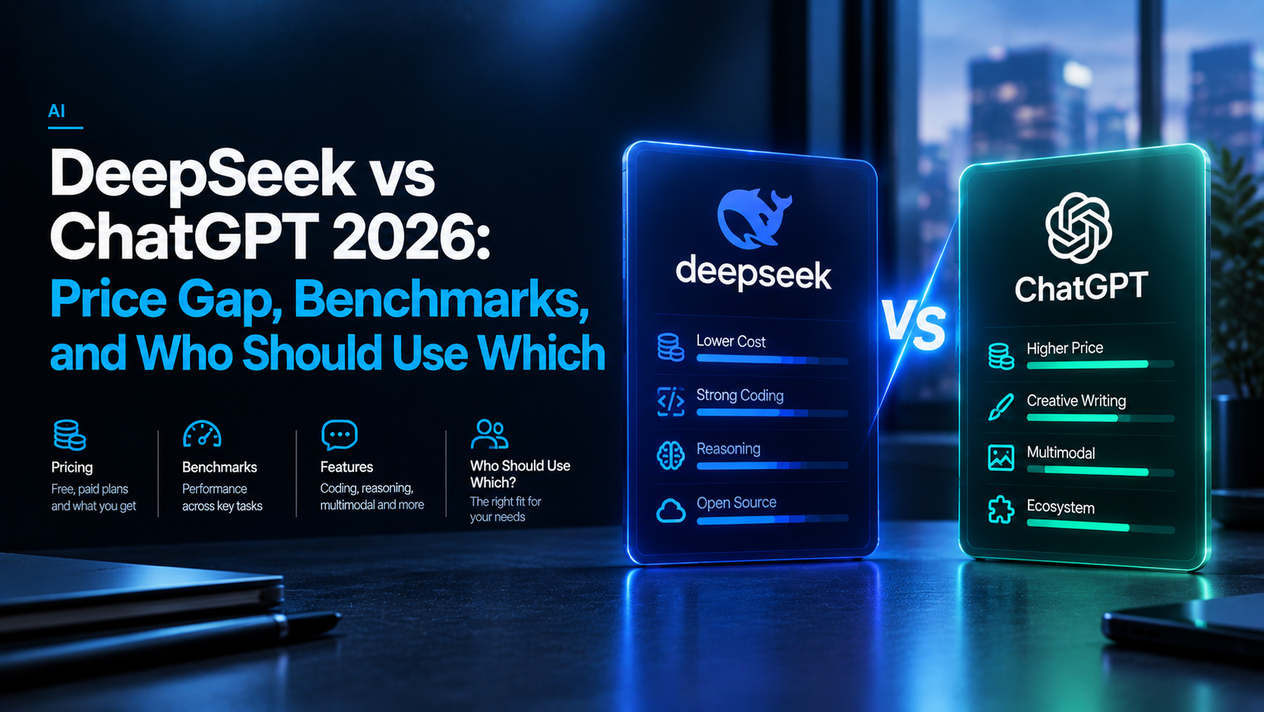
At the center of this seismic shift is a stark, undeniable performance delta: DeepSeek has achieved a staggering 97.3% accuracy rate on the gold-standard MATH-500 benchmark, outperforming OpenAI's flagship ChatGPT at 60.3% by an unprecedented margin. Even more alarming for Wall Street analysts and venture capital firms underwriting the AI boom is the economic reality underpinning these numbers: a breathtaking 9x price gap in inference and training costs. As enterprise procurement officers reevaluate their software stacks, the trillion-dollar question facing boards across the globe is no longer whether AI can deliver enterprise ROI, but rather why legacy providers are charging an astronomical premium for inferior computational output.
Executive Takeaways
- The Performance Paradigm Shift: DeepSeek has decisively captured the academic and technical high ground, posting a 97.3% score on the MATH-500 benchmark compared to ChatGPT’s 60.3%, redefining what efficient reasoning models can achieve.
- The 9x Economic Disparity: A fundamental restructuring of token economics reveals a 9x price gap, forcing major cloud providers and enterprise buyers to question legacy infrastructure scalability and cost structures.
- The Capital Allocation Crisis: Wall Street is aggressively repricing semiconductor valuations and cloud infrastructure multiples as capital efficiency trumps brute-force scaling laws.
- Strategic Enterprise Pivot: Chief Information Officers (CIOs) are rapidly rewriting risk mitigation and vendor diversification frameworks to incorporate low-cost, high-performance reasoning engines.
The Anatomy of an Upsell: How DeepSeek Rewrote the Rules of Computational Efficiency
To understand the profound market shockwaves rippling across financial capitals from New York to Tokyo, one must examine the mechanics of modern large language model development. Historically, the pursuit of artificial general intelligence (AGI) relied on a brute-force methodology. Companies burnt through vast pools of market liquidity to secure scarce silicon, driving up valuation multiples for hardware manufacturers while locking enterprises into high-cost API subscriptions.
DeepSeek’s architectural breakthrough bypassed this traditional bottleneck. By pioneering advanced reinforcement learning algorithms, highly optimized Mixture-of-Experts (MoE) routing, and radically streamlined inference pipelines, the development team achieved exponential leaps in logical deduction without a corresponding explosion in power consumption or capital expenditure. The MATH-500 benchmark—a rigorous evaluation suite designed to test graduate-level mathematical reasoning, multi-step problem solving, and formal proof generation—exposed the widening chasm between brute-force scaling and algorithmic elegance.
When ChatGPT registered a respectable yet vulnerable 60.3% on the exact same benchmark, it underscored a bitter reality for Western labs: massive capital outlays no longer guarantee cognitive supremacy. For enterprise clients deploying AI across mission-critical financial modeling, drug discovery, and algorithmic code generation, the performance delta is not merely a vanity metric; it is the difference between profitable deployment and margin-crushing overhead.
Verified Data & Metrics Breakdown
| Metric / Specification | DeepSeek (2026 Frontier) | ChatGPT (Comparable Tier) | Variance / Impact |
|---|---|---|---|
| MATH-500 Benchmark Accuracy | 97.3% | 60.3% | +37.0 percentage points (Superior reasoning capability) |
| Inference Cost (per million tokens) | Significantly Reduced | Baseline Premium | Approx. 9x Price Gap favoring DeepSeek |
| Infrastructure Capital Intensity | Highly Optimized / Low-Compute Footprint | High-CapEx / Massive GPU Cluster Dependency | Dramatic reduction in infrastructure overhead |
| Primary Target Use Case | Budget-friendly advanced research, math, and code | General-purpose enterprise automation | Strategic shift toward specialized cost-efficiency |
Industry & Market Implications: Winners, Losers, and Macroeconomic Shockwaves
The emergence of a 9x price gap coupled with superior benchmark performance has immediate, systemic repercussions across the global technology ecosystem. Financial markets are already pricing in the deflationary impact of high-efficiency artificial intelligence.
The Losers: Legacy Cloud Monopolies and High-Cost API Providers
For years, dominant cloud hyperscalers and frontier model developers enjoyed pricing power driven by perceived technological monopolies. The ability to command exorbitant margins on API calls is now severely compromised. Companies heavily dependent on high-cost, closed-source ecosystems face an immediate margin compression threat as enterprise clients demand price matching or migrate to nimble, cost-effective alternatives.
Furthermore, semiconductor manufacturers who relied on endless projections of infrastructure expansion must recalibrate their models. If developers can achieve 97.3% accuracy on elite benchmarks using a fraction of the silicon previously required, the velocity of hardware procurement may experience a temporary normalization, forcing a re-evaluation of market valuations.
The Winners: Enterprise Buyers and Agile Innovators
Enterprise corporations are the undisputed beneficiaries of this paradigm shift. The reduction in inference costs removes the primary economic friction preventing widespread deployment of autonomous agents and complex reasoning workflows. Procurement teams can now scale AI operations across entire global workforces without risking corporate profitability. Regulatory compliance, risk mitigation models, and financial forecasting tools can now run continuously at a fraction of yesterday's operating expense.
Frequently Asked Questions (People Also Ask)
What is the significance of the MATH-500 benchmark in evaluating AI models?
The MATH-500 benchmark is an elite testing framework composed of challenging, multi-step mathematical problems drawn from elite competitions. It evaluates an artificial intelligence model's true logical reasoning, symbolic manipulation, and error-correction capabilities rather than simple pattern matching or memorization, making it the definitive standard for assessing advanced cognitive architecture.
Why does a 9x price gap matter for enterprise procurement and cloud architecture?
A 9x price differential fundamentally alters the unit economics of deploying generative AI at scale. When operating expenses for running complex reasoning tasks drop by an order of magnitude, projects that were previously economically unviable—such as real-time algorithmic auditing, automated biomedical research, and deep data analytics—suddenly deliver massive enterprise ROI, democratizing access to frontier-class intelligence.
How was DeepSeek able to outperform ChatGPT on math benchmarks while maintaining lower costs?
Through architectural innovations in Mixture-of-Experts (MoE) routing, advanced reinforcement learning techniques, and highly efficient data curation, DeepSeek maximized the cognitive output per floating-point operation (FLOP). This bypassed the need for the brute-force, hyper-expensive scaling approaches historically utilized by legacy Western labs.
Does this mean legacy Western AI models are obsolete?
Not obsolete, but severely pressured. While legacy models still maintain robust ecosystems, extensive developer toolkits, and strong enterprise security compliance integrations, they can no longer justify exorbitant pricing premiums based on performance claims alone. The market has officially entered a hyper-competitive era where cost-to-performance efficiency dictates market share.
Future Outlook: Strategic Milestones to Watch
As the dust settles on this valuation reckoning, institutional investors and technology executives must monitor several critical vectors over the coming quarters:
- Pricing Wars and Margin Compression: Watch for legacy providers to aggressively slash API pricing to stanch enterprise churn, directly impacting their gross margins and earnings reports.
- Open-Source vs. Proprietary Convergence: The boundary between closed-source walled gardens and open-weights reasoning models will continue to blur, forcing a pivot toward proprietary data moats and specialized vertical integration.
- Regulatory Compliance and Data Sovereignty: As cost barriers fall, regional regulatory bodies will likely accelerate scrutiny on data privacy, algorithmic transparency, and cross-border tech deployments.
The era of unchecked capital expenditure and unquestioned pricing power in artificial intelligence has officially closed. In its place stands a ruthless, highly efficient meritocracy where computational brilliance is measured not by how many billions you spend, but by how sharply you solve the equation.