Executive Takeaways
Test Our Free AI & Tech Utilities Suite
Calculate LLM API token costs, analyze article dwell-time, or simulate tech DCA returns.
- Unprecedented Precision at 3,500 Meters: European research consortiums are deploying KM3NeT, a multi-site subsea optical observatory submerged up to 3,500 meters off the coasts of Italy and France, designed to measure subatomic particles and test the absolute boundaries of Albert Einstein's Special and General Relativity.
- Testing Lorentz Invariance: By monitoring high-energy cosmic neutrinos passing through the Earth, researchers are actively searching for "Lorentz Invariance Violation" (LIV)—a potential breakdown in the constancy of the speed of light that could unveil a unified theory of Quantum Gravity.
- High-Stakes Capital Allocation: Funded by a European investment exceeding €250 million, the infrastructure demands cutting-edge subsea fiber optics, extreme-pressure hardware engineering, and real-time petabyte-scale data processing architectures.
- Dual-Use Industrial & Defense Spillover: The technology underpinning deep-sea neutrino detection is catalyzing breakthroughs in anti-submarine acoustic surveillance, commercial subsea telecom resiliency, oceanographic climate telemetry, and specialized photonics manufacturing.
Introduction: Searching for Flaws in the Fabric of Spacetime

For more than a century, Albert Einstein’s theories of Special (1905) and General Relativity (1915) have served as the foundational bedrock of modern physics. From predicting gravitational lensing to enabling modern orbital GPS navigation, Einstein’s field equations have withstood every experimental test thrown at them. However, a profound incompatibility remains at the heart of fundamental physics: General Relativity describes a smooth, deterministic spacetime fabric at cosmological scales, whereas Quantum Mechanics governs a probabilistic, discrete subatomic realm. Merging these two titan paradigms into a single, unified theory of "Quantum Gravity" represents the holy grail of modern science.
To break the stalemate, experimental physicists have turned their sight to one of the most inhospitable environments on Earth: the dark, high-pressure depths of the Mediterranean Sea. Here, beneath thousands of meters of water, scientists are deploying kilometer-scale arrays of hyper-sensitive optical detectors. Their target is the neutrino—an elusive, ghostly subatomic particle with infinitesimally small mass and no electric charge that travels across cosmic distances virtually unimpeded.
By analyzing how these cosmic messengers propagate through space and interact within deep-water basins, researchers are stress-testing the core tenets of Special Relativity, specifically targeting potential violations of Lorentz Invariance. If light or ultra-high-energy particles vary in speed even by a fraction of a fraction of a percent depending on their energy energy levels, Einstein’s assertion that the speed of light in a vacuum is a universal constant will be disrupted, unlocking the first direct empirical doorway into quantum spacetime.
Engineering the Abyss: The Architecture of KM3NeT
Detecting astrophysical neutrinos requires an immense transparent target medium. While Antarctic experiments like IceCube freeze detectors into solid glacial ice, the European Cubic Kilometre Neutrino Telescope (KM3NeT) consortium chose the hyper-abyssal waters of the Mediterranean Sea. KM3NeT operates across two primary deep-water sites:
- KM3NeT/ARCA (Astroparticle Research with Cosmics in the Abyss): Situated 80 kilometers off the coast of Capo Passero, Sicily, at a depth of 3,500 meters. ARCA focuses on detecting high-energy cosmic neutrinos originating from extreme galactic and extragalactic phenomena like blazars, supernovae, and neutron star mergers.
- KM3NeT/ORCA (Oscillation Research with Cosmics in the Abyss): Located 40 kilometers off Toulon, France, at a depth of 2,450 meters. ORCA is optimized for lower-energy atmospheric neutrinos to study neutrino mass ordering and fundamental particle oscillations.
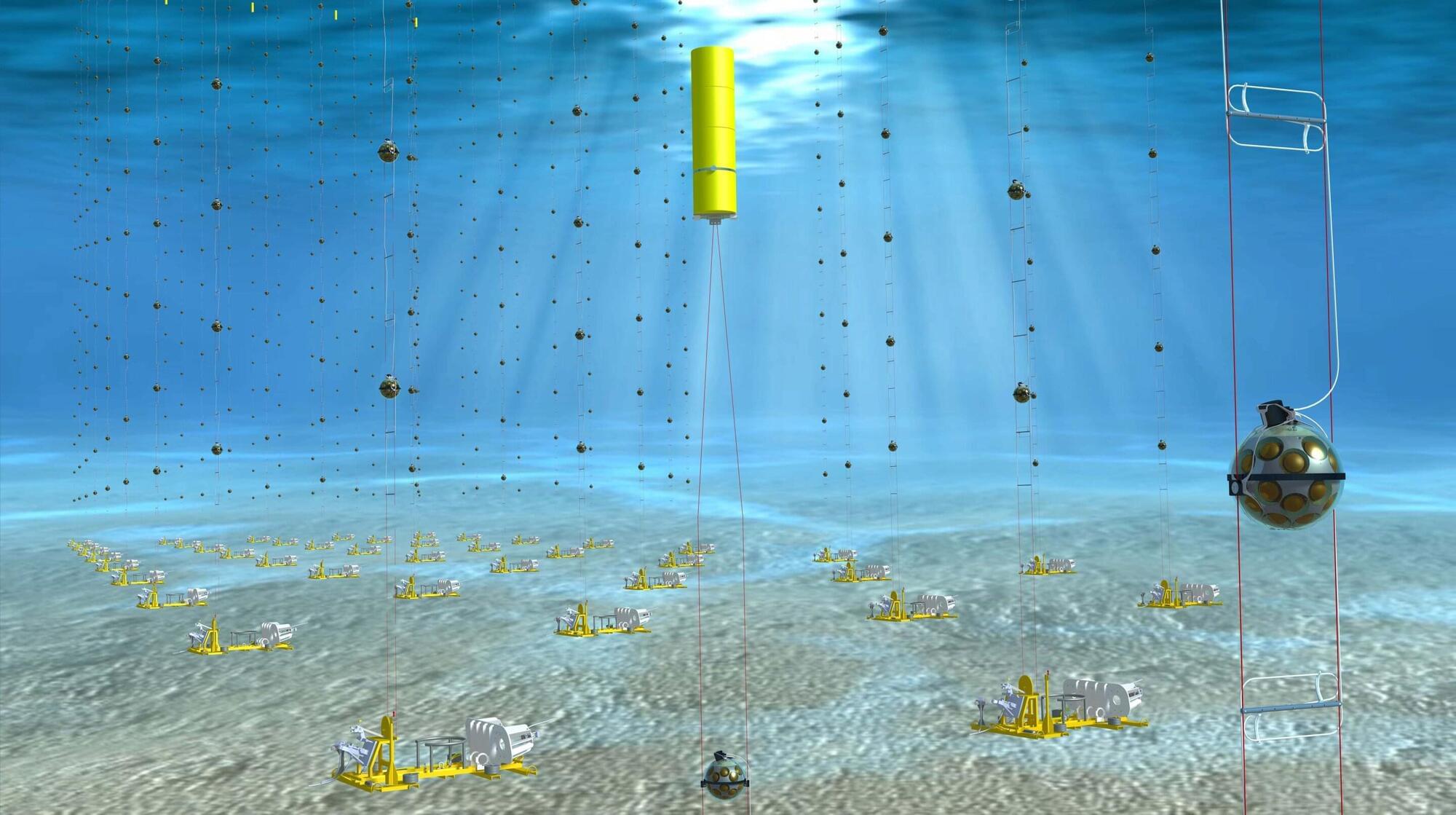
The engineering requirements for these installations represent an extraordinary feat of subsea infrastructure. Each installation consists of vertical flexible structures known as "Detection Units" (DUs), anchored to the seabed and held erect by submerged buoys. Each DU stands hundreds of meters tall and hosts dozens of Digital Optical Modules (DOMs)—pressure-resistant glass spheres engineered to withstand over 350 atmospheres of hydrostatic pressure.
Inside each glass DOM reside 31 small, high-efficiency photomultiplier tubes (PMTs), custom-designed to register Cherenkov radiation. When a high-energy neutrino collides with an atom of water in or near the detector array, it generates a relativistic charged particle (such as a muon) moving faster than the speed of light in water. This produces a faint, blue optical shockwave—Cherenkov light. The array of PMTs captures the timing of these optical signals with sub-nanosecond precision, allowing supercomputers to reconstruct the particle’s trajectory, energy, and origin with staggering accuracy.
The Physics Breakdown: How Deep-Sea Neutrinos Challenge Einstein
Why use deep-sea neutrinos to test Einstein’s laws rather than terrestrial particle accelerators like CERN's Large Hadron Collider? The answer lies in energy scales and baseline distance.
1. Lorentz Invariance Violation (LIV)
A core pillar of Special Relativity is Lorentz Invariance: the principle that the laws of physics—including the speed of light in a vacuum ($c$)—are identical for all observers, regardless of their velocity or inertial frame of reference. However, several candidate theories of Quantum Gravity (such as Loop Quantum Gravity and String Theory) suggest that at extremely small length scales (the Planck scale, approximately $10^{-35}$ meters), spacetime may not be smooth, but rather "foamy" or quantized.
This spacetime foam would act as a dispersive medium. Under such models, ultra-high-energy neutrinos traveling across billions of light-years would experience minute speed variations proportional to their energy. Over astronomical baselines, even an infinitesimal speed modification accumulates into a measurable time delay upon arrival at Earth. KM3NeT’s ability to measure the arrival time and directional flavor of high-energy neutrinos provides the world's most sensitive laboratory for putting strict upper bounds on Lorentz Invariance Violation.
2. Equivalent Principle and Quantum Oscillations
Einstein’s Equivalence Principle—the foundational core of General Relativity—states that the gravitational force experienced locally is identical to the pseudo-force experienced in a uniformly accelerating frame. In quantum physics, neutrinos oscillate between three "flavors" (electron, muon, and tau) as they travel. If gravitational fields interact differently with different neutrino flavors (a violation of the Equivalence Principle), it would alter the expected pattern of flavor oscillations observed as atmospheric neutrinos pass straight through the Earth's core to reach the ORCA detectors.
Comparative Infrastructure Matrix: Subsea vs. Glacial Physics Megaprojects
To evaluate the structural magnitude and scientific capacity of the Mediterranean subsea observatory, the table below compares key metrics against preceding and contemporary neutrino research facilities.
| Facility / Parameter | KM3NeT (ARCA & ORCA) | ANTARES (Predecessor) | IceCube (South Pole) |
|---|---|---|---|
Industrial, Enterprise, and Market Implications
While the fundamental science pursued by KM3NeT addresses theoretical physics, the enterprise ROI and technological spillovers generated by constructing ultra-deep marine observatories are delivering tangible commercial value to telecom, defense, and high-performance computing industries.
1. High-Bandwidth Subsea Telecom & Sensor Resiliency
Deploying optical sensor arrays at 350 bar pressure requires advanced subsea fiber-optic junction boxes, electro-optical wet-mateable connectors, and customized power delivery networks. The subsea telecom sector is directly leveraging hardware advances developed for KM3NeT to optimize the reliability of transcontinental submarine fiber cables. Companies specializing in subsea cable infrastructure have refined cable armor, optical signal amplifiers, and deep-sea repeaters based on environmental stress testing conducted at these research sites.
2. Dual-Use Defense Infrastructure: Acoustic Submarine Warfare (ASW)
The PMT optical DOMs are co-located with arrays of ultra-sensitive acoustic hydrophones used for calibration and positioning. These hydrophones record continuous, high-fidelity deep-ocean acoustic data. In an era of heightened geopolitical tension and subsea infrastructure vulnerability, this continuous acoustic network offers NATO and allied defense agencies unprecedented baseline acoustic mapping of the Mediterranean basin. The data assists in monitoring commercial traffic, seismic activity, marine mammal migrations, and covert submarine movements, illustrating clear dual-use capital efficiency.
3. Edge Computing and Data Architecture Demands
Because deep-sea water exhibits natural bioluminescence and background radioactive decay from Potassium-40 ($^{40}\text{K}$), KM3NeT's optical sensors stream enormous quantities of noisy raw data to shore. Instead of performing optical hardware triggering underwater, the facility employs an "all-data-to-shore" architecture. Raw data is continuously piped over optical fiber to onshore computing centers, requiring complex custom field-programmable gate arrays (FPGAs), real-time filtering algorithms, and scalable enterprise cloud analytics. The computational architecture pioneered here provides a blueprint for edge computing environments handling high-throughput sensor telemetry in industrial IoT, energy exploration, and aerospace applications.
Frequently Asked Questions (People Also Ask)
How does a deep-sea observatory test Albert Einstein's theories?
Einstein’s Special Relativity asserts that light travels at a constant speed in a vacuum regardless of its energy. Quantum gravity theories predict that spacetime at microscopic scales may cause subtle speed variations for ultra-high-energy particles. By tracking cosmic neutrinos traveling billions of light-years to deep-sea detectors in the Mediterranean, scientists can measure whether high-energy neutrinos experience arrival delays compared to lower-energy counterparts, directly testing the validity of Lorentz Invariance.
Why build a neutrino detector at the bottom of the Mediterranean Sea instead of on land?
Neutrinos interact extremely weakly with matter; trillions pass through your body every second unhindered. To detect them, scientists require an enormous, optically transparent volume of material where a collision can produce visible light. Deep ocean water serves as both a natural shield against background cosmic rays and a giant target medium. The deep sea is pitch black, allowing ultra-sensitive photomultipliers to detect the faint Cherenkov radiation generated by subatomic interactions.
What is the difference between IceCube at the South Pole and KM3NeT in the Mediterranean?
While IceCube uses deep Antarctic ice as its medium, KM3NeT uses deep ocean water. Water offers superior optical properties in terms of light scattering compared to ice, allowing KM3NeT to achieve higher directional angular resolution when identifying the exact cosmic source of a incoming neutrino. Additionally, being situated in the Northern Hemisphere gives KM3NeT an unobstructed view of the Milky Way’s galactic center.
What is Lorentz Invariance Violation (LIV), and why is it important?
Lorentz Invariance is the foundational symmetry of Special Relativity, stating that physical laws remain unchanged under speed boosts or directional rotations. If experimenters discover a violation (LIV), it would demonstrate that the speed of light is not universally constant for all energies. This would provide the first experimental evidence that spacetime is quantized, paving the way for a unified "Theory of Everything" that connects gravity with quantum mechanics.
Future Outlook: Strategic Milestones to Watch (2025–2030)
The KM3NeT project continues to expand towards its full operational footprint. Over the coming years, strategic milestones will mark critical inflection points for both physical sciences and deep-tech investments:
- Full Array Deployment (2025–2028): Continuous maritime operations deploying additional Detection Units will increase KM3NeT’s target volume beyond a cubic kilometer, drastically elevating detector sensitivity to rare astrophysical events.
- Joint Multi-Messenger Alerts: Integration into the global Multi-Messenger Astronomy Network will allow real-time automated cross-triggers between KM3NeT, gravitational wave observatories (LIGO, Virgo, KAGRA), and space telescopes (JWST, Fermi).
- Definitive Tests of Neutrino Mass Ordering: Within the next decade, data from the ORCA array near Toulon is projected to definitively measure the neutrino mass hierarchy, resolving one of particle physics' longest-standing open questions.
- Standardization of Subsea Optical Grids: The robust fiber-optic and deep-sea oceanographic sensing architectures established by KM3NeT are set to serve as the baseline blueprint for the European Multidisciplinary Seafloor and Water Column Observatory (EMSO), directly expanding environmental climate forecasting and marine conservation data pipelines.
As deep-sea robotic deployments continue off the coasts of Sicily and France, scientists are demonstrating that answers to the grandest cosmic mysteries—and the ultimate fate of Einstein's legacy—may ultimately be fished out of the darkest depths of our oceans.