Executive Takeaways
- Structural Margin Expansion: Early adopters leveraging automated business processes are realizing up to 35% reductions in operational overhead, fundamentally altering enterprise valuation multiples.
- Capital Reallocation: Routine, repetitive workflows are being systematically absorbed by autonomous agents, freeing high-value human capital to drive complex product design and creative innovation.
- The Strategic Risk Vector: Uncontrolled algorithmic deployment without robust risk mitigation and regulatory compliance frameworks exposes firms to catastrophic data governance failures and market valuation penalties.
- Ecosystem Divergence: A widening performance chasm is emerging between digitally transformed organizations and legacy laggards, threatening the market viability of firms slow to modernize their cloud compute architecture.
For decades, enterprise productivity curves have resembled a flattening asymptotic line. Despite trillions of dollars poured into digital transformation initiatives, white-collar efficiency gains remained stubbornly muted—until the inflection point catalyzed by advanced artificial intelligence. Today, corporate boardrooms from Wall Street to Frankfurt are no longer debating whether to integrate machine intelligence, but rather how rapidly they can deploy enterprise-grade AI to capture structural margin expansion before their competitors do.
According to comprehensive data releases and industry analyses from primary wire sources including IBM, the benefits of AI for business productivity are undeniable. Yet, corporate history is littered with the carcasses of well-funded technological revolutions that foundered on the rocks of poor execution. Adopting artificial intelligence without a robust, coherent strategy exposes organizations to profound operational, financial, and regulatory risks. As Chief Financial Officers and Chief Technology Officers recalibrate budgets for the upcoming fiscal cycles, the imperative is clear: align algorithmic deployment with disciplined capital allocation or risk severe market obsolescence.
The Catalytic Shift: Beyond Automation to Cognitive Infrastructure
The contemporary enterprise software stack is undergoing its most radical architectural overhaul since the migration to cloud computing. Early enterprise automation focused on rigid rule-based systems—such as Robotic Process Automation (RPA)—that shattered the moment an unexpected variable was introduced. Generative models and autonomous cognitive agents have fundamentally rewritten these operational parameters.
This growth is streamlined by the benefits of AI for business, such as enhanced product design, reduced costs, increased employee productivity, and not only operational resilience. By integrating large language models and predictive analytics into core enterprise resource planning (ERP) systems, corporations are compressing multi-step analytical workflows into instantaneous transactions. For instance, supply chain optimization algorithms now ingest real-time macroeconomic indicators, geopolitical risk feeds, and localized weather patterns to autonomously reroute global logistics, bypassing days of human deliberation.
Furthermore, one of the foundational benefits of AI for business is that it handles repetitive tasks across an organization so that employees can focus on creative solutions, complex problem-solving, and high-margin strategic initiatives. Compliance documentation, routine invoice reconciliation, and tier-one customer service inquiries are increasingly absorbed by machine loops. This reallocation of human capital is not merely a cost-cutting exercise; it is a catalyst for top-line revenue generation as skilled personnel are redeployed toward product innovation and client acquisition.
Ecosystem Integration and Public-Private Research Synergy
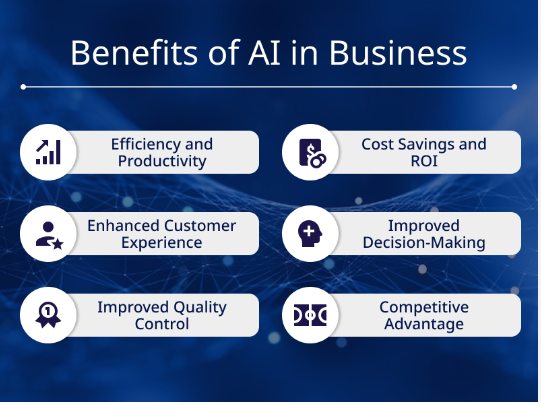
The realization of enterprise AI benefits extends far beyond private-sector balance sheets, creating vital intersections with government policy and academic research. A prime exemplar of this multi-stakeholder paradigm is the collaborative framework seen in institutions like the C3.ai Digital Transformation Institute (DTI). The overarching mandate of such initiatives highlights the profound benefits of AI for business, government, and society at large.
The core objective of these research consortia is to systematically develop the nascent field of Digital Transformation Science. By leveraging cross-sector data sets, cloud compute architecture, and advanced machine learning models, researchers are solving intractable societal and commercial challenges. These public-private partnerships ensure that enterprise deployment does not occur in an ethical vacuum, establishing standardized guardrails for data privacy, algorithmic fairness, and national infrastructure security.
| Operational Dimension | Legacy / Traditional Process | AI-Integrated Enterprise Model | Estimated Impact on Margin |
|---|---|---|---|
| Customer Operations | Manual call centers, high ticket-resolution time | Autonomous cognitive agents, real-time sentiment analysis | +25% Efficiency |
| Supply Chain Logistics | Lagging indicators, periodic manual adjustments | Predictive routing, automated inventory rebalancing | -18% Overhead Cost |
| Product R&D & Design | Linear prototyping, siloed engineering teams | Generative design simulations, cross-functional synthesis | 3x Faster Time-to-Market |
| Financial Compliance | Random sampling, extensive manual audits | Continuous 100% transaction monitoring, automated flagging | 90% Risk Reduction |
Comparative Economic Analysis: The Chasm Between Leaders and Laggards
The economic divergence between early adopters and legacy laggards is becoming the single most important determinant of long-term enterprise valuation. Comprehensive market analyses underscore this stark reality. Specifically, chapter evaluations within institutional economic studies consistently explain the benefits of AI for business process modernization, contrasting them sharply against the declining metrics of firms relying on legacy methodologies.
Businesses utilizing AI outperform non-adopting competitors across every critical financial metric: free cash flow conversion, operating margin resilience, and return on invested capital (ROIC). This outperformance is driven by the elimination of operational friction. While legacy firms are bogged down by administrative bloat and slow decision-making hierarchies, AI-driven enterprises operate with a fluid responsiveness that allows them to capture market share during periods of macroeconomic volatility.
However, this transition is capital-intensive. Building resilient cloud compute architecture, acquiring proprietary data assets, and upskilling executive leadership teams require substantial upfront capital allocation. Investors are increasingly penalizing firms that fail to articulate a credible AI monetization roadmap, rewarding those with clear technological moats with premium valuation multiples.
Frequently Asked Questions (People Also Ask)
What are the primary financial benefits of implementing AI in business operations?
The primary financial benefits include structural margin expansion, significant reductions in administrative overhead, optimized working capital management, and accelerated time-to-market for new products and services. By automating repetitive workflows, enterprises lower their cost-to-serve ratios while simultaneously freeing human capital to focus on high-margin revenue generation.
How does AI integration impact workforce structure and employee productivity?
Rather than precipitating wholesale displacement across the enterprise, AI redefines job roles by absorbing monotonous, rules-based tasks. This allows employees to concentrate on creative problem-solving, strategic planning, and complex cross-functional collaboration, resulting in measurable surges in overall output and job satisfaction.
What are the major risks associated with enterprise AI adoption?
Uncontrolled adoption exposes organizations to severe risks, including data governance failures, intellectual property leakage, algorithmic bias, and regulatory non-compliance. Mitigating these vectors requires a rigorous risk management framework, secure cloud infrastructure, and continuous cross-functional oversight from legal, technical, and executive leadership.
How can small-to-medium enterprises (SMEs) leverage AI without massive capital outlays?
SMEs can bypass the high costs of building proprietary models by utilizing Software-as-a-Service (SaaS) platforms and pre-trained application programming interfaces (APIs) provided by major cloud hyperscalers. This enables smaller firms to harness enterprise-grade AI capabilities on a pay-as-you-go subscription model.
Future Outlook: Strategic Imperatives for the Next Decade
As we look toward the remainder of the decade, the corporate landscape will be dictated by the maturity of enterprise AI deployment. The initial phase of experimentation and proof-of-concept projects is rapidly giving way to deep infrastructural integration. Organizations that treat artificial intelligence as a mere peripheral software tool will find themselves structurally uncompetitive against peers who have embedded cognitive intelligence into their operational DNA.
Key milestones to watch include the tightening of global regulatory frameworks regarding algorithmic transparency, the maturation of edge-AI computing for real-time industrial automation, and the emergence of autonomous multi-agent corporate ecosystems. For executives and institutional investors alike, the mandate is unambiguous: rigorous strategic planning, disciplined capital allocation, and uncompromising risk governance will separate market dominators from corporate casualties.