Executive Takeaways
- Frontier Restructuring: On August 10, 2026, OpenAI officially scaled its elite "Daybreak" cybersecurity initiative, fundamentally altering how enterprise defense systems leverage generative intelligence.
- The GPT-5.6-Cyber Vector: The rollout introduces GPT-5.6-Cyber, a specialized, high-parameter frontier model engineered specifically for proactive threat hunting, autonomous vulnerability patching, and real-time adversarial simulation.
- Collapsing Timelines: The strategic shift comes as industry data confirms the "cyber defense window"—the time it takes for malicious actors to weaponize a zero-day vulnerability—has compressed to historic lows under 60 minutes.
- Capital Reallocation: Fortune 500 CISOs and enterprise boardrooms are aggressively shifting capital allocation toward autonomous defense architecture, fundamentally transforming valuation multiples across legacy cybersecurity portfolios.
SAN FRANCISCO & NEW YORK — In the high-stakes theater of global cybersecurity, the tactical balance of power shifted dramatically on August 10, 2026. OpenAI’s official publication of "Expanding Daybreak as the Cyber Defense Window Narrows" marks a watershed moment not just for artificial intelligence, but for the fundamental mechanics of digital defense and economic infrastructure resilience. By aggressively expanding its frontier-AI-for-cybersecurity initiative, Daybreak, and introducing the proprietary GPT-5.6-Cyber model, OpenAI has thrown down the gauntlet against state-sponsored syndicates and sophisticated ransomware cartels that have increasingly weaponized generative AI.
For months, enterprise risk officers, cloud compute architects, and national security agencies have monitored a chilling convergence: offensive cyber actors utilizing automated loops to discover, exploit, and monetize enterprise vulnerabilities faster than human security operations centers (SOCs) can triage alerts. The response from San Francisco underscores a sobering market reality: manual security is no longer economically or technically viable at scale. As enterprise digital surfaces expand into complex multi-cloud and hybrid environments, the defense window has collapsed. Daybreak’s expansion is designed to buy back that lost time through autonomous, machine-speed remediation.
The Catalytic Shift: Why Daybreak Needed an Overhaul
Test Our Free AI & Tech Utilities Suite
Calculate LLM API token costs, analyze article dwell-time, or simulate tech DCA returns.
Launched initially as an experimental sandbox for vetted security researchers and allied defense agencies, the Daybreak initiative was conceived to bridge the gap between theoretical AI capabilities and concrete operational security. However, as threat actors adopted automated polymorphic malware and LLM-driven social engineering campaigns throughout late 2025 and mid-2026, the original parameters of Daybreak proved insufficient.
The August 10 restructuring addresses this deficit by tearing down legacy operational silos. OpenAI has integrated its most advanced reasoning architectures directly into enterprise security workflows. At the heart of this expansion is GPT-5.6-Cyber, an iterative leap forward that transcends traditional language modeling. Unlike its predecessors, which required extensive manual prompt engineering and human-in-the-loop oversight for complex defensive tasks, GPT-5.6-Cyber operates with native agentic autonomy. It can ingest millions of lines of proprietary legacy code, map intricate Active Directory topologies, simulate nation-state attack vectors, and deploy zero-downtime virtual patches across enterprise infrastructure in fractions of a second.
"We are no longer discussing theoretical efficiencies; we are managing an absolute operational emergency," noted a senior infrastructure partner at a leading Silicon Valley venture capital firm tracking enterprise software risk mitigation. "When the time between code deployment and weaponized exploit drops below an hour, human analysts become the bottleneck. Daybreak and GPT-5.6-Cyber represent the architectural counter-offensive required to restore capital liquidity and operational stability to the digital economy."
Inside GPT-5.6-Cyber: Capabilities and Compute Architecture
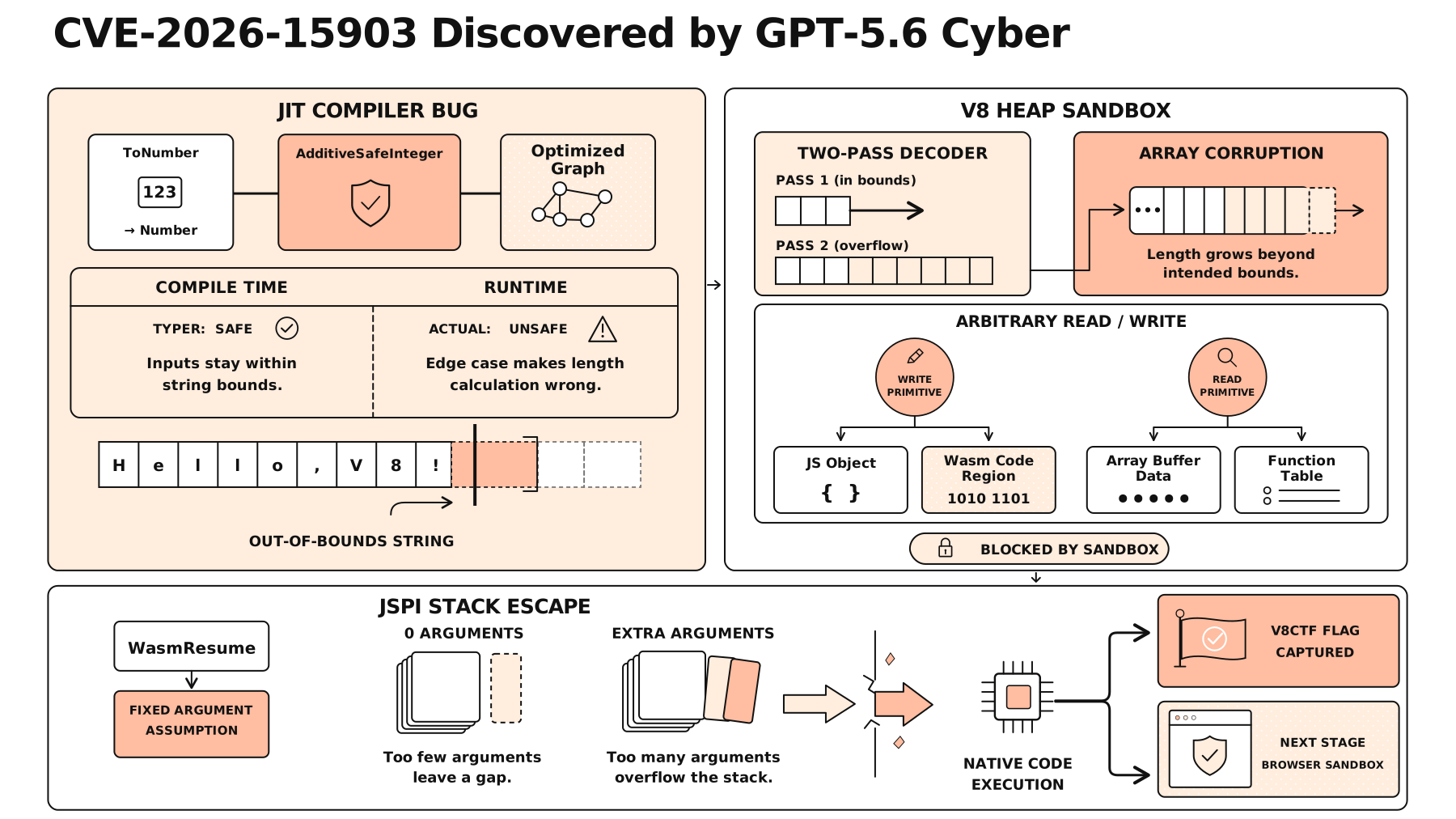
The technical specifications released alongside the Daybreak announcement reveal an unprecedented allocation of cloud compute architecture. GPT-5.6-Cyber utilizes an optimized Mixture-of-Experts (MoE) routing framework tailored specifically for binary analysis, network telemetry interpretation, and cryptographic verification.
- Autonomous Threat Hunting: Continuous, unprompted scanning of internal perimeter logs to identify anomalous lateral movement indicative of advanced persistent threats (APTs).
- Zero-Day Mitigation: Real-time heuristic evaluation that constructs defensive sandboxes around unpatched software libraries the moment suspicious behavioral signatures are detected.
- Adversarial Simulation: Controlled red-teaming protocols that allow enterprise CISOs to stress-test their resilience against simulated quantum-decrypt and multi-vector ransomware attacks before they manifest in production.
- Regulatory Compliance Automation: Instant mapping of defensive adjustments against evolving international standards, including the EU Artificial Intelligence Act, SEC cybersecurity disclosure mandates, and critical infrastructure directives.
This level of enterprise integration demands massive infrastructure scalability. Cloud providers and semiconductor manufacturers are already seeing downstream surges in specialized GPU demand as Fortune 500 corporations race to deploy localized instances of GPT-5.6-Cyber behind strict enterprise-grade perimeter firewalls, ensuring data sovereignty and preventing model poisoning.
Verified Data & Metrics Breakdown
To contextualize the urgency behind the Daybreak expansion, industry telemetry from leading threat intelligence firms highlights the stark economic and operational realities facing corporate boards today.
| Metric / Indicator | Pre-GPT-5.6 Baseline (2024–2025) | Current Post-Daybreak Standard (August 2026) | Strategic Impact |
|---|---|---|---|
| Zero-Day Exploitation Window | 14 to 28 days average | Under 60 minutes | Elimination of human-speed patching cycles. |
| SOC Alert Triage Time | 4.5 hours per high-severity incident | < 12 seconds (Autonomous) | Drastic reduction in analyst burnout and missed signals. |
| Enterprise Cyber Spend Allocation | 8.4% of total IT budget | 14.2% and accelerating | Massive capital shift toward autonomous AI defense platforms. |
| False Positive Rate (Advanced SIEM) | 38% to 52% | < 3.5% (GPT-5.6-Cyber Reasoning) | Substantial improvement in operational efficiency and signal clarity. |
Industry & Market Implications: Winners and Losers
The economic fallout from OpenAI’s aggressive expansion of Daybreak is already reverberating across global financial markets. Valuation multiples for traditional, signature-based cybersecurity vendors face severe downward pressure as institutional investors re-evaluate software-as-a-service (SaaS) portfolios. Firms that rely on legacy rule engines and reactive alerting are finding themselves priced out of enterprise RFPs in favor of platforms capable of native autonomous reasoning.
Conversely, hyper-scalers, specialized semiconductor fabrication enterprises, and next-generation AI security startups are experiencing unprecedented market liquidity. Private equity and venture capital syndicates are aggressively deploying dry powder into foundational model security layers, viewing autonomous cyber defense as an indispensable utility comparable to enterprise cloud infrastructure or power grids.
However, significant regulatory and geopolitical friction remains. Critics and international policymakers have raised valid concerns regarding the dual-use nature of models as powerful as GPT-5.6-Cyber. While designed for defensive orchestration, the underlying reasoning engines can theoretically be co-opted or jailbroken by bad actors to accelerate offensive operations. OpenAI’s governance framework attempts to mitigate this by gating access through stringent vetting protocols, requiring institutional KYC (Know Your Customer) compliance, and embedding tamper-proof telemetry tracing within every deployed instance.
Frequently Asked Questions (People Also Ask)
What is OpenAI’s Daybreak initiative?
Daybreak is OpenAI’s dedicated strategic initiative and collaborative sandbox designed to harness frontier artificial intelligence for advanced cybersecurity defense. Restructured significantly on August 10, 2026, it unites enterprise security leaders, researchers, and allied agencies to deploy machine-speed threat detection and automated remediation.
How does GPT-5.6-Cyber differ from standard language models?
GPT-5.6-Cyber is a specialized, high-parameter frontier model optimized specifically for binary analysis, code comprehension, and autonomous security agent loops. Unlike standard conversational models, it features native multi-step reasoning architectures built to investigate anomalies, simulate sophisticated cyber-attacks, and deploy patches without human intervention.
Why is the "cyber defense window" narrowing?
The cyber defense window is narrowing due to the widespread adoption of AI-driven automation by malicious syndicates. Automated discovery tools allow threat actors to weaponize software vulnerabilities in under 60 minutes, rendering traditional human-managed security operations centers (SOCs) inadequate without the backing of autonomous AI defenses.
What are the primary enterprise ROI drivers for adopting Daybreak tools?
Key return-on-investment (ROI) drivers include dramatic reductions in SOC alert triage times (from hours to seconds), minimization of false-positive fatigue, avoidance of catastrophic ransomware downtime liabilities, and optimized capital allocation compared to maintaining bloated, manually staffed security teams.
Future Outlook: What Comes Next
As the digital landscape absorbs the shockwaves of the Daybreak expansion, the next twelve months will serve as a definitive stress test for autonomous enterprise defense. Market observers will be monitoring several critical milestones:
- Regulatory Harmonization: Watch for coordinated international frameworks from the G7 and transnational bodies seeking to establish standardized safety baselines for autonomous cybersecurity models.
- Integration Velocity: The speed at which Fortune 500 enterprises successfully migrate from legacy SIEM (Security Information and Event Management) architectures to fully autonomous AI reasoning loops.
- Offensive Escalation: How state-sponsored threat groups adapt their offensive tactics in response to automated, sub-minute enterprise patching and defensive counter-reconnaissance.
One reality remains indisputable: the era of human-paced cybersecurity has officially drawn to a close. With Daybreak and GPT-5.6-Cyber, the battle lines of the digital economy are now drawn at the speed of light, forcing corporations to embrace autonomous defense or face obsolescence.