Executive Takeaways
- First-Hand Ground Truth: Founders Mike Murchison and David Hariri spent months working undercover as frontline customer service agents, discovering systemic operational friction that became the architectural blueprint for Ada.
- The Closed-Loop Paradigm: Moving beyond simple transactional chatbots, Ada builds fanatical customer experience (CX) loops that feed contextual interaction data directly back into enterprise AI agents for continuous optimization.
- Enterprise Copilot Deployment: Ada's copilot infrastructure delivers real-time, context-aware reply suggestions that drastically reduce Average Handling Time (AHT) while ensuring strict regulatory compliance and risk mitigation.
- Venture Backing & Market Validation: Endorsements from tier-1 institutional investors like Bessemer Venture Partners highlight the massive enterprise appetite for scalable, automated CX infrastructure capable of driving predictable ROI.
SAN FRANCISCO & TORONTO — In the high-stakes arena of enterprise software, customer experience (CX) has historically been treated as a cost center—a sprawling, human-heavy operational expense characterized by high turnover, training bottlenecks, and unpredictable ticket volumes. But as generative artificial intelligence matures from a speculative board-room buzzword into a core operational utility, a fundamental architectural shift is underway. At the vanguard of this transformation is Ada, an AI-native customer automation platform that has methodically redefined how global enterprises interact with their customer base.
Backed by heavyweight institutional backing from firms like Bessemer Venture Partners, Ada’s trajectory offers a masterclass in enterprise software disruption. By solving the complex engineering challenge of building self-improving CX loops, the company has positioned itself as essential infrastructure for brands navigating the turbulent transition toward fully autonomous AI agents.
From the Support Trench to the C-Suite: The Genesis of Ada
To understand Ada’s current market dominance, one must look backward to its origin story. Unlike many Silicon Valley startups born in sterile accelerator rooms, Ada’s founders, Mike Murchison and David Hariri, took an unorthodox, highly rigorous approach to problem validation. Before writing a single line of production code or courting venture capital, Murchison and Hariri spent months embedded as frontline customer service agents.
Working the digital trenches, answering angry consumer inquiries, parsing fragmented knowledge bases, and managing chaotic ticketing queues provided the founders with irreplaceable ground truth. They experienced firsthand the crippling limitations of legacy software: brittle rule-based decision trees, disconnected data silos, and agents drowning in repetitive tasks while burning out under immense psychological pressure.
This prolonged immersion revealed a glaring market gap. Enterprises did not need another incremental workflow tool; they needed an entirely new architectural paradigm. They needed a system capable of handling complex human intent at scale while maintaining rigorous brand governance and data security. This insight catalyzed the creation of Ada’s foundational architecture—a system engineered from the ground up to mimic the adaptability of top-tier human agents while leveraging the infinite compute and memory scaling of modern large language models (LLMs).
Architecting Fanatical CX Loops: The Engine Behind Autonomous AI Agents

In modern enterprise architecture, the phrase "customer experience loop" is frequently weaponized as marketing jargon. However, under Ada's technical framework, the closed-loop system is a rigorously engineered data pipeline. Traditional chatbots operate on static scripts: a user inputs a query, the system matches keywords, and if it fails, the user is summarily routed to a human agent—breaking the conversational continuity and fracturing the customer journey.
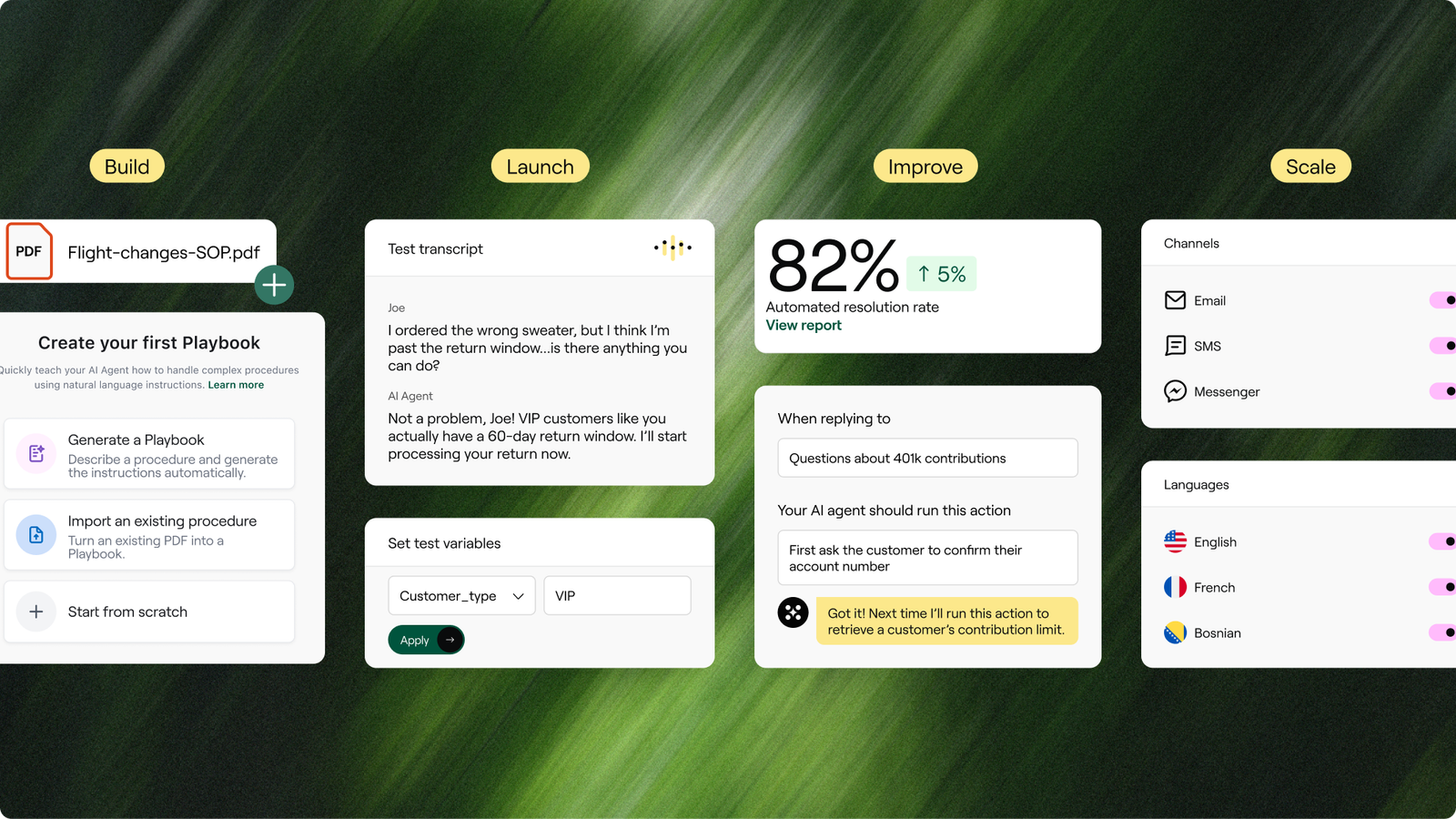
Ada’s platform fundamentally alters this dynamic by establishing a continuous, self-optimizing feedback loop:
- Contextual Ingestion: When a customer initiates an interaction across any channel—whether web, mobile app, SMS, or social messaging—Ada’s semantic routing layer ingests historical account data, CRM records, and real-time behavioral telemetry.
- Autonomous Execution: Rather than merely retrieving static documents, Ada’s AI agents execute multi-step workflows. They can verify user identities, process refunds, modify subscription tiers, and update enterprise databases via secure API calls without human intervention.
- The Learning Loop: Crucially, every resolution, edge-case failure, and human escalation is captured, vectorized, and fed back into the training pipeline. This infrastructure ensures that the AI agent continuously refines its decision-making parameters, resulting in escalating resolution rates over time.
This closed-loop methodology directly addresses enterprise concerns regarding infrastructure scalability and risk mitigation. By ensuring that the AI agent learns organically from brand-specific interactions, companies can deploy autonomous agents that sound, reason, and act with hyper-specific brand alignment.
Inside the Enterprise Deployment: Powering Copilots and Human Agents
While full autonomy is the ultimate destination, the enterprise transition requires a sophisticated co-pilot infrastructure to bridge the gap between human-led and machine-led operations. Ada’s deployment framework is explicitly engineered for this hybrid reality.
A prime example of this is the rollout of Ada’s advanced agent copilot. Designed to assist human customer service representatives rather than replace them outright, the copilot acts as an omniscient digital assistant during live customer interactions. Key technical capabilities of this deployment include:
- Real-Time Reply Suggestions: As conversations unfold, the copilot analyzes dialogue sentiment and intent, instantly generating context-aware response suggestions for the human agent.
- Dynamic Knowledge Synthesis: Instead of forcing agents to manually search through sprawling internal wikis, the system surfaces exact policy clauses, troubleshooting steps, and refund protocols within milliseconds.
- Post-Call Automation: Upon conversation closure, the copilot auto-generates conversation summaries, updates CRM fields, and tags qualitative customer sentiment data for executive review.
For enterprise chief technology officers and chief financial officers, this dual-pronged approach—combining fully autonomous AI agents for tier-1 inquiries with intelligent copilots for complex escalations—delivers immediate, measurable enterprise ROI. It dramatically slashes Average Handling Time (AHT), curtails training costs, and stabilizes employee turnover metrics.
| Operational Metric | Legacy Support Infrastructure | Ada Closed-Loop AI Architecture |
|---|---|---|
| Resolution Speed | Hours to days (queue-dependent) | Sub-second instantaneous response |
| First-Contact Resolution (FCR) | Historically capped at 45% - 60% | Frequently exceeds 75% - 85% via automated loops |
| Data Integration | Siloed databases; high friction | Unified API orchestration & real-time telemetry |
| Continuous Optimization | Manual script updates & periodic audits | Automated vector-based learning loops |
Industry & Market Implications: Who Wins and Who Loses?
The rapid enterprise adoption of Ada’s closed-loop AI infrastructure signals a profound market realignment. As venture capital firms like Bessemer continue to pour dry powder into generative CX infrastructure, the ripple effects are being felt across the broader technology and business services landscape.
The Winners: Enterprises that embrace autonomous CX loops early are unlocking unprecedented capital efficiency. By decoupling revenue growth from headcount scaling, these organizations can expand customer support operations globally without incurring linear cost increases. Furthermore, tech-forward BPO (Business Process Outsourcing) providers who transition their business models from headcount arbitrage to software-augmented service delivery are capturing higher-margin advisory and management contracts.
The Losers: Legacy software vendors tethered to rigid, rules-based ticketing systems are facing an existential crisis. If incumbents fail to aggressively refactor their tech stacks into AI-native, closed-loop architectures, they risk rapid customer churn. Additionally, traditional BPO firms reliant entirely on massive low-wage labor pools are facing severe pricing pressure as enterprise buyers demand automated efficiency and predictable software-driven outcomes.
Frequently Asked Questions (People Also Ask)
What distinguishes Ada’s AI agents from traditional customer service chatbots?
Traditional chatbots rely on rigid decision trees and exact keyword matching, frequently failing when customers deviate from expected scripts. Ada utilizes advanced generative AI and closed-loop data architectures that understand complex human intent, execute multi-step backend actions securely, and continuously learn from every interaction to improve future performance autonomously.
How does Ada ensure enterprise data security and regulatory compliance?
Ada’s infrastructure is engineered with enterprise-grade security protocols, including SOC 2 Type II compliance, GDPR adherence, and rigorous data encryption standards. Customer data is compartmentalized, ensuring that proprietary enterprise telemetry is never cross-contaminated or utilized to train public foundational models without explicit authorization.
What role do human agents play in Ada’s deployment model?
Human agents remain vital for high-empathy, highly complex, or heavily nuanced escalations. Ada empowers these human operators through its advanced copilot suite, which delivers real-time reply suggestions, automated conversation summaries, and instant knowledge-base retrieval to drastically lower handling times.
What kind of financial ROI can enterprises expect when implementing Ada?
Enterprises typically achieve rapid ROI through a combination of reduced operational headcount expansion, lower Average Handling Times (AHT), increased First-Contact Resolution (FCR) rates, and significant decreases in customer churn driven by instantaneous, 24/7 personalized support.
Future Outlook: The Road Ahead for Autonomous CX
As we look toward the remainder of 2026 and beyond, the trajectory of customer experience automation is clear. The boundary between software and service is permanently dissolving. Companies like Ada are no longer viewed merely as software vendors, but as essential architectural partners orchestrating the cognitive frontline of global commerce.
Key milestones to watch in the immediate future include deeper integrations with enterprise resource planning (ERP) and supply chain systems, allowing AI agents to autonomously manage complex transactional disputes such as multi-leg shipping delays and dynamic inventory rerouting. Furthermore, as regulatory scrutiny surrounding automated decision-making intensifies globally, platforms that successfully blend absolute data governance with high-velocity autonomous learning will capture dominant market share.
For executive leadership teams, the mandate is unambiguous: treating customer experience as an operational afterthought is no longer viable. The future belongs to those who architect fanatical, self-optimizing CX loops—turning what was once a burdensome operational cost center into an unassailable competitive advantage.