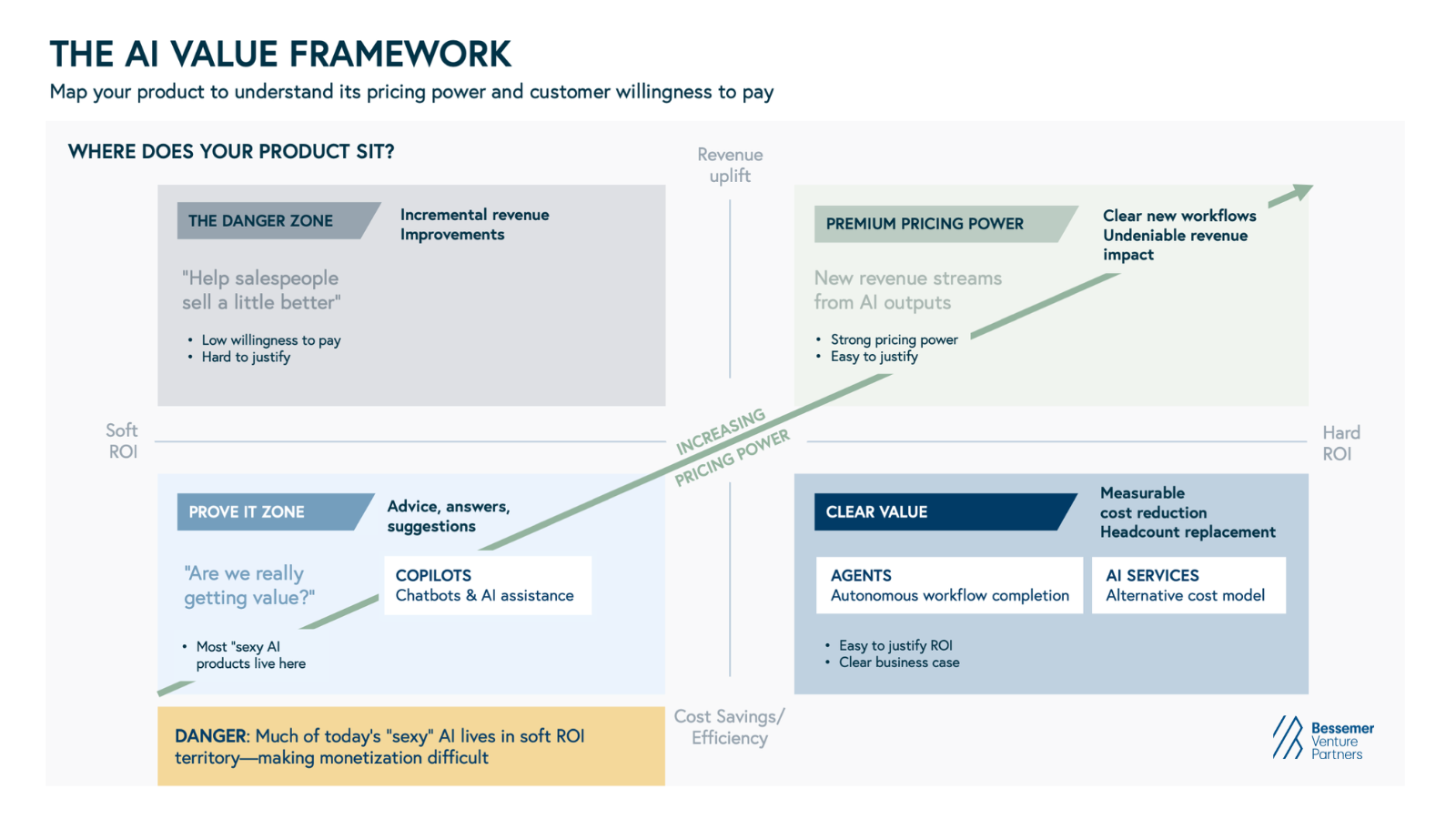
- The Token Dilemma: Traditional Software-as-a-Service (SaaS) gross margins of 80%+ are collapsing under the weight of heavy inference costs, forcing a structural pivot in venture-backed tech.
- Value-Based Hybrid Models: Market leaders are abandoning pure usage-based and flat-rate tiers, deploying outcome-based and seat-hybrid pricing strategies to protect enterprise valuation multiples.
- The Bessemer Benchmark: Landmark intelligence released by Bessemer Venture Partners codifies the exact commercial blueprints deployed by category-defying unicorns like Intercom, EvenUp, and DeepL.
- Capital Allocation Shift: Corporate buyers now demand verifiable enterprise ROI and rigorous risk mitigation before signing multi-million-dollar AI infrastructure commitments.
SAN FRANCISCO & NEW YORK — For three decades, the software industry operated on a deceptively simple economic gravity: write code once, copy it infinitely at near-zero marginal cost, and price it on a predictable per-seat subscription model. That era is officially over. As generative artificial intelligence transitions from a flashy corporate science experiment to core enterprise infrastructure, venture capital firms, boardrooms, and chief financial officers are grappling with a brutal reality check. Every prompt, every parameter adjustment, and every synthesized token burns compute cycles, draining gross margins faster than traditional revenue can scale.
Into this high-stakes vacuum steps a definitive new blueprint: The AI Pricing and Monetization Playbook, published by premier venture capital firm Bessemer Venture Partners. Released as one of the most eagerly anticipated strategic frameworks of the tech sector, the analysis deconstructs how modern software dynasts are rewriting the rules of value capture. Drawing on hard-fought lessons from category leaders such as Intercom, EvenUp, DeepL, Leena AI, and Sett, the playbook provides an urgent navigational guide for founders attempting to survive the margin compression plaguing the modern tech ecosystem.
The Structural Collapse of Traditional SaaS Economics
To understand the urgency behind the Bessemer framework, one must examine the fundamental fracture in cloud economics. Traditional enterprise software enjoyed gross margins hovering comfortably between 75% and 85%. Sales and marketing absorbed the bulk of early capital, but once a customer was acquired, serving them incremental data required negligible overhead. Generative AI shatters this paradigm.
Running frontier Large Language Models (LLMs) requires massive GPU cluster allocations, expensive cloud compute architecture, and relentless vector database queries. Consequently, raw inference costs act as a permanent tax on top-line growth. Early-stage AI startups that rushed to market with flat-fee subscriptions or un-capped usage tiers quickly discovered that their power users—those leveraging the tool for heavy, automated workflows—were actively destroying unit economics.
“We are witnessing a wholesale restructuring of software valuation multiples,” says a senior enterprise software investor tracking capital allocation trends in Silicon Valley. “When your cost of goods sold (COGS) scales linearly with customer engagement, a per-seat pricing model is a slow-motion suicide pact. Founders must tie monetization directly to economic utility.”
Deconstructing the Playbook: How Market Leaders Capture Value

The Bessemer playbook highlights a vital evolution in monetization strategy: moving away from primitive billing models toward sophisticated, multi-dimensional structures. Modern AI product leaders are discovering that enterprises do not want to pay for tokens—they want to pay for business outcomes.
1. Outcome-Based and Value-Driven Pricing
In the legal tech sector, for instance, category leader EvenUp bypasses traditional seat licenses by pricing software directly against the measurable output of the workflow—in their case, analyzing medical chronologies and personal injury demand packages. By aligning software costs with the tangible financial and operational gains of the buyer, EvenUp protects its margins while capturing a healthy percentage of the economic value created.
2. The Usage-Plus-Platform Hybrid
Pure usage-based pricing introduces revenue volatility, making it difficult for enterprise CFOs to forecast annual recurring revenue (ARR). Conversely, flat-rate tiers invite margin abuse. The playbook demonstrates how companies like customer service automation pioneer Intercom successfully deployed hybrid models. Customers pay a predictable platform base fee for foundational access, supplemented by metered consumption tiers for automated AI resolutions. This balances predictability for enterprise budgeting with downside protection for the vendor's cloud infrastructure costs.
3. Language Localization and Latency Arbitrage
DeepL illustrates another nuanced dimension of the playbook: monetizing specialized linguistic accuracy and enterprise-grade security at scale. By positioning its translation models not as generic chatbot wrappers, but as mission-critical enterprise localization engines with strict regulatory compliance and data privacy guarantees, DeepL commands premium pricing power that undercuts legacy human translation costs while preserving healthy software margins.
| Company | Primary Vertical | Monetization Strategy | Core Economic Advantage |
|---|---|---|---|
| Intercom | Customer Service AI | Hybrid (Platform Base + Per-Resolution) | Mitigates compute volatility while scaling with automation volume. |
| EvenUp | Legal Tech / Personal Injury | Outcome & Value-Based Pricing | Captures a percentage of the economic efficiency delivered to law firms. |
| DeepL | AI Translation & Localization | Tiered SaaS + Enterprise API Volume | Commanding pricing power via unmatched translation fidelity and data security. |
| Leena AI | HR & Employee Experience | Per-Employee-Per-Month (PEPM) Hybrid | Aligns enterprise HR budgets with automated ticket resolution capacity. |
Industry & Market Implications: Who Wins, Who Loses
The transition codified in the Bessemer analysis carries profound consequences for global capital markets, private equity portfolios, and corporate procurement departments.
The Winners: Enterprise software startups that successfully transition from feature-wrapper status to indispensable workflow engines will command premium valuation multiples. Venture capitalists will increasingly reward companies demonstrating gross margin resilience and clear net revenue retention (NRR) expansion loops driven by value realization rather than forced seat inflation.
The Losers: Shallow "wrapper" startups—companies that build minimal proprietary UI layers on top of foundational models without proprietary data moats or workflow integration—face an existential reckoning. As cloud providers and frontier model labs (such as OpenAI, Anthropic, and Google) bake native workflow capabilities directly into their base tiers, undifferentiated software businesses will see their pricing power evaporate entirely.
Furthermore, enterprise procurement officers are adopting a highly defensive posture. Armed with stringent risk mitigation frameworks, IT buyers now demand transparent cost-per-inference metrics, verifiable data governance protocols, and guaranteed Service Level Agreements (SLAs) before onboarding third-party AI systems.
Frequently Asked Questions (People Also Ask)
Why are traditional per-seat SaaS pricing models failing for artificial intelligence products?
Traditional SaaS models assume near-zero marginal costs for delivering software to additional users. Generative AI products, however, incur high inference and compute costs (GPU utilization, vector database queries) for every prompt and interaction. If a power user consumes excessive compute under a flat per-seat or flat-fee subscription, the company's gross margins collapse. Monetization must account for underlying infrastructure expenses.
What is outcome-based pricing in the context of enterprise AI?
Outcome-based pricing ties the software's cost directly to the measurable economic value or business result it delivers—such as the number of legal demand packages drafted, automated customer support tickets resolved, or hours of manual HR labor saved. This aligns the software vendor's revenue directly with the client's ROI, enabling higher pricing power.
How does the Bessemer Venture Partners playbook help AI founders?
The playbook provides actionable frameworks, real-world case studies (featuring companies like Intercom and EvenUp), and structural guidance on how to transition away from unstable usage-only or flat-rate pricing. It outlines how to design hybrid monetization structures that protect gross margins, optimize infrastructure scalability, and satisfy enterprise procurement requirements.
What metrics should CFOs and investors track when evaluating AI software startups?
Key metrics include gross margin stability (adjusting for inference COGS), Net Revenue Retention (NRR) driven by usage expansion, Customer Acquisition Cost (CAC) payback periods, and the ratio of compute cost per dollar of Annual Recurring Revenue (ARR). Ensuring these metrics remain healthy separates durable enterprise platforms from transient feature wrappers.
Future Outlook: What Comes Next
As we advance through 2026, the artificial intelligence landscape is entering a mature phase of commercial discipline. The era of unchecked cash burn subsidized by cheap venture capital has officially closed. Boardrooms no longer reward top-line growth fueled by unprofitable token consumption.
Over the next 12 to 18 months, market consolidation will accelerate. Startups that fail to adopt the hybrid, value-driven pricing architectures outlined in the Bessemer playbook will face distressed acquisitions or orderly wind-downs. Conversely, disciplined operators who successfully master infrastructure scalability, regulatory compliance, and outcome-based monetization will secure dominant market liquidity, commanding elite valuation multiples in both public and private markets. For founders and investors alike, the message is unequivocal: master the monetization playbook, or surrender your margins to the cost of compute.



/odishatv/media/media_files/2026/09/07/spider-man-brand-new-day-2026-09-07-19-46-42.jpg)