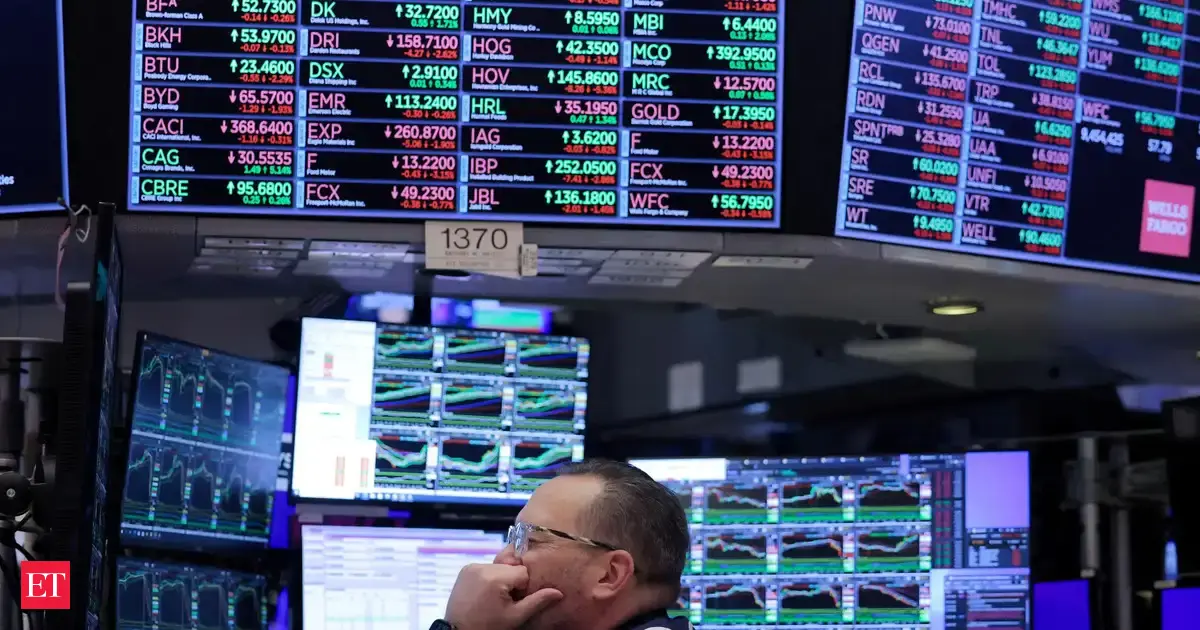
NEW YORK — Global financial markets entered a period of intense, white-knuckle volatility this morning as Dow Jones Industrial Average, S&P 500, and Nasdaq Composite futures oscillated between marginal gains and sharp, algorithmic-driven losses. This precarious state follows one of the most punishing single-session sell-offs in recent quarters. Institutional trading desks are navigating an increasingly treacherous macroeconomic landscape, caught in the crosshairs of aggressive capital reallocation, shifting monetary policy expectations, and deteriorating valuation multiples across both mega-cap technology stalwarts and cyclical industrials.
With the Bureau of Labor Statistics (BLS) scheduled to release the headline Employment Situation Report at 8:30 a.m. Eastern, risk management has become the paramount mandate for Chief Investment Officers, hedge fund managers, and primary dealers alike. The impending labor market data is no longer viewed merely as an indicator of economic health; it is the ultimate diagnostic tool determining whether the Federal Reserve can successfully engineer a soft landing or if equity valuations must undergo a deeper, more structural risk-mitigation phase.
Executive Takeaways
Test Our Free AI & Tech Utilities Suite
Calculate LLM API token costs, analyze article dwell-time, or simulate tech DCA returns.
- High-Stakes Macro Catalyst: Equity futures remain locked in a tight, nervous range as institutional investors brace for the monthly non-farm payrolls print, which will dictate the Federal Reserve's next interest rate trajectory.
- Systemic De-Grossing: This week's brutal sell-off exposed vulnerability in stretched valuation multiples, triggering aggressive stop-loss execution, systemic de-grossing, and a flight toward defensive cash equivalents.
- Sector-Wide Capital Rotation: Portfolio managers are aggressively reevaluating capital allocation, rotating out of high-beta growth assets and heavily leveraged enterprise tech into high-yield fixed income and defensive consumer staples.
- Liquidity Compression: Order book depth has thinned significantly, exacerbating intraday price swings and magnifying volatility across major index ETFs and single-stock options chains.
Anatomy of a Sell-Off: The Catalyst Behind the Carnage

The roots of the current market spasm trace back to a confluence of hotter-than-expected labor cost metrics, persistent sticky inflation prints, and a sudden realization by institutional allocators that terminal interest rates may remain higher for longer. For months, equity markets traded on the optimistic assumption of an imminent, aggressive monetary easing cycle by the central bank. However, recent macroeconomic releases have systematically dismantled that thesis.
As Treasury yields pushed toward multi-month highs, the discount rate applied to future corporate cash flows jumped commensurately. This shift immediately punished high-growth, long-duration assets. Enterprise software providers, semiconductor fabrication giants, and cloud infrastructure leaders saw their valuation multiples compressed as institutional investors recalculated equity risk premiums. The resulting sell-off was not merely a retail-driven panic; it was a textbook institutional deleveraging event. Prime brokers reported a surge in margin calls, forcing systematic macro funds and quantitative long/short equity strategies to liquidate profitable positions across the board to meet liquidity requirements.
Furthermore, corporate guidance from bellwether industrial and retail conglomerates has highlighted mounting pressures on operating margins. Executives across multiple sectors have pointed to rising compliance costs, wage inflation, and constrained enterprise IT spending as headwinds that threaten earnings per share (EPS) growth for the upcoming fiscal quarters. Consequently, the consensus narrative has shifted from uninterrupted expansion to cautious capital preservation, forcing a brutal re-pricing of risk.
Verified Data & Metrics Breakdown
To understand the magnitude of the current market positioning, it is critical to analyze the key quantitative indicators driving trading desk behavior heading into today's jobs report:
| Market Indicator / Metric | Current Reading | Historical Average / Target | Market Implication |
|---|---|---|---|
| S&P 500 Forward P/E Ratio | 21.4x | 17.8x (10-Year Average) | Elevated valuation leaves equities vulnerable to further earnings downgrades and macroeconomic shocks. |
| Cboe Volatility Index (VIX) | 19.85 | 16.50 | Signals heightened anxiety and increased options hedging activity among institutional portfolio managers. |
| U.S. 10-Year Treasury Yield | 4.48% | 3.85% (Trailing 12-Month) | Increases borrowing costs for corporations and offers a compelling risk-free yield alternative to equities. |
| Non-Farm Payrolls (Consensus Estimate) | 175,000 | 200,000 (Prior 6-Month Trend) | A reading significantly above or below this range will trigger immediate, high-amplitude algorithmic trading responses. |
Industry & Market Implications: Winners, Losers, and Systemic Risk
The current market bifurcation has created clear winners and losers across the economic landscape. Understanding these dynamics is essential for institutional capital allocation and corporate risk mitigation strategies.
The Losers: High-Beta Growth & Leveraged Enterprises
Sectors heavily reliant on low interest rates and continuous capital injections are bearing the brunt of the correction. High-growth technology firms, unprofitable biotech startups, and consumer discretionary companies facing shrinking demand are experiencing sharp multiple contractions. Corporations with near-term debt refinancing schedules face a daunting reality: servicing debt at current market rates will cannibalize free cash flow, dampening future enterprise ROI and forcing management teams to slash capital expenditures and infrastructure scalability budgets.
The Winners: Defensive Yield, Energy, and Private Credit
Conversely, capital is finding a safe harbor in defensive sectors such as healthcare, utilities, and select consumer staples boasting resilient pricing power. Furthermore, private credit funds and institutional lenders are capitalizing on the banking sector's retrenchment, stepping in to provide structured financing at highly lucrative yields. Energy majors, supported by resilient global demand and disciplined capital allocation policies, continue to generate robust free cash flows that insulate them from broader market turbulence.
From a macroeconomic perspective, the Federal Reserve finds itself navigating a razor-thin margin. A labor report that comes in excessively hot will force the central bank to maintain restrictive policy, risking a hard landing. Conversely, a precipitous drop in job creation could signal that monetary policy has over-tightened, triggering recessionary fears. This binary outcome is precisely why market liquidity has dried up, leaving order books paper-thin and highly susceptible to headline-driven volatility.
Frequently Asked Questions (People Also Ask)
Why are stock market futures reacting so violently to the upcoming jobs report?
Stock market futures are hyper-sensitive to the monthly employment situation report because the labor market is the primary engine of consumer spending and wage inflation. The Federal Reserve explicitly relies on labor market data to determine its monetary policy stance. A stronger-than-expected jobs report suggests persistent inflationary pressures, which could prompt the Fed to keep interest rates higher for longer. Conversely, a weak report raises recession concerns, both of which negatively impact corporate earnings projections and equity valuation multiples.
What does "de-grossing" mean in the context of institutional stock sell-offs?
De-grossing refers to institutional investors and hedge funds actively reducing their total long and short exposure by selling assets and raising cash. During periods of elevated market volatility or macro uncertainty, risk managers enforce de-grossing protocols to lower portfolio beta, reduce leverage, and protect capital against sudden, systemic drawdowns in order book depth.
How do rising Treasury yields impact corporate stock valuations?
Rising Treasury yields increase the risk-free rate of return, which alters the discount rate financial analysts use to calculate the present value of a corporation's future cash flows. When this discount rate rises, the present value of future earnings drops significantly. This mathematical reality disproportionately punishes high-growth technology and infrastructure companies whose valuations are heavily dependent on cash flows projected far into the future.
What is the difference between a soft landing and a hard landing for the economy?
A "soft landing" describes a scenario where the Federal Reserve successfully cools inflation through higher interest rates without triggering a widespread economic recession or a severe spike in unemployment. A "hard landing," on the other hand, occurs when aggressive monetary tightening tips the economy into a formal recession, characterized by sharp GDP contraction, widespread corporate layoffs, and significant corporate earnings declines.
Future Outlook & What to Watch Next
As Wall Street digests the immediate aftermath of the jobs report, market participants must shift their focus to the upcoming corporate earnings season and forthcoming consumer price index (CPI) releases. The trajectory of equities through the remainder of the quarter will depend heavily on three critical milestones:
- Corporate Margin Resilience: Management commentary during Q3 and Q4 earnings calls regarding pricing power, operational efficiency, and margin protection will determine if current equity valuations are justified.
- Central Bank Forward Guidance: Speeches from Federal Open Market Committee (FOMC) officials will provide essential qualitative color on how policymakers interpret incoming labor and inflation data.
- Credit Spread Monitoring: Widening high-yield corporate credit spreads would serve as an early warning sign of systemic liquidity strain, signaling that financial stress is bleeding out of the equity market and into the broader credit ecosystem.
Ultimately, today's market turbulence represents a necessary, albeit painful, recalibration. As speculative excess is systematically purged from order books, disciplined investors who prioritize robust balance sheets, strong free cash flow generation, and sensible capital allocation will find compelling, long-term entry points amid the volatility.