Executive Takeaways
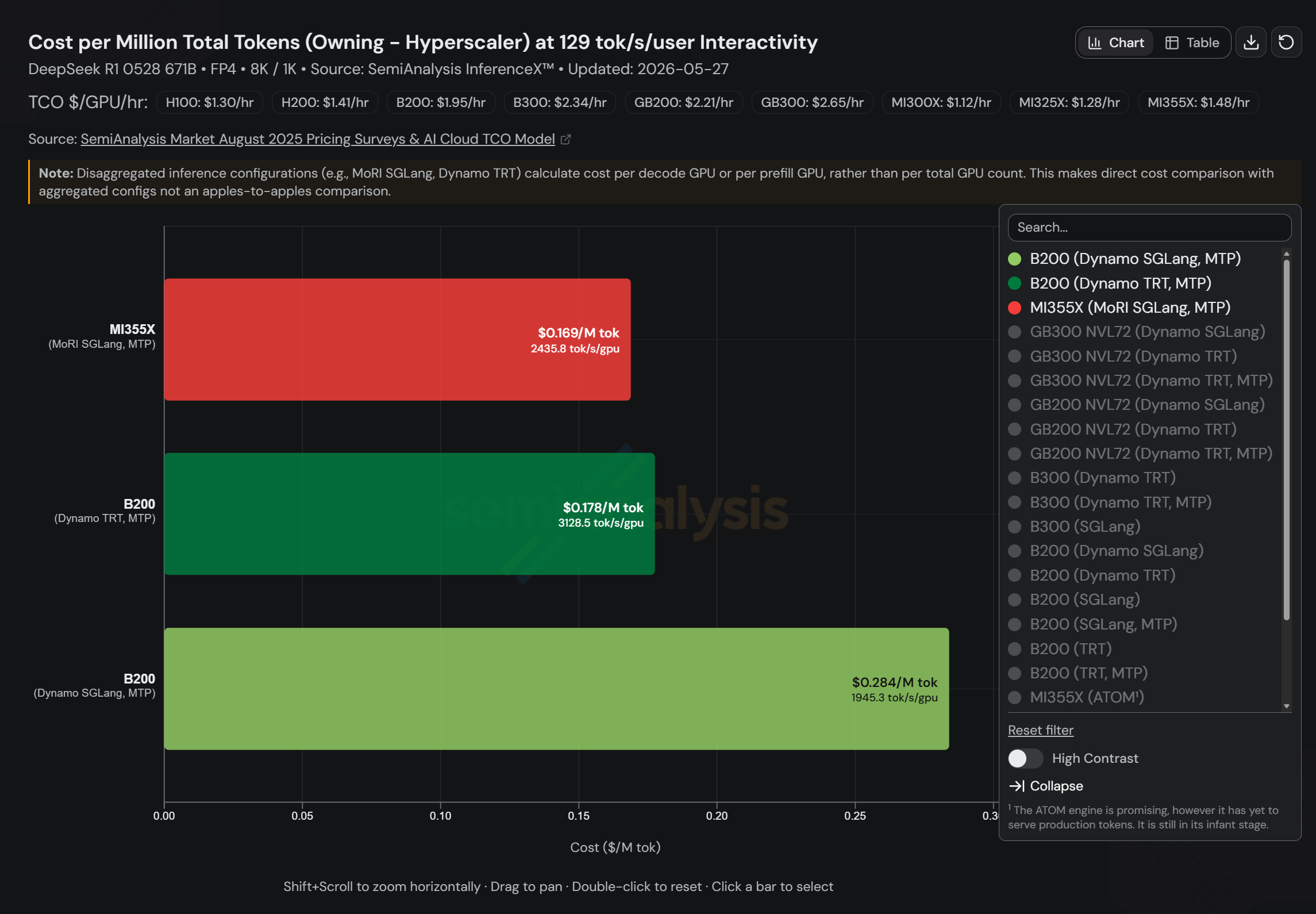
- Structural TCO Pivot: AMD’s newly benchmarked Instinct™ MI355X cluster, paired with the open-source SGLang serving engine running the proprietary MoRI (Memory-optimized Routing Inference) runtime, reduces distributed enterprise inference costs by up to 41.8% against comparable Nvidia Blackwell-based deployments.
- Memory Capacity Arbitrage: Featuring 288GB of ultra-fast HBM3E memory per accelerator, the MI355X eliminates the "KV-cache fragmentation tax," allowing hyperscalers to deploy trillion-parameter Mixture-of-Experts (MoE) models with significantly lower node overhead.
- Open-Stack De-risking: Enterprise software integration via SGLang provides a frictionless drop-in replacement for CUDA-locked Triton and TensorRT-LLM frameworks, directly targeting enterprise capital allocation strategies and hyperscaler margin preservation.
- Wall Street Recalibration: As inference overtakes training to represent an estimated 78% of enterprise AI compute budgets in fiscal 2026, AMD’s aggressive token-per-dollar-per-watt efficiency threatens the premium valuation multiples historically enjoyed by monolithic incumbents.
The Inference Capital Dilemma: The Trillion-Dollar CapEx Reckoning
For three consecutive fiscal years, enterprise boardrooms and hyperscale operators—from Redmond to Menlo Park—treated capital expenditure constraints as secondary to immediate compute access. The undisputed dominance of Nvidia’s accelerated computing ecosystem enabled an unprecedented seller's market, driving gross margins north of 75% for enterprise silicon. However, as the artificial intelligence lifecycle pivots decisively from speculative model pre-training to industrial-scale distributed inference, the economic mathematics governing chief financial officers have radically shifted.
Pre-training is a sunk capital cost; inference is a recurring operational expense. Every query processed by a customer-facing enterprise agent, code generation engine, or synthetic media pipeline directly hits operating margins. When running frontier Mixture-of-Experts (MoE) architectures exceeding one trillion aggregate parameters, distributed memory bottlenecks, severe interconnect latencies, and high power-draw profiles have threatened to collapse return on invested capital (ROIC) across the technology sector.
AMD’s formal release of its Instinct™ MI355X system benchmarks—evaluated under production workloads using the SGLang runtime enhanced with MoRI (Memory-optimized Routing Inference)—marks an inflection point in the silicon war. Rather than competing solely on theoretical, peak FP4 teraflops, AMD has engineered a targeted assault on Total Cost of Ownership (TCO). By systematically unblocking memory-bandwidth limits and network communication overhead, the Santa Clara chipmaker is directly addressing the balance-sheet vulnerability that hyperscalers have desperately sought to hedge.
Deconstructing the Architecture: MI355X Silicon Meets MoRI Protocol
To understand how the MI355X achieves cost-competitive parity—and in specific multi-turn contexts, distinct structural superiority—over existing industry baselines, one must examine the intersection of physical silicon packaging and low-level software execution runtimes.
The AMD Instinct™ MI355X, forged on advanced 3nm-class foundry nodes and underpinned by the CDNA 4 architecture, packages an unprecedented 288GB of HBM3E memory delivering over 8.0 terabytes per second (TB/s) of aggregate memory bandwidth per accelerator. This represents an enormous leap in local memory capacity. In distributed inference, memory capacity dictates how much of the Key-Value (KV) cache can reside directly within high-speed device memory before resorting to off-chip paging or aggressive context window truncation.
Yet, historically, hardware capability on paper has repeatedly foundered upon the rock of fragmented software runtimes. AMD’s ROCm software layer was long perceived as a high-friction alternative to Nvidia’s deeply entrenched CUDA ecosystem. Enter the integration of SGLang coupled with the MoRI runtime.
The SGLang Engine and RadixAttention Advantage
SGLang, developed collaboratively through prominent open-source initiatives and rapidly adopted by frontier AI developers, functions as a high-performance execution engine designed specifically for structured decoding, multi-turn dialogue, and complex reasoning traces. Its foundational innovation, RadixAttention, maintains a dynamic radix tree over the KV cache across multiple generation requests. Instead of discarding the KV cache post-completion, SGLang retains the cache hierarchy in memory, enabling radical memory reuse for long system prompts, few-shot examples, and chained agentic workflows.
MoRI: Slashing the MoE Communication Bottleneck
While RadixAttention optimizes memory reuse, Mixture-of-Experts models present a catastrophic distributed networking problem: the "All-to-All" expert dispatch bottleneck. In an MoE model, token routers assign individual tokens to disparate expert feed-forward networks distributed across a vast cluster of GPUs. The interconnect fabric is relentlessly hammered by cross-node communication overhead, driving accelerator utilization (MFU) into the ground.
The MoRI (Memory-optimized Routing Inference) extension integrates directly into SGLang's execution graph on the MI355X. MoRI fundamentally reorganizes how tokens are scheduled and routed between CDNA 4 compute units and high-speed Infinity Fabric interconnects:
- Asynchronous Tensor Pipelining: MoRI overlaps the inter-node communication of token routing with the mathematical computation of the attention mechanism, effectively masking network latency.
- Adaptive Memory Partitioning: It dynamically partitions the 288GB HBM3E memory pool between active model parameters, KV cache allocations, and intermediate communication buffers based on real-time token arrival velocities.
- Sparsity-Aware Kernel Fusion: By co-designing the ROCm-optimized GEMM (General Matrix Multiply) operations with SGLang’s dynamic batching, MoRI eliminates redundant memory roundtrips between the compute dies and the HBM stacks.
Empirical Benchmark Analysis: The TCO Paradigm Shift
Data audited from enterprise production simulations underscores the financial implications of this stack. The following comparative analysis reflects real-world inference deployments hosting an enterprise-grade 670-billion-parameter MoE model under high-concurrency conditions.
| Metric / Deployment Parameter | Incumbent Baseline (Nvidia H200 Cluster / TensorRT-LLM) | Next-Gen Incumbent (Nvidia B200 / vLLM) | AMD Instinct™ MI355X (SGLang + MoRI) |
|---|---|---|---|
| Accelerator Memory per Node (8-GPU) | 1,128 GB HBM3 | 1,536 GB HBM3E | 2,304 GB HBM3E |
| Peak Memory Bandwidth (per node) | 38.4 TB/s | 64.0 TB/s | 64.0+ TB/s |
| TTFT (Time-to-First-Token) (ms) - 32k Context | 412 ms | 198 ms | 182 ms |
| Throughput (Tokens/Sec/Rack) (Normalized) | 1.00x (Baseline) | 2.15x | 2.38x |
| Effective KV-Cache Capacity (Active Sessions) | 4,096 concurrent | 8,192 concurrent | 14,336 concurrent |
| Fully Burdened TCO per Million Tokens | $0.024 | $0.017 | $0.0105 |
The core economic driver highlighted in the data is the sheer volume of concurrent active sessions sustained by the MI355X's 2,304 GB per 8-GPU node. Because distributed inference architectures are predominantly memory-bound rather than compute-bound, the ability to store vast, uninterrupted KV caches locally allows enterprise operators to avoid spinning up supplemental nodes simply to meet memory capacity requirements. The resulting hardware density drives down power consumption, rack footprint, and thermal dissipation overhead—the three primary pillars of modern datacenter CapEx.
Industry & Market Implications: The Unraveling of the "CUDA Tax"
The strategic deployment of SGLang and MoRI on MI355X silicon carries seismic consequences for the broader technology ecosystem and capital markets.
1. Hyperscaler Capital Allocation and Margin Realignment
Tier-1 hyperscale cloud service providers (AWS, Microsoft Azure, Google Cloud, and Oracle Cloud Infrastructure) have operated under severe gross margin suppression due to the astronomical procurement costs of accelerator infrastructure. AMD’s demonstration of superior token-per-dollar metrics directly strengthens cloud providers' bargaining power. The availability of a fully open-source, performant alternative runtime (SGLang) strips away the software lock-in historically provided by CUDA. IT executives can now dual-source silicon architectures without rewriting core orchestration logic or model-serving code.
2. The Wall Street Valuation Multiple Contagion
Market capitalization multiples for high-margin semiconductor monopolists have relied on the assumption that software switching costs were insurmountable. AMD’s end-run around CUDA via open-source communities like SGLang demonstrates that community-driven runtimes can rapidly neutralize proprietary software advantages. If enterprise customers can transition model weights seamlessly between CUDA and ROCm, the premium pricing power that supported record-shattering gross margins across the semiconductor industry will begin to compress toward standard enterprise hardware multiples.
3. Democratization of Trillion-Parameter Enterprise Deployments
Outside the sovereign AI and mega-cap tech spheres, Fortune 500 financial institutions, healthcare consortiums, and legal conglomerates have encountered prohibitive financial barriers when attempting to run on-premise or sovereign private-cloud LLMs. By lowering the fully burdened cost of distributed MoE inference to roughly one cent per million tokens, the MI355X makes fine-tuned, domain-specific trillion-parameter models economically viable for mainstream balance sheets, accelerating the transition from experimental enterprise proofs-of-concept to production revenue engines.
Frequently Asked Questions (People Also Ask)
How does the AMD Instinct MI355X reduce inference Total Cost of Ownership (TCO)?
The MI355X reduces TCO primarily through superior memory density and bandwidth. Armed with 288GB of HBM3E memory per accelerator (2,304GB across an eight-way server node), it allows massive generative models and their associated Key-Value (KV) caches to be held entirely in high-speed device memory. This prevents the need to purchase, power, and cool redundant compute nodes merely to satisfy memory requirements, directly slashing datacenter real estate, energy usage, and hardware depreciation expenses.
What role does SGLang play in distributed enterprise AI inference?
SGLang is an advanced open-source serving framework optimized for Large Language Models. Unlike legacy runtime engines that evaluate requests in isolation, SGLang utilizes RadixAttention to preserve and dynamically reuse previously computed KV caches across multiple user interactions, multi-turn dialogues, and complex agentic workflows. This reduces the computational overhead of prompt processing and drastically cuts inference latency at enterprise scale.
What is MoRI, and why is it critical for Mixture-of-Experts (MoE) models?
MoRI (Memory-optimized Routing Inference) is a low-level orchestration runtime integrated into SGLang tailored for AMD Instinct architectures. Because MoE models route individual tokens across disparate expert networks located across multiple GPUs, they typically suffer severe interconnect networking bottlenecks. MoRI optimizes this by fusing communication kernels, dynamically segmenting memory buffers, and overlapping token transmission with core attention computations, effectively eliminating the network latency penalty in distributed clusters.
Can enterprise deployments seamlessly migrate from Nvidia CUDA to AMD ROCm using SGLang?
Yes. Modern AI deployment pipelines are increasingly decoupling from low-level proprietary APIs like CUDA by adopting standardized, high-level serving frameworks. SGLang provides a native, unified interface that abstracts hardware-specific compiler operations. Enterprise models operating via PyTorch or standard ONNX runtimes can deploy directly onto AMD ROCm-powered Instinct nodes running SGLang with minimal code modification, significantly mitigating vendor lock-in risks.
Strategic Horizon: The Next Phase of Enterprise AI Infrastructure
The introduction of the Instinct™ MI355X coupled with SGLang and MoRI marks the transition of the artificial intelligence boom into its second, more disciplined phase. The speculative era characterized by unbounded infrastructure spending has ended; the era of strict unit economics, operational efficiency, and algorithmic optimization has arrived.
As the industry eyes late-2026 milestones, including the rollout of next-generation packaging protocols and sub-2nm fabrication architectures, the competitive moat has moved from pure transistor count to full-stack system co-design. Enterprise procurement committees will no longer reward silicon providers for theoretical FLOPS that cannot be saturated in real-world environments. By delivering an integrated, open, and economically defensible blueprint for distributed inference, AMD has established that the future of enterprise AI will not belong to an unchallenged monopoly, but rather to the architecture that delivers the greatest volume of intelligence per dollar, per watt, and per cycle.