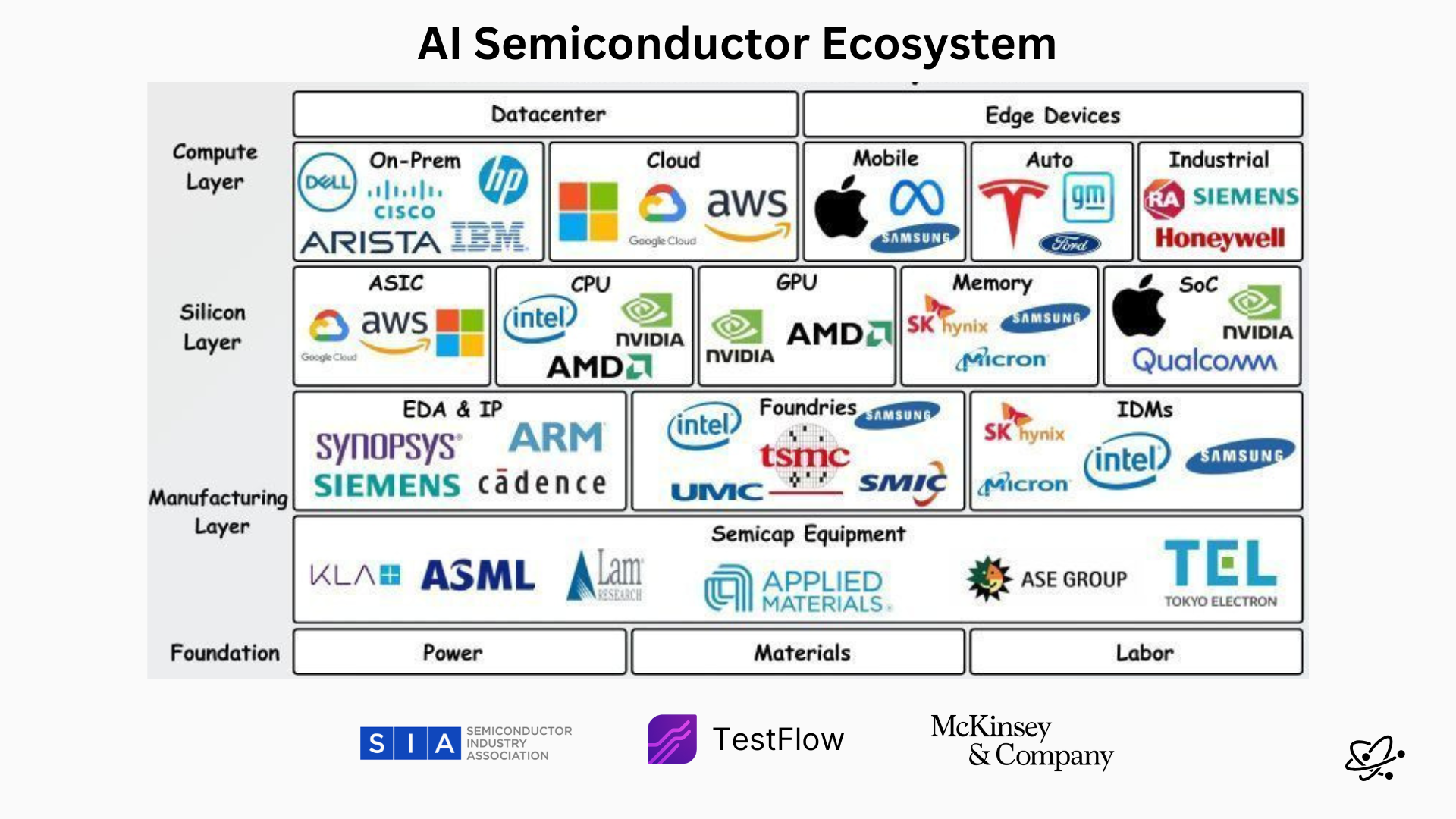
Executive Takeaways
- NVIDIA's Unprecedented Moat: Despite aggressive capital allocation by hyperscalers to build custom ASICs, NVIDIA maintains a dominant market share exceeding 80% in training enterprise-grade Large Language Models (LLMs), underpinned by its proprietary CUDA software ecosystem.
- The Custom Silicon Pivot: Hyperscale cloud providers—including Amazon Web Services, Microsoft, and Google—are aggressively deploying proprietary ASICs (Application-Specific Integrated Circuits) to mitigate infrastructure scalability bottlenecks and compress total cost of ownership (TCO).
- The Hardware Diversification Wave: Beyond legacy semiconductor giants, an elite cohort of over 30 challengers, spanning venture-backed startups and sovereign semiconductor initiatives, are competing for market liquidity by optimizing for inference efficiency, memory bandwidth, and edge computing architectures.
The global race for artificial intelligence supremacy has fundamentally transformed the semiconductor industry, elevating silicon from a cyclical industrial commodity into the most critical geopolitical and financial asset of the twenty-first century. At the epicenter of this seismic shift is NVIDIA Corporation, a firm whose market capitalization has surged past historical benchmarks on the back of insatiable enterprise demand for parallel computing capabilities. Yet, beneath the veneer of NVIDIA’s near-monopoly lies a rapidly evolving, fiercely contested ecosystem. Driven by soaring enterprise ROI demands, margin pressures, and systemic supply chain vulnerabilities, more than 30 dedicated AI chip makers—ranging from hyper-funded Silicon Valley startups to trillion-dollar cloud titans—are reshaping the global hardware landscape.
This investigative report breaks down the structural dynamics of the AI chip market, analyzing how foundational technological shifts, massive capital expenditure cycles, and complex cloud compute architectures are defining the winners and losers of the next industrial revolution.
The Catalyst: Parallel Computing and the Exhaustion of Traditional CPU Architecture
For decades, enterprise data centers relied on central processing units (CPUs) built for sequential instruction processing. However, the exponential scaling of generative AI, deep learning, and transformer-based neural networks rendered traditional architectures obsolete. Training and executing billions of parameters simultaneously requires massive parallel computing capabilities—a domain where Graphics Processing Units (GPUs), Tensor Processing Units (TPUs), and custom ASICs excel.
The turning point arrived when enterprise adoption transitioned from experimental machine learning models to production-grade generative AI systems. Corporations realized that inference speed and training duration directly dictate operational efficiency and competitive advantage. Consequently, chief information officers and chief financial officers began viewing advanced semiconductor acquisition not as a discretionary IT expense, but as a core pillar of capital allocation and infrastructure scalability.
However, this surging demand exposed severe supply chain vulnerabilities. Lead times for high-performance accelerators stretched across multiple quarters, creating severe bottlenecks and inflating procurement costs. This environment created a powerful financial incentive for competitors, venture capitalists, and tech conglomerates to disrupt NVIDIA's market dominance through hardware diversification.
NVIDIA’s Strategic Hegemony and the CUDA Moat
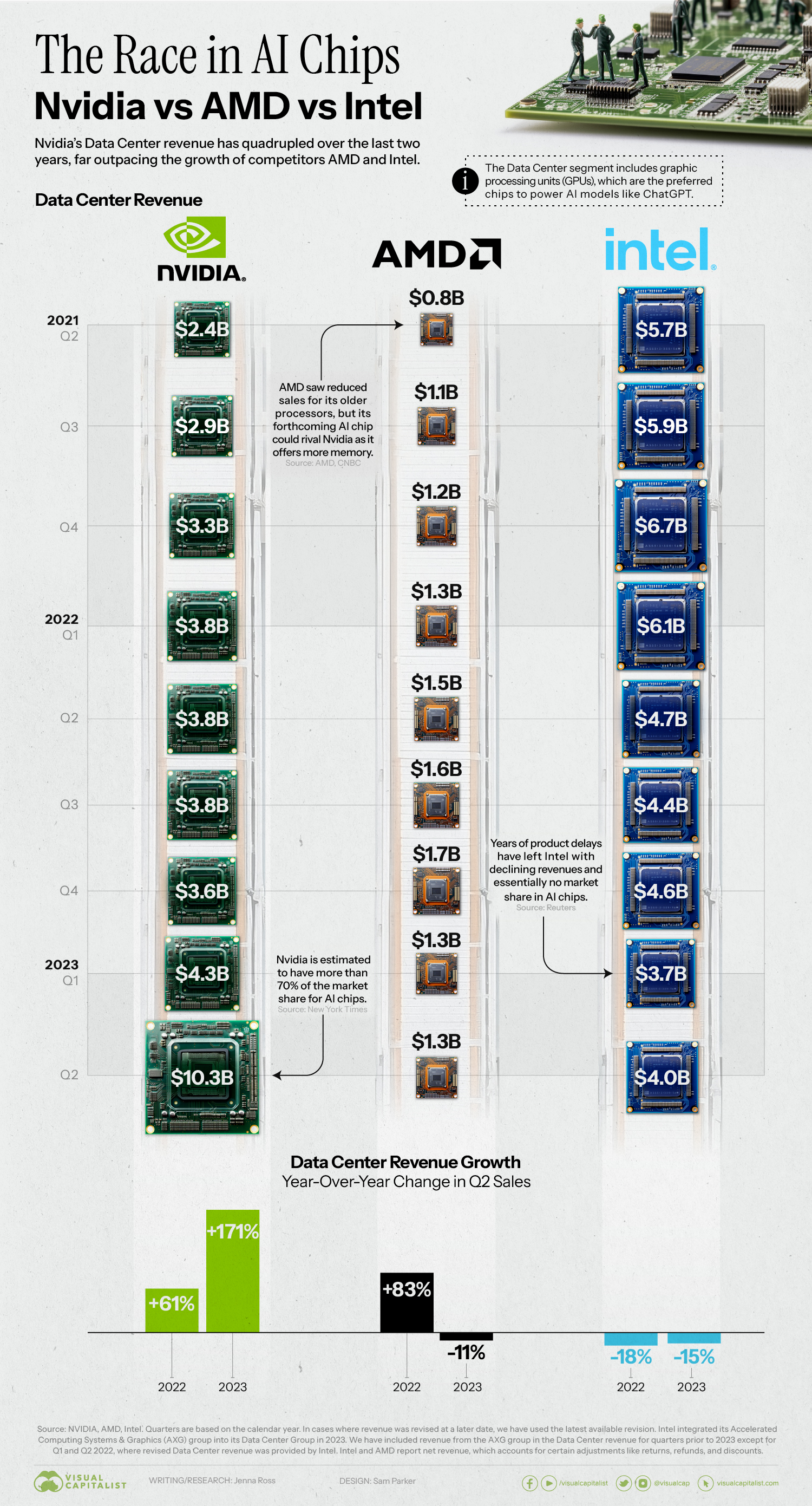
To understand the competitive landscape, one must first dissect the mechanics of NVIDIA’s enduring lead. While hardware specifications—such as floating-point operations per second (FLOPS) and high-bandwidth memory (HBM) capacity—dominate industry headlines, NVIDIA’s true economic moat is software.
Launched nearly two decades ago, NVIDIA’s CUDA (Compute Unified Device Architecture) programming model established an entrenched developer ecosystem. Millions of machine learning engineers, data scientists, and academic researchers have written millions of lines of code optimized specifically for CUDA-enabled GPUs. This creates formidable high switching costs. An enterprise currently achieving high efficiency on NVIDIA infrastructure faces immense technical and operational friction when attempting to migrate workloads to competing architectures.
Furthermore, NVIDIA has aggressively evolved from a pure-play component supplier into a vertically integrated data center systems architect. By bundling networking hardware (via its acquisition of Mellanox), proprietary liquid-cooling chassis, and full-stack orchestration software, NVIDIA offers hyperscalers turnkey infrastructure solutions that minimize latency and maximize cluster-level performance.
The Challenger Ecosystem: Silicon Giants, Hyperscalers, and Venture-Backed Disruptors
Despite NVIDIA's formidable barriers to entry, the sheer magnitude of the AI hardware market—projected by top-tier financial institutions to reach hundreds of billions of dollars annually—has unlocked unprecedented venture capital liquidity and corporate research budgets. The top 30+ AI chip makers can be categorized into three distinct strategic tiers:
1. Legacy Semiconductor Incumbents
- AMD (Advanced Micro Devices): Positioned as the primary merchant silicon alternative to NVIDIA. AMD’s Instinct MI300 series combines CPU and GPU compute complexes on a single package, offering competitive memory bandwidth designed to capture enterprise market share in large-scale LLM training.
- Intel Corporation: Leveraging its legacy manufacturing footprint and its Gaudi accelerator portfolio, Intel is attempting a turnaround strategy focused on providing cost-effective alternatives for inference workloads and enterprise deployments seeking supply chain diversification.
2. Hyperscale In-House ASIC Initiatives
Perhaps the most profound structural threat to merchant silicon providers comes from their own largest customers. Alphabet (Google), Amazon (AWS), and Microsoft are investing tens of billions of dollars in proprietary silicon:
- Google TPUs: Pioneered years ago, Google’s Tensor Processing Units power internal workloads and are increasingly available via Google Cloud Platform, offering optimized price-to-performance ratios for specific transformer architectures.
- AWS Trainium and Inferentia: Designed explicitly to compress cloud compute costs for Amazon’s enterprise clients, these custom chips bypass third-party markup, directly improving AWS margins while providing clients with tailored infrastructure scalability.
- Microsoft Maia: Microsoft’s custom silicon initiative aims to optimize performance for its Azure cloud infrastructure and proprietary OpenAI integrations, mitigating dependency on external component pricing.
3. Venture-Backed Pure-Play Innovators
An agile vanguard of well-funded startups is challenging the industry by pioneering radical architectural departures from traditional von Neumann computing:
- Groq: Pioneering the Language Processing Unit (LPU), Groq eliminates traditional external memory bottlenecks by utilizing deterministic, on-chip SRAM, delivering blistering inference speeds for real-time generative AI applications.
- Cerebras Systems: Defying conventional wafer manufacturing limits, Cerebras developed the Wafer-Scale Engine (WSE)—a massive semiconductor chip the size of an entire silicon wafer, designed to accelerate massive neural network training without inter-chip communication latency.
- SambaNova Systems and Tenstorrent: Leveraging reconfigurable dataflow architectures and advanced IP licensing models to target high-efficiency enterprise deployments and sovereign AI infrastructure builds.
Verified Data & Metrics: Major AI Chip Architectures Compared
| Company / Chip Family | Primary Architecture Type | Target Workload Focus | Key Competitive Advantage |
|---|---|---|---|
| NVIDIA (Blackwell / H100) | Advanced GPU / System-on-Chip | Foundation Model Training & Inference | Entrenched CUDA software ecosystem & full-stack integration |
| AMD (Instinct MI300X) | Heterogeneous APU (CPU + GPU) | LLM Training & High-Performance Computing | Superior high-bandwidth memory capacity per package |
| Google (TPU v5p) | Custom ASIC | Cloud-Native Deep Learning Workloads | Deep integration with TensorFlow/JAX & cloud infrastructure |
| Groq (LPU Architecture) | Deterministic SRAM Processor | Ultra-Low Latency Real-Time Inference | Eliminates external memory bottlenecks for rapid token generation |
| Cerebras (Wafer-Scale Engine) | Wafer-Scale Processor | Massive-Scale Neural Network Training | Unprecedented core count and on-chip memory bandwidth |
Industry & Market Implications: Winners, Losers, and Economic Realities
The structural evolution of the AI chip market carries profound implications for corporate balance sheets, venture capital deployment, and macroeconomic stability.
Who Wins
- Enterprise Buyers with Specialized Infrastructure Needs: Organizations that successfully diversify their hardware procurement across merchant GPUs and custom ASICs can optimize their total cost of ownership (TCO) and reduce operational risk.
- Foundry Monopolists: Advanced semiconductor foundries—most notably Taiwan Semiconductor Manufacturing Company (TSMC)—act as the indispensable tollbooths of the AI boom, manufacturing chips for NVIDIA, AMD, and hyperscale custom silicon initiatives alike.
- Alternative Software Framework Builders: Open-source compilation frameworks like Triton, ONNX, and PyTorch compiler extensions are gradually lowering the software barriers that protect NVIDIA's CUDA monopoly, empowering alternative hardware solutions.
Who Loses
- Legacy Server Vendors Lacking AI Integration: Original Equipment Manufacturers (OEMs) that fail to transition their product lines toward high-density liquid-cooled AI server racks face margin compression and commoditization.
- Undercapitalized Semiconductor Startups: The capital expenditure required to tape out advanced nodes (e.g., 3nm and sub-3nm) at modern foundries runs into hundreds of millions of dollars. Startups lacking enterprise validation or deep-pocketed sovereign backing risk running out of cash before achieving commercial scale.
Frequently Asked Questions (People Also Ask)
What makes specialized AI chips different from traditional CPUs?
Traditional CPUs are designed for general-purpose, sequential task execution, making them inefficient for heavy data processing. AI chips—such as GPUs, TPUs, and custom ASICs—utilize massively parallel architectures capable of executing thousands of mathematical calculations simultaneously. This parallel processing capability is essential for managing the matrix multiplications that underpin deep learning models and generative AI systems.
Why is NVIDIA’s CUDA software platform considered such a strong competitive advantage?
CUDA is a proprietary software ecosystem that allows developers to write code that executes directly on NVIDIA GPUs. Because the platform has been refined over nearly two decades, the vast majority of machine learning libraries, frameworks, and enterprise models are optimized for CUDA. This creates high switching costs, as migrating complex AI workloads to alternative hardware requires substantial software rewiring and validation.
How are cloud hyperscalers impacting the merchant AI chip market?
Hyperscalers like Amazon, Microsoft, and Google are investing heavily in custom Application-Specific Integrated Circuits (ASICs) designed explicitly for their internal cloud workloads and enterprise service offerings. While NVIDIA remains the dominant supplier for bleeding-edge model training, these custom silicon initiatives aim to reduce procurement costs, mitigate supply chain bottlenecks, and improve profit margins across cloud infrastructure.
Are venture-backed AI chip startups capable of unseating established industry leaders?
While venture-backed startups face immense capital hurdles—such as skyrocketing wafer fabrication costs at advanced nodes—they frequently succeed by targeting specialized niches like ultra-low latency inference, edge computing, or novel memory architectures. Rather than directly replacing dominant general-purpose GPUs, successful startups often position their products as high-efficiency co-processors for specific enterprise workloads.
Future Outlook: Milestones and Strategic Watchpoints for Investors
As the AI hardware market matures from a speculative gold rush into a disciplined, enterprise-driven capital expenditure cycle, several key inflection points will dictate market leadership over the next 24 to 36 months:
- The Shift from Training to Inference Dominance: While initial capital allocation favored massive model training, enterprise monetization relies heavily on real-time inference. Watch for market share shifts toward silicon architectures optimized specifically for low-latency, energy-efficient token generation.
- Advancements in Packaging and Interconnects: As monolithic die scaling hits fundamental physical limits, innovations in 2.5D/3D packaging, chiplets, and high-speed optical interconnects will become primary differentiators for performance scalability.
- Regulatory and Geopolitical Dynamics: Export controls, sovereign semiconductor subsidies (such as the U.S. CHIPS Act and European equivalents), and trade policy shifts will continue to fracture global supply chains, forcing chip makers to localize manufacturing and diversify geographic exposure.
Ultimately, while NVIDIA commands the current silicon throne, the sheer economic scale of the artificial intelligence revolution ensures that no single company can monopolize every tier of the market. The next phase of the AI hardware war will be defined by architectural diversity, software interoperability, and ruthless cost-efficiency across global enterprise infrastructure.