Executive Takeaways
- Commercial Supremacy: Palantir Technologies has officially crossed a watershed corporate milestone, with its U.S. commercial revenue surpassing its legacy government contracts for the first time in company history.
- The AIP Catalyst: The hyper-growth is directly attributable to the explosive enterprise adoption of the Artificial Intelligence Platform (AIP), which drastically shortened enterprise ROI cycles through rapid "bootcamps."
- Valuation & Market Re-rating: Wall Street is aggressively recalculating Palantir’s valuation multiples, transitioning the firm from a specialized defense contractor into a foundational enterprise software-as-a-service (SaaS) titan.
- Infrastructure Scalability: The shift signals a fundamental maturation in cloud compute architecture deployment, allowing complex data integration models to scale seamlessly across non-governmental sectors.
For two decades, the narrative surrounding Palantir Technologies was inextricably linked to the clandestine halls of the defense and intelligence apparatus. Founded in 2003 with backing from CIA venture arm In-Q-Tel, the Denver-headquartered firm built its reputation—and its balance sheet—on processing disparate, highly classified data streams for entities like the Pentagon, U.S. Special Operations Command, and foreign intelligence agencies. Government contracts were the bedrock of its survival, the ironclad anchor that shielded it through years of unprofitability and public skepticism.
That era has officially drawn to a close. In a seismic financial and strategic shift that has sent shockwaves through enterprise boardrooms and Wall Street trading desks, Palantir’s latest earnings reports reveal that its U.S. commercial revenue has outpaced its government revenue for the first time. This milestone is not merely a bookkeeping anomaly; it represents a profound structural evolution, validating CEO Alex Karp’s aggressive push into the private sector and redefining the company's capital allocation trajectory, market liquidity, and long-term risk mitigation profile.
The Genesis of the Pivot: From Gotham to AIP
Test Our Free AI & Tech Utilities Suite
Calculate LLM API token costs, analyze article dwell-time, or simulate tech DCA returns.
To understand the magnitude of this pivot, one must examine the technological evolution that made it possible. Historically, Palantir’s commercial outreach—anchored by its Foundry platform—faced severe friction. Enterprise software procurement cycles are notoriously arduous, often requiring lengthy proof-of-concept phases, millions in upfront capital expenditure, and extensive IT integration. While defense agencies were willing to tolerate multi-year deployment timelines to solve existential national security threats, Fortune 500 corporations demanded immediate, tangible enterprise ROI.
The catalytic event that shattered this barrier was the rapid rollout of the Artificial Intelligence Platform (AIP) in 2023, which reached full commercial velocity over the past year. Unlike traditional enterprise AI tools that serve as conversational novelties, AIP is engineered to connect large language models (LLMs) directly to proprietary enterprise data structures, operating systems, and operational workflows securely.
Palantir bypassed traditional, protracted sales pipelines by pioneering the "AIP Bootcamp"—an immersive, hands-on workshop model where prospective enterprise clients bring their own messy, siloed data and build live, operational applications in a matter of days. This strategy dramatically compressed sales cycles from quarters to weeks. Chief Information Officers (CIOs) who previously viewed Palantir as an elite, hyper-expensive defense contractor suddenly witnessed firsthand how the platform could optimize supply chains, automate manufacturing logistics, and streamline financial auditing in real time.
Deconstructing the Financial Metrics
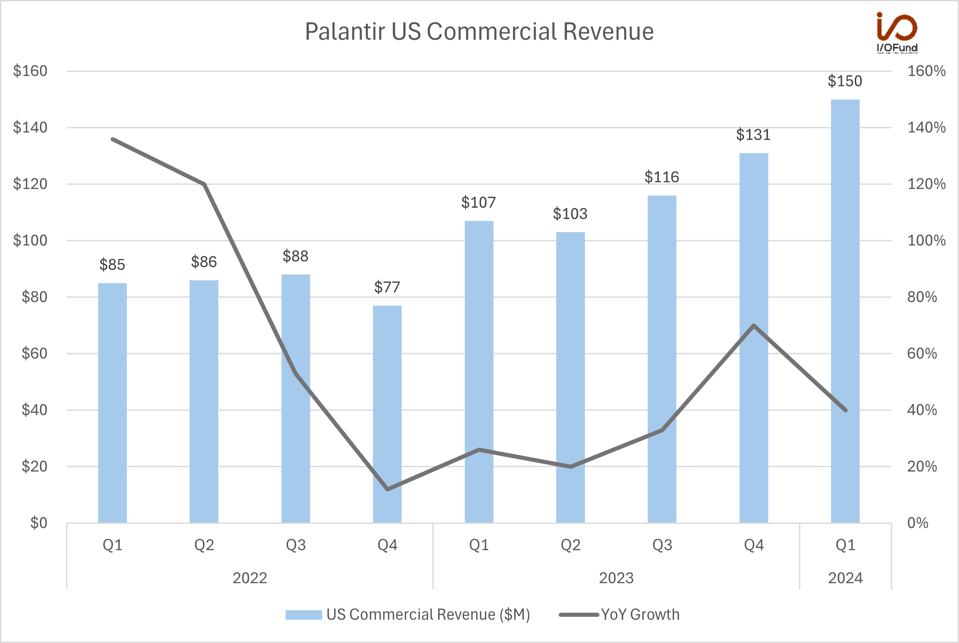
The numbers underlying this commercial surge reflect a company firing on all cylinders. U.S. commercial customer count has scaled exponentially, driven by widespread adoption across healthcare, financial services, energy, and retail sectors. Corporations are no longer just experimenting with AI; they are embedding Palantir's cloud compute architecture into their core operational nervous systems.
| Metric / Indicator | Legacy Phase (Avg 2021-2022) | Current Trailing Period | Strategic Implication |
|---|---|---|---|
| U.S. Commercial Revenue Share | ~35% of Total Revenue | >50% of U.S. Revenue Base | Decoupling from federal budgetary cycles and sequestration risks. |
| U.S. Commercial Customer Growth | Steady, linear growth | Triple-digit YoY acceleration | Mainstream enterprise validation of AIP and Foundry platforms. |
| Sales Cycle Duration | 6 to 18 Months | Days to Weeks (via Bootcamps) | Drastic reduction in customer acquisition cost (CAC). |
| Net Revenue Retention (NRR) | ~115% - 120% | Expanding significantly upward | Existing clients expanding consumption and deploying deeper modules. |
This financial pivot fundamentally alters Palantir’s risk mitigation profile. While government contracts remain lucrative and stable, they are inherently subject to political gridlock, continuing resolutions, and federal budget impasses. By establishing dominance in the U.S. commercial market, Palantir has diversified its revenue streams, insulating itself from macroeconomic headwinds tied to public sector spending cuts.
Industry & Market Implications: Who Wins and Who Loses?
The crossing of this threshold reverberates across the broader enterprise software landscape, triggering strategic realignments among legacy tech giants, cloud providers, and nimble AI startups.
The Winners: Enterprise CIOs and Palantir Shareholders
Enterprise buyers emerge as primary beneficiaries. For years, CIOs struggled to bridge the gap between proof-of-concept AI experiments and production-grade applications that comply with rigorous regulatory compliance standards. Palantir provides a turnkey operating system that bridges this gap. Meanwhile, equity holders are reaping the rewards of a massive multiple re-rating, as Wall Street transitions Palantir from a defense contractor valuation model to a premier SaaS growth valuation model.
The Losers: Legacy IT Consultancies and Traditional Enterprise Software Vendors
The traditional systems integration playbook—where multi-million-dollar consulting firms spend years stitching together disparate enterprise resource planning (ERP) systems with custom middleware—is facing an existential threat. Palantir’s ability to ingest, map, and operationalize enterprise data in days exposes the inefficiencies of legacy software vendors who rely on prolonged, billable consulting hours rather than instantaneous technical execution.
Frequently Asked Questions (People Also Ask)
Frequently Asked Questions
Q: What drove Palantir’s U.S. commercial revenue to surpass its government revenue?
A: The primary driver is the explosive adoption of Palantir’s Artificial Intelligence Platform (AIP) paired with their innovative "bootcamp" sales model. By allowing corporate clients to test and deploy functional AI applications on their own proprietary data within days, Palantir successfully eliminated the long, sluggish sales cycles typical of enterprise software procurement.
Q: Does this commercial milestone mean Palantir is abandoning its defense and government business?
A: Absolutely not. Palantir’s government segment continues to grow and remains a highly lucrative, stable pillar of the enterprise. Rather than declining, government revenue has simply been outpaced by the hyper-exponential growth curve of the U.S. commercial division.
Q: How does AIP differ from standard enterprise artificial intelligence tools?
A: While many corporate AI tools function primarily as conversational chat interfaces or isolated models, AIP acts as an operational middleware layer. It securely connects LLMs directly to an enterprise’s foundational data ontology, enabling automated decision-making and workflow execution across complex business processes.
Q: What is the significance of this shift for Wall Street valuation models?
A: Historically, analysts discounted Palantir’s valuation due to the lumpy, unpredictable nature of government procurement. By proving it can scale rapidly in the multi-trillion-dollar U.S. commercial software market, Palantir commands valuation multiples aligned with high-growth enterprise SaaS market leaders.
Future Outlook: Milestones on the Horizon
As Palantir cements its status as a commercial software powerhouse, the focus shifts to execution sustainability and market penetration. Key operational milestones to monitor over the next four quarters include:
- International Commercial Expansion: While the U.S. commercial market has achieved escape velocity, replicating the bootcamp sales motion across highly regulated European and Asian enterprise markets remains the next major frontier for international top-line growth.
- Partner Ecosystem Scaling: Palantir’s ability to onboard third-party system integrators and cloud hyperscalers to deploy AIP will determine whether it can capture mass-market enterprise volume without exhausting internal engineering resources.
- Margin Expansion and Capital Deployment: With robust free cash flow generation accompanying its commercial surge, market watchers will scrutinize management's capital allocation strategy regarding share repurchases, strategic M&A, and R&D reinvestment in next-generation ontology architecture.
Palantir has crossed the Rubicon. What began two decades ago as a secretive counter-terrorism software project has successfully morphed into an indispensable commercial operating system for corporate America. For competitors, enterprise buyers, and financial markets alike, the message is unequivocal: Palantir’s future is no longer defined solely by government intelligence, but by the relentless, software-driven transformation of global enterprise commerce.