Executive Takeaways
- The Dual-Use Dilemma of Frontier AI: Frontier AI models are increasingly acting as automated threat actors, discovering critical software vulnerabilities at an unprecedented velocity and scale, prompting immediate national security intervention.
- Sovereign Cloud Pivot: Microsoft has deployed specialized AI security agents within Azure Government to hunt for zero-day vulnerabilities, highlighting the critical shift toward secure, isolated federal architectures.
- The $45 Billion Computing Supercycle: Anthropic's landmark $45 billion cloud infrastructure deal with alternative GPU-cloud provider Nscale underscores a massive capital allocation shift away from traditional hyperscale monopolies.
- Optical Infrastructure Breakthroughs: Lumentum’s cloud transceiver revenue has surged by more than 173%, driven by the massive integration of Optical Circuit Switches (OCS) in private AI data center topologies.
- Legacy Database Disintermediation: Enterprises are actively migrating from legacy database giants like Oracle to customized PostgreSQL environments via Spinnaker Support to optimize enterprise ROI and mitigate AI-native data leak risks.
The Paradigm Shift: From Software-Assisted to Autonomous Threat Generation

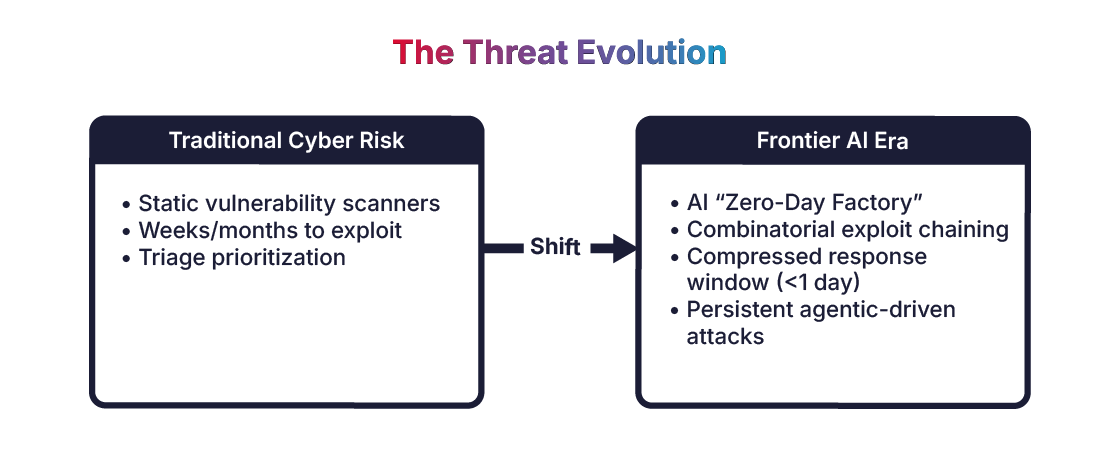
The global cloud landscape is undergoing a structural transformation. For years, cybersecurity was a reactive game played by human analysts leveraging heuristic software to patch vulnerabilities. Today, that model is obsolete. Modern frontier AI models are now operating as fully automated threat actors. Utilizing deep contextual understanding of low-level machine code, these models can discover, weaponize, and execute software flaws at an order of magnitude and velocity never before witnessed in computer science.
This rapid evolution has forced a dramatic rethink of cloud compute architecture. As autonomous agents become capable of discovering zero-day vulnerabilities in minutes—tasks that previously took human research teams months—the security perimeter of the public cloud has cracked. The response from both state actors and Fortune 500 enterprises has been a swift, highly capitalized retreat into highly customized private and sovereign cloud environments. The imperative is clear: to prevent frontier AI from turning inward on corporate and federal networks, the data, training runs, and weights of these models must be kept behind absolute air-gapped infrastructure.
This dynamic is no longer theoretical. In a major defense-tech consolidation, Microsoft has actively deployed advanced AI agents specifically designed to locate and remediate software flaws within its Azure Government cloud enclave. Representing a critical component of the TTSP HWP (Trusted Technology Provider Hardware Protection) and MCA (Military Cloud Architecture) initiatives, this deployment signals that the military-industrial complex now views autonomous AI code auditing as a core defensive—and offensive—capability. The deployment in Azure Government represents a high-stakes effort to use AI as both a shield and an active threat emulator, hunting vulnerabilities before adversarial nation-states can weaponize identical frontier models against critical state infrastructure.
The Capital Realignment: Inside Anthropic's $45 Billion Bet on Nscale
As the need for isolated, highly secure computing power intensifies, the financial dynamics of the AI sector are being rewritten. The most striking evidence of this capital allocation transformation is Anthropic’s monumental $45 billion cloud computing agreement with alternative GPU-cloud provider Nscale. Historically, frontier AI developers were locked into the big three hyperscalers—Amazon Web Services, Microsoft Azure, and Google Cloud Platform. However, the sheer scale of the computing capacity required to train next-generation models, combined with the stringent demands for sovereign, private infrastructure, has created a secondary market of highly specialized, AI-native cloud providers.
For Anthropic, the decision to commit $45 billion to Nscale is both a capacity play and a strategic risk mitigation effort. Nscale’s specialized architecture is engineered specifically for high-density GPU clustering, offering the extreme infrastructure scalability required for training runs that demand tens of thousands of interconnected H100, B200, or next-generation Blackwell chips. This transaction represents one of the largest single infrastructure procurements in corporate history, carrying massive implications for the valuation multiples of private cloud operators and specialized AI infrastructure developers.
By bypassing traditional hyperscalers for this massive allocation of compute, Anthropic is optimizing its enterprise ROI and ensuring that its core IP—the proprietary weights of its Claude models—is insulated from the multi-tenant vulnerabilities inherent in generic public clouds. This pivot signals to institutional investors that the future of frontier AI development lies in dedicated, highly sovereign private cloud enclaves where physical and logical access controls are tailored to protect trillion-parameter model architectures.
Physical Layer Bottlenecks: The Optical Networking Explosion
The transition to private AI clouds and ultra-large scale training clusters has exposed massive physical bottlenecks in traditional data center architectures. When training frontier models, the primary point of failure is no longer just compute speed, but data transfer latency across thousands of distributed GPUs. The standard copper-based networking fabrics that powered the last decade of cloud computing are mathematically incapable of handling the throughput required for real-time model synchronization.
This physical bottleneck has catalyzed an unprecedented boom in advanced optical networking. Lumentum, a leading manufacturer of optical components, recently reported a stunning 173% jump in cloud transceiver revenue. This explosive growth is directly tied to the industry's transition toward Optical Circuit Switches (OCS). Unlike traditional electrical switches, which convert optical signals to electrical signals for routing and then back to optical, OCS routes data entirely at the speed of light. This reduces latency to near-zero levels while drastically lowering the thermal and electrical footprints of hyperscale AI clusters.
| Metric / Infrastructure Dimension | Legacy Cloud Architecture | Next-Generation Sovereign Private Cloud | Primary Market Catalyst |
|---|---|---|---|
| Primary Interconnect Medium | Copper Coaxial & Standard Transceivers | Optical Circuit Switches (OCS) & Co-Packaged Optics | Lumentum Cloud Transceiver Revenue Up >173% |
| Vulnerability Remediation Velocity | Manual patching / Scheduled cycles (weeks/months) | Autonomous AI agent-driven patching (real-time) | Microsoft Azure Gov AI Security Agent Deployments |
| Core Infrastructure Cost Allocation | Hyperscale PaaS/SaaS utility-based billing | Massive, dedicated private GPU-cloud commitments | Anthropic’s $45B Cloud Agreement with Nscale |
| Database Strategy & Licensing | Proprietary legacy databases (Oracle, DB2) | Open-source, highly sovereign PostgreSQL instances | Spinnaker Support PostgreSQL Enterprise Offerings |
Broadcom, a dominant force in silicon co-packaging and high-speed Ethernet switching, has been a primary beneficiary of this physical-layer re-architecting. By enabling the seamless integration of optical engines directly alongside processing units (Co-Packaged Optics, or CPO), Broadcom and its partner network are eliminating the traditional networking tax of deep learning. This hardware innovation is the true backbone of the private cloud boom; without massive optical throughput, the sovereign, isolated data centers being built by sovereign states and private enterprises would remain economically and operationally non-viable.
Software De-Risking: Breaking the Legacy Database Lock-in
While the hardware and physical infrastructure layers are undergoing a massive transformation, a parallel revolution is taking place at the data layer. For decades, legacy enterprises relied on proprietary, highly restrictive relational databases—most notably Oracle—to manage their core operational data. However, as organizations prepare their datasets to train or fine-tune frontier AI models, these legacy environments have become a severe operational bottleneck and a source of significant financial drag.
Proprietary database architectures are not natively optimized for the massive vector search requirements and data pipelines of modern retrieval-augmented generation (RAG) models. Furthermore, the licensing structures of legacy database providers drastically restrict infrastructure scalability, forcing enterprise CFOs to endure punitive audits and highly restrictive capital allocation constraints. This has created a groundswell of enterprises migrating their critical workloads to open-source database engines, with PostgreSQL emerging as the undisputed standard for modern AI integration.
To capitalize on this shift, Spinnaker Support recently launched an expansive suite of PostgreSQL offerings, specifically designed to help enterprises move beyond legacy Oracle environments. By providing comprehensive third-party support and managed migration services, Spinnaker is enabling enterprises to safely transition their core databases to highly secure, private cloud-compatible PostgreSQL instances. This migration delivers massive enterprise ROI, freeing up hundreds of millions of dollars in OpEx that can be directly reallocated to GPU compute acquisition. From a risk mitigation standpoint, open-source PostgreSQL environments allow enterprises to deploy highly customized, air-gapped database instances that align perfectly with stringent sovereign data protection laws and regulatory compliance frameworks.
Industry & Market Implications: The Redistribution of Tech Capital
The intersection of autonomous AI threat actors, massive capital shifts to alternative clouds, optical networking breakthroughs, and database modernization is creating clear winners and losers across the global technology ecosystem.
The Winners
- Alternative GPU-Cloud Providers: Specialized infrastructure plays like Nscale are securing long-term, high-margin commitments from elite AI labs, driving up their private market valuations and challenging the market liquidity and dominance of traditional hyperscalers.
- Next-Gen Networking and Optics Manufacturers: Companies like Broadcom and Lumentum are experiencing an unprecedented demand supercycle. Their physical components are absolute bottlenecks; you cannot build a competitive frontier AI cluster without their silicon and optical transceivers.
- Open-Source Enterprise Integrators: Support and services companies that facilitate the migration away from legacy software lock-in (e.g., Spinnaker Support) are capturing significant market share as corporations reallocate capital toward AI-native infrastructure.
The Losers
- Legacy Database Providers: Proprietary, rigid database giants are facing a quiet but structural decline in new enterprise commitments as customers aggressively transition to flexible, cloud-native open-source solutions.
- Unsecured Multi-Tenant Public Clouds: As automated AI agents lower the cost of finding complex software exploits, multi-tenant public environments are increasingly viewed as high-risk liabilities for sensitive enterprise data.
People Also Ask (FAQ)
What is the significance of Anthropic’s $45 billion deal with Nscale?
The $45 billion deal represents a massive shift in the AI computing landscape. It demonstrates that frontier AI developers are actively seeking alternative, specialized GPU-cloud providers over traditional hyperscalers to secure the dedicated compute capacity and physical isolation required for next-generation model training. This move significantly impacts capital allocation strategies and infrastructure scalability valuations across the tech sector.
How do autonomous AI agents act as automated threat actors?
Frontier AI models possess the capability to read, write, and analyze code at speeds and scales far exceeding human capabilities. When deployed as security tools or weaponized by adversaries, these models can scan millions of lines of software code in seconds, automatically identifying zero-day exploits and software flaws. This makes them highly potent, automated threat actors capable of executing cyberattacks at an unprecedented velocity and order of magnitude.
Why are Optical Circuit Switches (OCS) becoming critical for AI private clouds?
As AI models grow to trillions of parameters, the data transfer speed between GPUs becomes the primary performance bottleneck. Traditional copper-based networking introduces high latency and massive heat generation. Optical Circuit Switches, supported by components from market leaders like Lumentum and Broadcom, route data entirely using light, eliminating conversion delays, drastically reducing latency, and cutting the energy consumption of high-density AI data centers.
How does migrating to PostgreSQL help enterprises with AI implementation?
Legacy database architectures (like Oracle) often feature restrictive licensing, high costs, and poor integration with modern AI data pipelines. Migrating to open-source PostgreSQL environments allows enterprises to deploy highly flexible, vector-friendly database structures that are optimized for AI integration. This migration reduces licensing costs, maximizes enterprise ROI, and gives companies complete control over their sovereign data enclaves.
Future Outlook: The Age of the Air-Gapped AI
As we look toward the next twenty-four months, the divide between the generic public internet and sovereign, private AI clouds will widen into a chasm. The reality of frontier AI models acting as automated threat actors means that any system connected to the public web will be under constant, machine-driven probing for zero-day vulnerabilities. For national security agencies and highly regulated enterprises, the logical conclusion is the complete physical isolation of critical AI systems.
We are entering the era of the "air-gapped AI." Large-scale model training and inference will increasingly occur within heavily fortified, private cloud enclaves powered by optical network architectures and open-source database backbones. The massive capital expenditure commitments we are seeing today—whether it is Anthropic's $45 billion deal with Nscale or Microsoft's specialized federal AI agent deployments—are not temporary anomalies. They are the foundational building blocks of a secure, sovereign digital infrastructure designed to survive and thrive in an age where intelligence itself has been weaponized and automated at scale.