Executive Takeaways
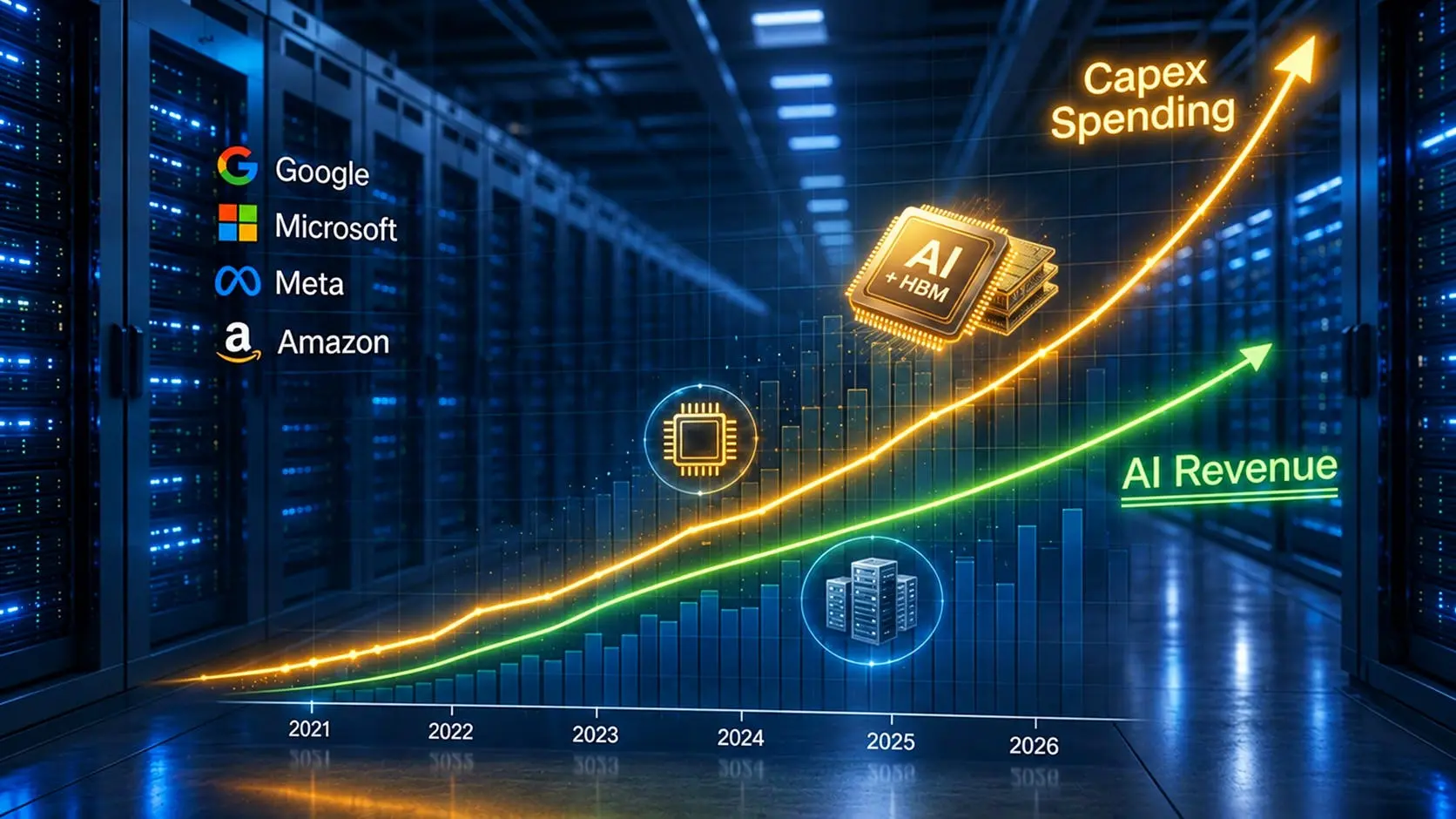
- The Trillion-Dollar Milestone: Institutional research from firms like the I/O Fund projects enterprise artificial intelligence capital expenditures to breach the staggering $1 trillion threshold, shifting the structural economics of the technology sector.
- The Revenue vs. Margin Dilemma: While hyperscalers and mega-cap tech giants are reporting unprecedented top-line AI monetization, spiraling infrastructure costs and depreciation schedules are compressing near-term free cash flow (FCF).
- The Supplier Advantage: Upstream semiconductor fabricators, advanced packaging specialists, networking infrastructure builders, and power-grid innovators are capturing superior valuation multiples and risk-mitigated margins compared to downstream application providers.
- Strategic Capital Allocation: Portfolio managers and institutional investors are rapidly recalibrating asset allocations away from pure-play consumer software toward hardware infrastructure enablers that hold structural pricing power.
NEW YORK & LONDON — The race for artificial intelligence supremacy has entered its most capital-intensive phase yet. As global enterprises rush to integrate generative AI, foundational model orchestration, and automated agentic workflows, Big Tech’s aggregate AI revenue is surging at an exponential velocity. Yet, behind the headline-grabbing quarterly sales figures lies a more nuanced structural reality: the ultimate beneficiaries of this multitrillion-dollar industrial transformation are not the consumer-facing platforms, but the specialized hardware and infrastructure suppliers fueling the boom.
According to exhaustive data and market intelligence released by the I/O Fund, total AI capital expenditures (CapEx) across the hyperscale ecosystem are hurtling toward an unprecedented $1 trillion threshold. This staggering sum reflects a fundamental reshaping of global cloud compute architecture, data center construction, and silicon procurement. However, as executive boards grapple with escalating infrastructure costs, financial analysts are increasingly questioning where the sustainable long-term free cash flow (FCF) will pool as the market matures.
The Anatomy of the CapEx Supercycle
Test Our Free AI & Tech Utilities Suite
Calculate LLM API token costs, analyze article dwell-time, or simulate tech DCA returns.
To understand why suppliers hold the structural high ground in the current market cycle, one must examine the mechanics of the modern enterprise tech stack. Over the past twenty-four months, hyperscalers—including Microsoft, Amazon Web Services, Alphabet, and Meta Platforms—have committed unprecedented fiscal resources to secure advanced graphics processing units (GPUs), tensor processing units (TPUs), and high-bandwidth memory (HBM).
This aggressive capital allocation strategy has successfully unlocked massive enterprise software monetization streams. Cloud providers are reporting billions in annualized run-rates for AI-as-a-service (AIaaS) offerings, enterprise developer tools, and proprietary assistant integrations. However, this top-line surge requires a continuous, high-beta reinvestment cycle. Every new cluster of training and inference servers demands exponential increases in electricity generation, liquid cooling systems, and ultra-low-latency optical networking components.
Consequently, while downstream tech giants experience top-line acceleration, their near-term FCF profiles are facing temporary headwinds due to capital intensity and accelerated asset depreciation schedules. Upstream suppliers, by contrast, operate with formidable pricing power, high barriers to entry, and gross margins that often eclipse those of the end-service providers. These specialized component manufacturers are effectively selling the picks and shovels in a modern digital gold rush, shielding themselves from the hyper-competitive pricing wars currently unfolding in the consumer software layer.
Comparative Analysis: Hyperscalers vs. Core Infrastructure Suppliers

Evaluating the financial mechanics of the AI boom requires a granular look at how capital flows through the ecosystem. The divergence between software-driven revenue generation and hardware-driven margin capture defines the contemporary market landscape.
| Metric / Dimension | Big Tech Hyperscalers (Downstream) | AI Hardware & Infrastructure Suppliers (Upstream) |
|---|---|---|
| Primary Revenue Driver | Cloud compute, enterprise software subscriptions, ad-tech targeting | Advanced accelerators, custom silicon, optical transceivers, cooling |
| CapEx Exposure | Extremely High (Data center builds, real estate, energy procurement) | Moderate-High (R&D, foundry wafer commitments, cleanroom capacity) |
| Free Cash Flow Trajectory | Compressed in near-term due to front-loaded infrastructure investments | Expansive, bolstered by robust enterprise demand and high pricing power |
| Valuation Multiples | Tied to overall cloud growth and macroeconomic advertising cycles | Tied directly to technological obsolescence cycles and fab allocation |
Industry & Market Implications: Risk Mitigation and Asset Allocation
The realization that hardware suppliers may capture a superior risk-adjusted return compared to consumer-facing platforms is causing a systemic shift in institutional portfolio management. Chief Investment Officers (CIOs) and portfolio managers are actively executing risk mitigation strategies to hedge against potential monetization delays in enterprise AI adoption.
If enterprise ROI on generative AI tools stalls—a scenario frequently debated by financial regulators and corporate treasurers—downstream tech firms risk margin contraction from unrecovered capital expenditures. Conversely, hardware and infrastructure suppliers lock in revenues upon product delivery and integration, insulating them from the downstream software adoption curve.
Furthermore, the physical constraints of this supercycle have elevated secondary industries into prime investment targets. Power generation utilities, electrical grid modernization specialists, and nuclear energy providers have become critical nodes in the AI supply chain. As data center power requirements scale into gigawatt-territory, grid reliability is no longer just an operational detail; it is the ultimate bottleneck for market liquidity and revenue realization.
Frequently Asked Questions (People Also Ask)
Why are AI infrastructure suppliers expected to outperform Big Tech in free cash flow generation?
While hyperscalers must absorb massive, upfront capital expenditures for data center real estate, server hardware, and long-term energy contracts, upstream suppliers operate with specialized manufacturing monopolies and high pricing power. Suppliers recognize revenue upon hardware delivery, whereas cloud providers must amortize heavy infrastructure costs over multi-year enterprise adoption cycles, creating near-term pressure on free cash flow margins.
What role does enterprise ROI play in the current tech capital expenditure cycle?
Enterprise return on investment (ROI) serves as the primary gauge for the sustainability of Big Tech's CapEx surge. If business clients achieve rapid productivity gains and measurable bottom-line savings from AI deployments, hyperscalers will justify continued heavy spending. However, any prolonged lag in enterprise software monetization could trigger a cyclical pullback in cloud infrastructure orders, making hardware suppliers more insulated due to their diversified customer base.
How are energy and power constraints influencing the broader AI market outlook?
Power density requirements for next-generation training clusters have transformed electrical grid capacity into a major bottleneck. Data centers now demand unprecedented gigawatt-scale power allocations. Consequently, utilities, grid infrastructure providers, and clean-energy developers have become essential participants in the AI supply chain, driving new avenues of market valuation and economic impact.
Future Outlook and Strategic Milestones
As the market navigates the remainder of the decade, several critical inflection points will dictate whether the supply-chain dominance persists or if downstream software monetization catches up. First, institutional analysts will closely monitor quarterly CapEx revisions from the core hyperscalers. Any deceleration in infrastructure spending could signal a maturing market phase or an impending digestion period for silicon assets.
Second, technological advancements in architectural efficiency—such as model quantization, edge-AI inference optimization, and alternative chip designs—will alter the cost-per-token economics. Companies capable of innovating rapidly within advanced packaging and optical interconnects will maintain structural advantages, regardless of shifts in software-layer demand.
Ultimately, while consumers and enterprises will reap the productivity dividends of artificial intelligence, the financial architecture of the current boom favors those who control the physical and silicon foundations. For institutional investors navigating this trillion-dollar landscape, maintaining exposure upstream remains the definitive strategy for capturing high-margin, risk-mitigated growth.