Executive Takeaways
- Empirical Operational Reality: A comprehensive cross-sectional investigation by AIMultiple researchers Cem Dilmegani and Hazal Şimşek validates 25 mission-critical use cases across 48 empirical global deployments, proving artificial intelligence has crossed the threshold from experimental proofs-of-concept into high-yield, rate-base infrastructure.
- Capital Allocation Shift: Regulated utilities are pivoting hundreds of millions in operational expenditure (OPEX) toward algorithmically driven Non-Wires Alternatives (NWAs), deferring billions in capital expenditure (CAPEX) for physical substation and transmission line expansions.
- Asymmetric Value Distribution: Predictive maintenance, automated vegetation management, and dynamic load balancing generate the highest immediate returns, driving asset uptime improvements of up to 30% and reducing catastrophic outage liabilities by double-digit margins.
- The Regulatory Bottleneck: While machine learning architectures demonstrate clear capability to manage volatile distributed energy resources (DERs), utility scale remains constrained by legacy supervisory control systems (SCADA) and archaic public utility commission (PUC) rate-making formulas.
The Catalytic Shift: An Aging Grid Collides with the Compute Supercycle
Global power grids are confronting an unprecedented operational pincer movement. On one flank lies the aggressive load demands of hyperscale artificial intelligence data centers, industrial electrification, and electric vehicle adoption. On the other lies a decaying physical architecture never designed for bidirectional power flows or volatile climate disruptions. In North America and Western Europe, over 60% of high-voltage transmission assets and power transformers are operating past their engineered design lifespans.
Against this volatile backdrop, research published by AIMultiple analysts Cem Dilmegani and Hazal Şimşek provides the market's most rigorous empirical mapping to date of how machine intelligence is being operationalized across the utility lifecycle. Synthesizing 48 deep-dive enterprise deployments, the research disproves the prevailing venture-capital narrative that utility AI adoption is perpetually stalled in "pilot purgatory." Instead, it reveals a capital-intensive sector quietly weaponizing deep neural networks, computer vision, and edge telemetry to extract vital operating capacity from heavily stressed infrastructure.
The imperative is no longer ideological; it is existential. With global utility investments surpassing $800 billion annually, the misallocation of capital carries catastrophic financial and physical risks. Grid operators are discovering that physical copper-and-iron upgrades are too slow and capital-inefficient to meet immediate reliability mandates. Algorithmic orchestration has transitioned from an innovation-lab novelty into the sector’s primary lever for balance-sheet preservation.
Dissecting the Taxonomy: Top AI Domains Across the Utility Value Chain
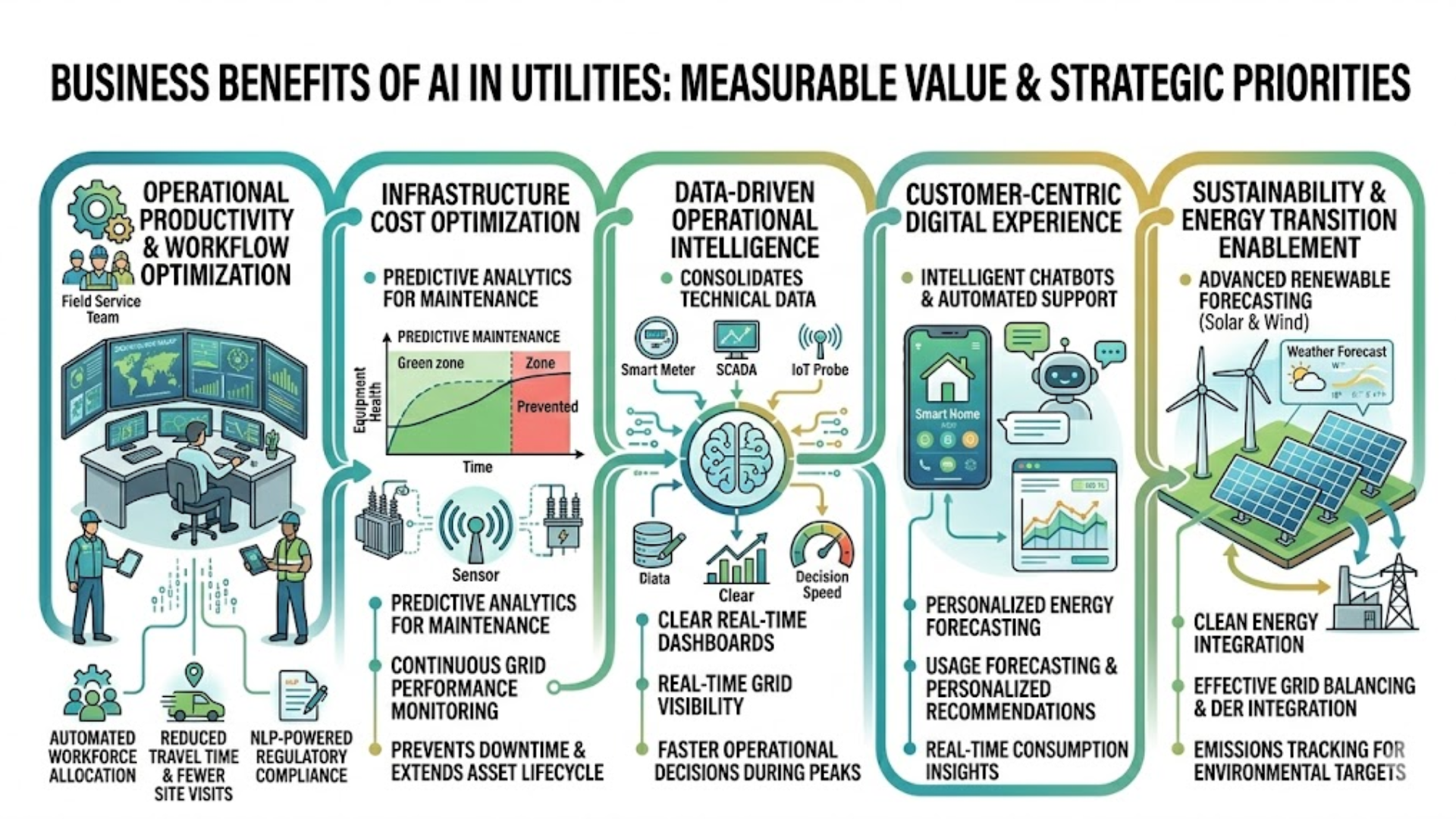
The AIMultiple investigation categorizes utility transformation across four operational vectors: Transmission and Distribution (T&D) Reliability, Generation and Asset Health, Demand Response and Dynamic Pricing, and Enterprise Customer Operations. Across these vectors, 25 distinct use cases emerge as definitive drivers of enterprise value.
1. Transmission & Distribution: The Non-Wires Revolution
Historically, the utility response to capacity bottlenecks has been simple: build more lines. Today, Dynamic Line Rating (DLR) combined with computer vision has upended this paradigm. Conventional transmission capacity relies on static seasonal assumptions regarding ambient temperature and wind speed. By ingesting real-time microclimate weather feeds, localized sensor data, and mechanical tension measurements, machine learning models continuously calculate true conductor ampacity.
Utilities deploying algorithmic DLR are unlocking 15% to 40% of hidden transmission capacity on existing corridors without stringing a single foot of new cable. Simultaneously, automated vegetation management—traditionally a primary operational expense and the leading catalyst for catastrophic wildfire liabilities—has transitioned from calendar-based tree-trimming cycles to predictive satellite and LiDAR analytics. Machine vision algorithms now audit thousands of line-miles overnight, predicting growth trajectories against localized precipitation and wind models to dispatch tree crews with surgical precision.
2. Generation Optimization & Renewable Intermittency
In power generation, the rapid retirement of baseload thermal assets in favor of non-synchronous renewables has exposed transmission operators to severe frequency and voltage fluctuations. The study highlights how predictive dispatch models ingest high-resolution numerical weather prediction (NWP) outputs, cloud-cover satellite feeds, and historical turbine telemetry to forecast renewable generation with sub-minute granularity.
Beyond dispatch, predictive asset maintenance has yielded undeniable returns. Wind operators utilize continuous acoustic monitoring paired with convolutional neural networks (CNNs) to detect sub-surface structural delamination in turbine blades long before mechanical failure occurs. In thermal and hydro assets, autoencoder-driven anomaly detection models identify micro-frictional variances in generator bearings, allowing asset owners to intervene weeks before an unscheduled outage forces a multi-million-dollar emergency power purchase on the volatile spot market.
3. Demand-Side Flexibility and Virtual Power Plants (VPPs)
The edge of the grid has morphed from a passive consumption sink into an active, distributed generation asset. Advanced Metering Infrastructure (AMI) generates massive volumes of high-frequency consumption telemetry. AIMultiple's synthesis reveals that utilities leveraging transformer-based time-series models can forecast load profiles down to the individual distribution feeder level with over 95% accuracy.
This predictive fidelity enables the orchestration of Virtual Power Plants (VPPs)—aggregations of behind-the-meter residential batteries, smart thermostats, and industrial loads that mimic traditional peaking power plants. Orchestration platforms deploy reinforcement learning algorithms to bid this flexible capacity into wholesale ancillary service markets, stabilizing grid frequency during net-peak demand without firing up expensive, carbon-intensive natural gas peaker units.
Verified Data: Benchmarking AI Impact Across Utility Deployments
The following empirical matrix synthesizes real-world enterprise deployments identified in the AIMultiple research and corroborating infrastructure audits, demonstrating the financial and operational scale of mature utility AI deployments:
| Operational Vector | Flagship Use Case | Algorithmic Architecture | Empirical Operational Impact | Corporate Benchmark Reference |
|---|---|---|---|---|
| T&D Optimization | Predictive Vegetation & Wildfire Risk | Multispectral Satellite Vision & LiDAR Segmentation | 40% reduction in vegetation-related outages; 28% OPEX savings | Pacific Gas & Electric / Florida Power & Light |
| Grid Capacity | Dynamic Line Rating (DLR) | Ensemble Microclimate ML & Physics-Informed NNs | 15% to 35% instantaneous transmission capacity unlocks | National Grid / Elia Group |
| Asset Management | Substation Transformer Health Indexing | Autoencoders & Dissolved Gas Analysis (DGA) ML | 50% reduction in catastrophic failure risk; 12-year asset extension | Duke Energy / Enel Group |
| Renewable Dispatch | Solar/Wind Short-Term Intermittency Forecasting | Spatial-Temporal Graph Neural Networks (ST-GNN) | 18% improvement in day-ahead forecast accuracy; curtailment dropped 22% | Iberdrola / NextEra Energy |
| Grid Edge / Metering | Non-Technical Loss (Theft) Detection | Unsupervised Anomaly Detection on AMI Telemetry | $15M–$45M annualized recovered revenue; false alarms reduced 70% | Terna / State Grid Corp of China |
| Customer Operations | Autonomous Outage Ingestion & Dispatch | Large Language Models & Geospatial Routing Agents | 65% reduction in mean time to dispatch (MTTD); call volume handled autonomously | UK Power Networks / Con Edison |
The CAPEX vs. OPEX Equation: The Regulatory Conundrum
The economic deployment of AI within the utility complex faces a unique structural hurdle: the traditional regulatory compact. For nearly a century, investor-owned utilities (IOUs) generated shareholder returns primarily through a guaranteed return on equity (ROE) tied to their rate base—effectively incentivizing the deployment of physical capital (steel in the ground, concrete substations) while treating operational expenditures (software licensing, SaaS platforms, cloud compute) as direct pass-through costs without profit margins.
AIMultiple’s investigation captures an industry midway through a regulatory reckoning. Forward-looking state regulators and European ministries are adopting performance-based rate-making (PBR) structures. Under these regimes, utilities are explicitly rewarded for operational efficiency gains, emissions reductions, and asset optimization achieved via digital intelligence.
This accounting evolution is accelerating a fundamental pivot in enterprise capital allocation. When software can mimic the reliability gains of a $100 million physical substation upgrade for a fraction of the cost, the risk equation shifts. Financial markets are pricing in these operational efficiencies, conferring valuation premiums on utilities that successfully transition from capital-heavy physical expansion to software-leveraged, asset-light grid operations.
Industry & Market Implications: Winners, Losers, and Systemic Risk
The Clear Winners
- Hyperscale Cloud & Grid Software Providers: Enterprise giants (Microsoft Azure, AWS, Google Cloud) partnering with domain-specific platforms (Schneider Electric, Siemens Energy, GE Vernova, AutoGrid) are capturing an expanding slice of recurring utility IT spend.
- Commercial and Industrial Power Consumers: Industrial operators capable of automating demand response via AI-to-AI handshakes with the grid will secure deeply discounted interruptible power tariffs, reducing their overall energy footprint.
- Asset-Light Infrastructure Funds: Private equity investors backing virtual transmission networks, standalone battery storage software, and grid-edge aggregators will realize asymmetric returns compared to legacy capital-intensive developers.
The Vulnerable Losers
- Legacy Engineering-Procurement-Construction (EPC) Firms: Traditional contractors reliant on multi-year, multi-billion-dollar line-stringing programs face margin erosion as utilities deploy non-wires alternatives to solve localized congestion.
- Siloed Software Vendors: Point-solution vendors offering basic anomaly detection without deep integration into fundamental SCADA and Energy Management Systems (EMS) are being systematically displaced by unified, enterprise-grade AI platforms.
- Late-Adopting Utilities: Organizations lagging in enterprise data unification risk crippling credit-rating downgrades from agencies like Moody’s and S&P, which increasingly factor climate-event resilience and grid reliability analytics into their core credit scoring models.
Frequently Asked Questions (People Also Ask)
How is artificial intelligence specifically utilized across power and water utilities?
AI is applied across operational and enterprise tiers: optimizing power generation through predictive weather-intermittency models, predicting asset failure in aging distribution transformers via sensor telemetry, automating wildfire and storm risk management through computer-vision satellite analysis of surrounding vegetation, dynamically balancing loads through smart-meter data analytics, and identifying water pipeline leakage through subterranean acoustic neural networks.
What are the primary operational barriers preventing utilities from deploying AI at scale?
The primary impediments are not algorithmic but systemic. Utilities struggle with siloed legacy IT and operational technology (OT) architectures, strict air-gapped cybersecurity mandates that complicate cloud deployments, incomplete or unstandardized historic sensor data, and traditional utility commission rate structures that incentivize physical asset spending over cloud software and intelligence investments.
How does utility AI mitigate power grid instability caused by renewable energy?
Renewables like solar and wind lack the mechanical inertia of spinning thermal turbines and fluctuate based on weather conditions. AI mitigates this by running advanced spatial-temporal algorithms that forecast generation swings hours and days in advance, while simultaneously orchestrating distributed battery storage systems (BESS) and industrial loads to respond instantaneously to frequency deviations.
What is the measurable enterprise ROI for an investor-owned utility deploying AI?
Verified deployments documented by research firms like AIMultiple indicate double-digit returns across multiple operational vectors. Typical empirical returns include a 20% to 30% reduction in catastrophic equipment failures, a 15% to 40% unlock in transmission capacity via Dynamic Line Rating without new hardware, and tens of millions of dollars saved annually through automated non-technical loss (theft) detection and streamlined vegetation management programs.
Future Outlook: Autonomous Grid Architecture (2025–2030)
The next evolutionary phase of utility AI will shift from assisted-intelligence dashboards to fully autonomous closed-loop grid orchestration. Over the next 24 to 36 months, regulatory implementations of initiatives like FERC Order 2023 in the United States will force grid operators to clear unprecedented interconnection backlogs, a task physically impossible without end-to-end automated study processing and algorithmic queue clearing.
Concurrently, the integration of distributed energy resources will necessitate edge-computed synthetic inertia. As millions of inverters, electric vehicle chargers, and micro-batteries populate the distribution grid, sub-second latency constraints will render human-in-the-loop control obsolete. The utility of 2030 will function not as a static pipeline of bulk electrons, but as an autonomous, self-healing operating system—balancing dynamic supply and demand variables at line speed through localized, multi-agent artificial intelligence.