For decades, enterprise security was built on the metaphorical equivalent of a medieval walled city: build a formidable perimeter, establish a heavily guarded moat, and trust everyone who successfully crosses the drawbridge. Today, that legacy paradigm is not merely obsolete; it is an existential corporate liability. Driven by accelerated cloud compute architecture adoption, remote and hybrid workforces, and sophisticated nation-state cyber campaigns, the perimeter-based security model has collapsed. Enter Zero Trust—a strategic architectural philosophy demanding that no user, device, or application is implicitly trusted, regardless of whether they reside inside or outside the corporate network.
Yet, for all its technical merit and endorsement from regulatory bodies worldwide, Zero Trust faces a formidable internal adversary: the corporate boardroom. Securing capital allocation for a comprehensive Zero Trust implementation requires translating complex cybersecurity telemetry into undeniable business value, risk mitigation metrics, and capital expenditure (CapEx) versus operational expenditure (OpEx) optimization. Based on recent intelligence from the enterprise security sector, including strategic analyses from Barracuda Networks, this investigative report dissects the definitive playbook for winning executive and stakeholder support, bridging the chasm between the server room and the C-suite.
Executive Takeaways
- Framing Beyond Fear: To secure board approval, CISOs must shift the Zero Trust narrative away from fear-based threat mongering and toward enterprise ROI, business continuity, and valuation multiple protection.
- Bridging the Technical-Financial Divide: Technical justifications—such as micro-segmentation, identity and access management (IAM), and continuous endpoint validation—must be explicitly mapped to regulatory compliance and reduced cyber insurance premiums.
- Phased Infrastructure Scalability: Stakeholders frequently balk at the perceived disruption and upfront capital outlay of wholesale architectural overhauls; a phased, high-impact rollout minimizes friction and demonstrates early financial wins.
- Mitigating Insider and Supply Chain Risk: Modern attacks leverage compromised credentials rather than perimeter breaches, making continuous verification an indispensable pillar of modern risk mitigation.
The Paradigm Shift: From Implicit Trust to Continuous Verification
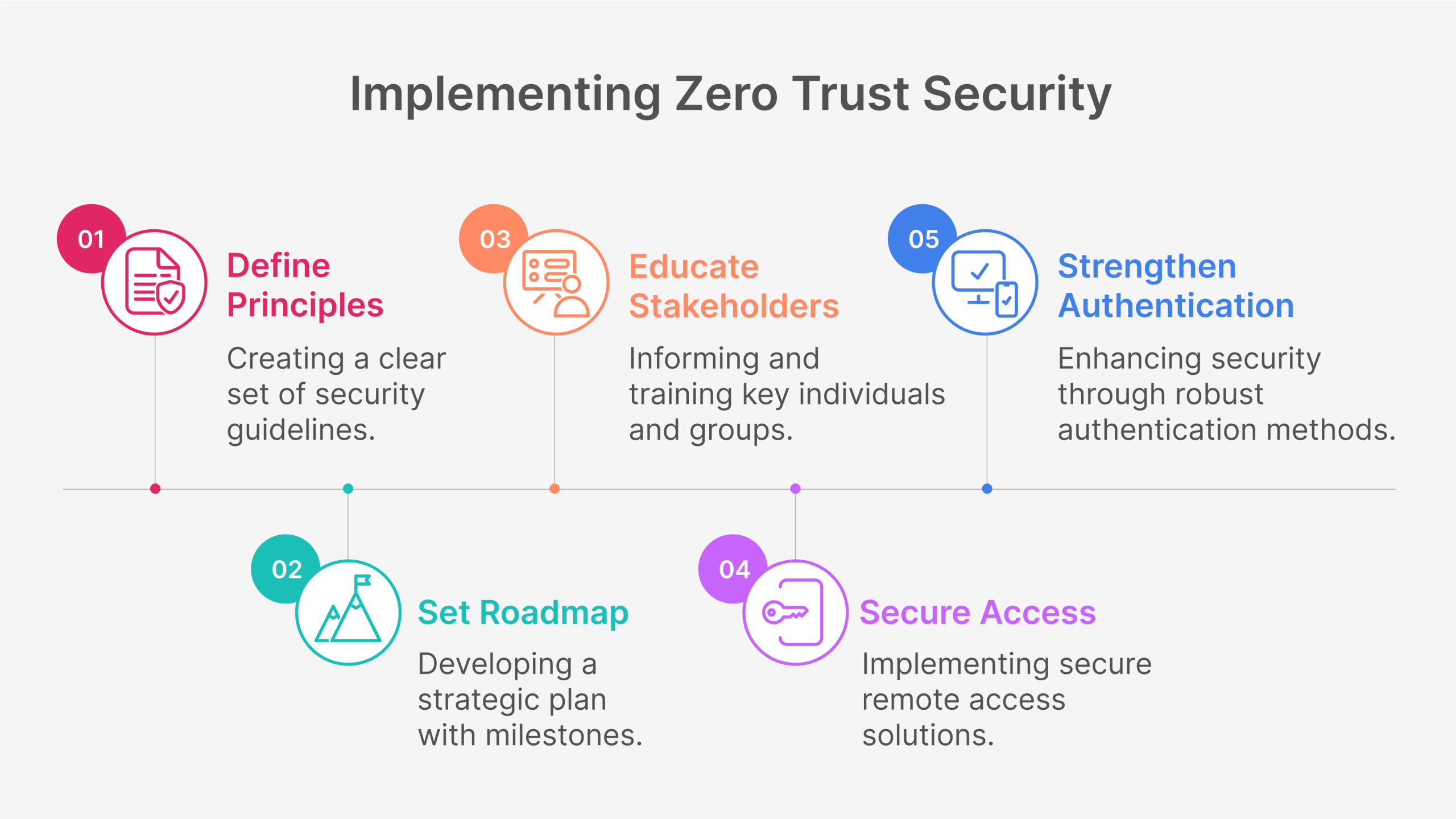
The historical trajectory of enterprise cybersecurity has been defined by reactive spending. Historically, security budgets expanded proportionally to the latest high-profile data breach. However, as global supply chains digitized and cloud compute architecture displaced localized data centers, the attack surface expanded exponentially. Cybercriminals no longer need to scale perimeter walls; they simply harvest credentials and walk through the front door disguised as legitimate users.
Zero Trust—summarized by the foundational mandate "Never Trust, Always Verify"—dismantles the traditional castle-and-moat architecture. Every access request is authenticated, authorized, and encrypted before access is granted. While engineers and system administrators immediately recognize the operational necessity of this approach, corporate directors and chief financial officers often view it through a different lens: cost center expansion, user friction, and operational drag.
Overcoming this institutional inertia requires treating internal stakeholders—CFOs, chief operating officers (COOs), and line-of-business (LOB) heads—as demanding enterprise clients. The burden of proof rests on security leadership to prove that Zero Trust is not a friction-heavy IT project, but a fundamental driver of operational resilience and market liquidity preservation.
Building the Business Case: Translating Tech to Capital
When presenting to the board, technical jargon such as "least privilege access," "continuous monitoring," and "identity-centric security" often fails to resonate. To secure executive buy-in, security leaders must frame the Zero Trust business case around three core financial pillars:
- Valuation Multiple Protection: A catastrophic data breach can instantly erode enterprise value, resulting in depressed valuation multiples, activist investor intervention, and executive turnover. Zero Trust acts as a balance sheet defense mechanism.
- Cyber Insurance Optimization: Underwriters are aggressively raising premiums or denying coverage entirely for organizations lacking modern identity and access controls. Implementing Zero Trust directly correlates with reduced underwriting risk and favorable policy pricing.
- Regulatory Compliance and M&A Readiness: With global regulatory frameworks—such as SEC cybersecurity disclosure rules, GDPR, and NIS2—imposing severe penalties for security negligence, Zero Trust provides verifiable proof of due diligence, accelerating mergers and acquisitions (M&A) due diligence timelines.
Furthermore, leadership must demonstrate how Zero Trust enables agile business operations. By decoupling network access from physical location, organizations empower remote and hybrid workforces to operate securely without sacrificing productivity or introducing latency.
Overcoming Technical and Cultural Friction
Even when financial stakeholders approve the capital allocation, cultural resistance within the enterprise can derail implementation. Developers, sales teams, and regional managers frequently view security controls as bureaucratic roadblocks designed to slow down velocity and time-to-market.
To win stakeholder support across departmental lines, CISOs must adopt a collaborative deployment strategy. Rather than imposing top-down restrictions that disrupt daily operations, security teams must partner with department heads to map critical workflows. By demonstrating that modern Zero Trust solutions leverage seamless multi-factor authentication (MFA) and context-aware single sign-on (SSO), leadership can reframe security from a restrictive gatekeeper into an enabler of frictionless, secure collaboration.
Verified Data & Metrics Breakdown
| Implementation Dimension | Traditional Perimeter Security | Zero Trust Architecture | Executive Impact & ROI |
|---|---|---|---|
| Access Philosophy | Implicit trust inside the network perimeter; strict trust outside. | Continuous verification of every user, device, and application context. | Radical reduction of lateral movement during a breach. |
| Capital Expenditure (CapEx) | High upfront hardware firewall and perimeter appliance costs. | Shift toward cloud-native software-defined perimeters and subscription SaaS. | Optimized cash flow management and predictable operational expenditure (OpEx). |
| Risk Mitigation Profile | Vulnerable to stolen credentials and internal lateral movement. | Enforces principle of least privilege, containing compromised endpoints. | Substantially lowers cyber insurance premiums and breach remediation costs. |
| Compliance & Audit Readiness | Complex, manual log collection across disparate local systems. | Centralized, automated identity and access telemetry logging. | Accelerates regulatory audits and M&A technical due diligence. |
Industry & Market Implications
The macroeconomic implications of widespread Zero Trust adoption extend far beyond individual corporate balance sheets. As global enterprises allocate multi-billion-dollar budgets toward identity-centric security architectures, a massive structural shift is occurring across the technology sector.
Winners: Enterprise cybersecurity vendors specializing in cloud access security brokers (CASB), identity governance and administration (IGA), secure access service edge (SASE), and endpoint detection and response (EDR) are experiencing unprecedented valuation growth. Consulting firms and managed security service providers (MSSPs) guiding these complex transitions are also capturing substantial advisory fees.
Losers: Legacy hardware vendors reliant on perimeter firewall appliances, traditional VPN resellers, and outdated on-premises identity management providers face severe headwinds. Organizations failing to modernize their security posture risk commoditization, supply chain disqualification, and catastrophic financial loss following a breach.
Frequently Asked Questions (People Also Ask)
1. How do I convince a CFO who views Zero Trust purely as an unbudgeted IT expense?
To persuade a CFO, you must translate cybersecurity metrics into financial risk models. Present Zero Trust not as an incremental software purchase, but as an insurance policy protecting enterprise valuation, preventing revenue-halting ransomware incidents, and reducing escalating cyber insurance premiums. Highlight how cloud-based Zero Trust architectures transition heavy upfront capital expenditures into predictable, scalable operational expenditures.
2. What is the typical timeline for securing board approval on a Zero Trust roadmap?
Board approval cycles typically range from three to six months, depending on organizational maturity. The process accelerates significantly when security leadership presents a phased roadmap rather than an intimidating, all-at-once organizational upheaval. Securing early wins with high-risk assets or remote worker populations builds immediate executive confidence.
3. How does Zero Trust impact day-to-day employee productivity and user experience?
When engineered correctly, modern Zero Trust enhances user experience by replacing cumbersome, legacy VPN connections with seamless, context-aware single sign-on (SSO) and adaptive multi-factor authentication (MFA). Employees gain secure access to necessary applications from any location or device without enduring artificial operational friction.
4. What are the most common pitfalls when pitching Zero Trust to non-technical stakeholders?
The primary pitfall is leading with technical complexity—such as micro-segmentation protocols or encryption algorithms—rather than business outcomes. Non-technical executives care about regulatory compliance, business continuity, risk mitigation, and capital efficiency. Framing the initiative around these business pillars ensures immediate alignment and support.
Future Outlook & Strategic Milestones
The transition toward absolute Zero Trust is no longer a speculative technological evolution; it is the baseline operating standard for the modern digital economy. Over the next 24 to 36 months, enterprise boards will increasingly tie executive compensation and cybersecurity performance metrics directly to Zero Trust maturity milestones.
Key indicators to monitor include the integration of artificial intelligence and machine learning (AI/ML) into continuous authentication engines, the tightening of cyber insurance underwriting mandates requiring verified Zero Trust deployment, and regulatory bodies codifying identity-centric security frameworks into statutory law. For enterprise leaders, the directive is unequivocal: master the art of articulating the Zero Trust business case today, or prepare to account for the catastrophic financial consequences of inaction tomorrow.