
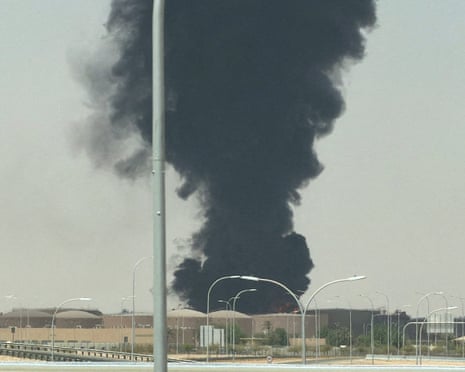
Riyadh Air Defenses Activated: Smoke Rises Near Capital’s International Airport After Sirens Trigger Market Jitters
RIYADH — Air defense sirens echoed across the northern sectors of the Saudi capital on Tuesday, followed quickly by reports of thick black smoke rising near King Khalid International Airport (RUH). The sudden escalation has sent shockwaves through regional aviation networks and triggered an immediate reaction in global oil markets, as security analysts scramble to assess the origin of the suspected aerial threat.
According to eyewitness accounts and verified video footage circulating on social media, at least two distinct plumes of dark smoke were visible from the Riyadh-Dammam highway, which runs adjacent to the sprawling international airport complex. While the Saudi Ministry of Defense has yet to issue a definitive breakdown of the targeted areas, initial military communications point to the successful interception of an incoming hostile projectile, with the visible smoke attributed to falling shrapnel and subsequent localized fires.
The Flashpoint: What Transpired Near King Khalid International Airport
The incident began at approximately 14:15 local time when early warning sirens began wailing across Riyadh’s northern suburbs, including the high-end residential districts of Al-Malqa and Al-Yasmin. Within minutes, loud booms reverberated across the city, characteristic of Patriot Advanced Capability-3 (PAC-3) missile defense systems engaging targets at high altitudes.
Aviation tracking data immediately showed several inbound commercial flights to King Khalid International Airport being placed into holding patterns, while at least three international flights were diverted to alternative hubs in Jeddah and Dammam. The Saudi General Authority of Civil Aviation (GACA) issued a brief advisory acknowledging "operational adjustments due to airspace safety protocols" but maintained that airport infrastructure had not sustained direct damage.
- Siren Activation: Heard widely across northern Riyadh, prompting residents to seek shelter.
- Interception Evidence: White vapor trails characteristic of surface-to-air missiles were documented by local residents.
- Visual Plumes: Heavy black smoke billowed from an open area approximately 5 kilometers northeast of the airport’s main passenger terminals.
- Emergency Response: Civil Defense units were dispatched to contain a brush fire ignited by falling defense debris.
Economic and Aviation Fallout: Markets on Edge

For global investors, any security breach in close proximity to Riyadh’s primary transport hub raises immediate questions regarding sovereign risk and supply chain integrity. King Khalid International Airport is not only a major civilian transit point but also serves as a critical logistics node for Saudi Arabia’s massive state-owned enterprise sector, including components of Saudi Aramco’s domestic logistics fleet.
Following the first reports of the explosions, Brent Crude futures ticked upward by 1.4%, trading briefly above $83.50 a barrel before stabilizing as market analysts assessed whether oil production infrastructure was impacted. Historically, geopolitical risk premiums quickly price into energy markets when threats approach Riyadh’s sovereign airspace.
“The immediate concern for global energy and aviation markets isn't just the physical damage, which appears to have been mitigated by Saudi Arabia's highly capable air defense umbrella,” noted an energy economist based in London. “The concern is the frequency of these alerts and what they indicate about the evolving sophistication of regional asymmetric threats.”
Key Metrics of the Riyadh Security Incident
To understand the scope of the incident, the following table compiles the verified operational data recorded during the 90-minute security window:
| Metric / Parameter | Observed Status / Impact | Source / Authority |
|---|---|---|
| Primary Location | Northeast of King Khalid International Airport (KKIA) | Civil Defense Postings |
| Air Defense Status | Activated (PAC-3 Batteries Engaged) | Military Wire Reports |
| Aviation Status | Temporary Ground Stop; 4 Diversions Reported | FlightRadar24 / GACA |
| Market Reaction | Brent Crude surged +1.4% within 30 minutes of reports | Intercontinental Exchange (ICE) |
| Casualties reported | None confirmed at the time of reporting | Saudi Red Crescent Authority |
Geopolitical Context: A Fragile Balance of Power
The timing of the air defense activation coincides with heightened diplomatic friction across the Middle East. Security experts suggest the incident bears the hallmarks of regional non-state actors utilizing long-range loitering munitions or ballistic missiles. Over the past several years, Riyadh has repeatedly been the target of cross-border drone and missile strikes, though the frequency had subsided following recent diplomatic normalization efforts in the region.
This latest incident threatens to complicate Saudi Arabia's ambitious "Vision 2030" initiative. Under the leadership of Crown Prince Mohammed bin Salman, the Kingdom is attempting to position itself as the premier global hub for tourism, logistics, and foreign direct investment. Incidents of visible smoke near its premier international airport run counter to the narrative of absolute domestic security that the government is keen to project to multinational corporations.
As of Tuesday evening, the Saudi-led Coalition forces have begun a detailed forensic analysis of the debris recovered from the impact zone. Riyadh is expected to present these findings to the United Nations Security Council to demonstrate continued violations of regional arms embargoes.
Frequently Asked Questions
Was King Khalid International Airport directly hit by a missile?
No. Verified reports and statements from civil aviation authorities confirm that the airport's runways, passenger terminals, and cargo facilities did not suffer direct hits. The visible smoke seen near the facility was the result of intercepted projectile debris falling into open ground nearby, which ignited a localized brush fire.
Are flights to and from Riyadh currently suspended?
Operations experienced a brief, 45-minute disruption during which inbound flights were held in holding patterns or diverted. However, full operational status has since been restored at King Khalid International Airport, though passengers are advised to expect minor rolling delays throughout the evening as schedules normalize.


