Inside the ECB’s Blueprint: How the Eurosystem Is Permanently Shrinking and Reshaping Its Balance Sheet
FRANKFURT — In a sweeping policy pivot that marks the definitive end of the post-global financial crisis era, the European Central Bank is systematically dismantling its legacy asset footprint. Delivering a landmark address at the ECB Conference on Money Markets, Executive Board member Isabel Schnabel laid out the definitive architecture for what Frankfurt officially terms "a new Eurosystem balance sheet." For institutional investors, corporate treasurers, and risk managers navigating European capital markets, this transformation represents a fundamental rewiring of liquidity provision, collateral management, and asset pricing mechanics.
Executive Takeaways
- Structural Downsizing: The Eurosystem is transitioning away from massive, crisis-era asset purchase programs toward a leaner, demand-driven operational framework.
- Collateral & Liquidity Overhaul: The new balance sheet heavily prioritizes market liquidity, stringent risk mitigation, and flexible, short-term refinancing operations over permanent quantitative easing.
- Capital Allocation Shifts: Commercial banks and institutional asset managers must adapt to structural scarcity in reserves, impacting enterprise ROI, short-term funding costs, and portfolio valuation multiples.
- Monetary Policy Transmission: The operational framework explicitly aims to anchor short-term interest rates efficiently while safeguarding financial stability across the Eurozone.
The Catalytic Shift: From Crisis Management to Structural Normalization
For more than a decade, the European Central Bank's balance sheet functioned as the primary shock absorber for the Eurozone economy. Successive waves of sovereign debt stress, the COVID-19 pandemic, and the subsequent energy shock forced Frankfurt into unprecedented monetary expansion. Asset purchase programs—most notably the Asset Purchase Programme (APP) and the Pandemic Emergency Purchase Programme (PEPP)—bloated the Eurosystem's consolidated balance sheet to historic multiples of the region's aggregate GDP.
However, as Isabel Schnabel articulated in her foundational address, maintaining an oversized balance sheet introduces severe structural distortions. It dampens money market activity, impairs price discovery in sovereign debt markets, and complicates the precise execution of monetary policy. The newly unveiled framework marks a decisive departure from this paradigm. By engineering a controlled, predictable reduction in legacy bond holdings, the ECB is returning to a system where central bank reserves are supplied primarily through targeted lending operations against high-grade collateral rather than outright market interventions.
This structural evolution demands a rigorous re-evaluation of institutional risk mitigation and capital allocation strategies. Financial institutions can no longer rely on chronic, unconstrained excess liquidity. Instead, treasury desks must optimize their intraday liquidity management and collateral availability to secure funding in a market transitioning toward greater structural scarcity.
Comparative Balance Sheet Dynamics: 2006 vs. 2024 and Beyond
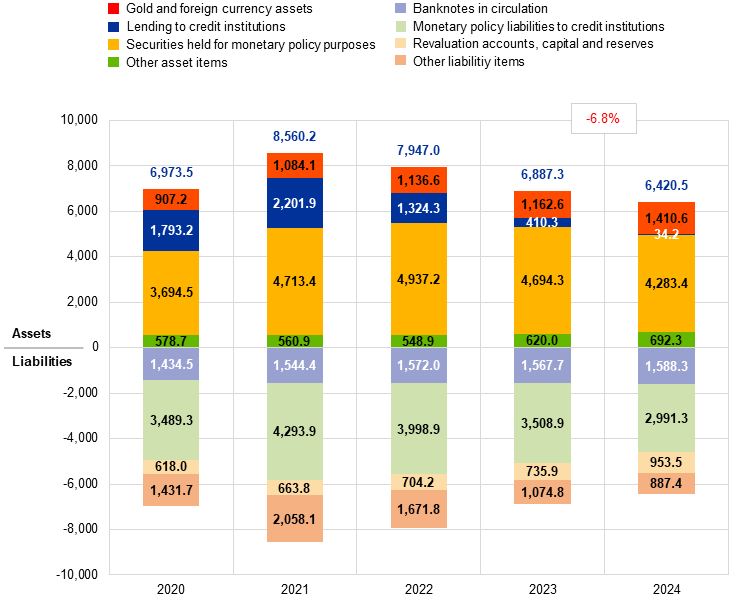
A granular examination of the Eurosystem's consolidated balance sheet reveals a profound transformation in asset composition and liability structures. Comparing the pre-crisis baseline of December 31, 2006, with the post-pandemic peak of December 31, 2024, highlights the magnitude of the operational pivot currently underway.
| Balance Sheet Metric | 31 December 2006 (Legacy Baseline) | 31 December 2024 (Post-Crisis Peak Era) | New Framework Trajectory (2025–Onwards) |
|---|---|---|---|
| Total Assets / Size | ~€1.2 Trillion | ~€6.8 Trillion | Structural reduction toward optimized equilibrium |
| Primary Asset Driver | Main refinancing operations (MROs) | Outright purchase programs (APP / PEPP) | Balanced mix of secured lending and lean portfolios |
| Reserve Abundance | Scarcity-based operational framework | Massive structural excess liquidity | Demand-driven reserves via regular refinancing |
| Collateral Standards | Traditional high-grade sovereign/private paper | Temporarily widened collateral easing measures | Re-tightening and stringent risk management |
Industry & Market Implications: Winners and Losers
The intentional contraction of the Eurosystem balance sheet carries profound microeconomic and macroeconomic repercussions. As the ECB steps back from its role as dominant market maker in European debt instruments, market participants must navigate a sharply altered competitive landscape.
Who Wins
- Active Fixed-Income Managers: The return of genuine price discovery and yield differentiation across sovereign and corporate debt provides fertile ground for alpha generation.
- Money Market Funds & Interbank Lenders: With reserves becoming less abundant, private money market activity is surging, breathing new life into interbank lending and repo markets.
- Prudent Commercial Banks: Institutions with robust, diversified funding models and pristine collateral pools gain a distinct competitive advantage over liquidity-dependent peers.
Who Loses
- Fiscal Authorities: Eurozone governments accustomed to absorbing massive sovereign debt issuances via central bank purchases must now rely entirely on private-sector demand, potentially facing higher sovereign borrowing costs.
- Leveraged Asset Portfolios: Entities that built investment strategies on the assumption of permanent, low-cost central bank liquidity face painful deleveraging pressures and compressed valuation multiples.
- Weaker Banking Institutions: Banks that failed to restructure their balance sheets during the era of free money will experience immediate margin compression as wholesale funding costs normalize upward.
Frequently Asked Questions (People Also Ask)
What is the primary objective of the new Eurosystem balance sheet framework?
The primary objective is to transition the European Central Bank away from crisis-era emergency interventions and toward a lean, structurally sound operational framework. This ensures precise monetary policy transmission, restores vibrant private money market activity, and maintains strict risk mitigation standards without distorting sovereign debt pricing.
How will the balance sheet reduction affect commercial bank liquidity?
Commercial banks will experience a steady decline in excess central bank reserves. Consequently, institutions will need to rely more heavily on regular ECB refinancing operations and active participation in private repo and interbank markets to satisfy their daily liquidity and regulatory requirements.
What role does collateral play in the ECB's modernized operational strategy?
Collateral management is the cornerstone of the new framework. As outright asset purchases wind down, lending against high-quality, stringently risk-assessed collateral becomes the primary mechanism for supplying central bank liquidity, ensuring the Eurosystem's balance sheet remains fully protected against credit and market risk.
When was this new policy framework formally detailed?
The definitive blueprint was outlined by ECB Executive Board member Isabel Schnabel during a keynote address at the ECB Conference on Money Markets in Frankfurt, building upon ongoing academic and institutional evaluations of post-crisis monetary architecture.
Future Outlook and Key Milestones to Watch
As the European Central Bank executes this multi-year balance sheet normalization, financial markets must monitor several critical forward-looking indicators. First, the pace of quantitative tightening (QT)—specifically the roll-off schedule of legacy bond portfolios—will dictate how smoothly sovereign debt markets absorb increased private supply. Second, structural adjustments in the ECB's minimum reserve requirements and operational lending floors will test the resilience of Eurozone interbank plumbing.
Ultimately, the pivot toward "a new Eurosystem balance sheet" is not merely an accounting exercise; it is a fundamental realignment of public and private financial responsibilities in Europe. For enterprise leaders, CFOs, and global investors, mastering this new operational reality is essential for capital preservation, accurate valuation forecasting, and strategic risk navigation in the years ahead.