Executive Takeaways
- Probing Quantum Gravity at 3,500 Meters: The KM3NeT collaboration is deploying thousands of hyper-sensitive optical sensors across the Mediterranean seabed to detect ultra-high-energy neutrinos, serving as a deep-sea laboratory to test Lorentz Invariance Violation (LIV)—a core pillar of Albert Einstein’s Special and General Relativity.
- Infrastructure Scale & Capital Allocation: Spanning two primary deep-water sites off the coasts of Italy (ARCA) and France (ORCA), this multi-hundred-million-euro infrastructure project leverages subsea fiber-optic networks, specialized optical sensor spheres, and petabyte-scale real-time compute architectures.
- Next-Generation High-Energy Physics: By monitoring Cherenkov radiation generated by cosmic particle collisions in abyssal seawater, physicists are hunting for micro-variations in the speed of light at Planck-scale energies ($10^{19}$ GeV), which could unlock a unified Theory of Quantum Gravity.
- Commercial & Dual-Use Technological Spillover: The extreme engineering required for subsea physical containment, high-bandwidth optical signal processing, and low-latency underwater telemetry is yielding high-value IP in oceanographic monitoring, subsea defense arrays, and subsea optical fiber resilience.
Introduction: The Abyssal Search for Broken Symmetry
Test Our Free AI & Tech Utilities Suite
Calculate LLM API token costs, analyze article dwell-time, or simulate tech DCA returns.
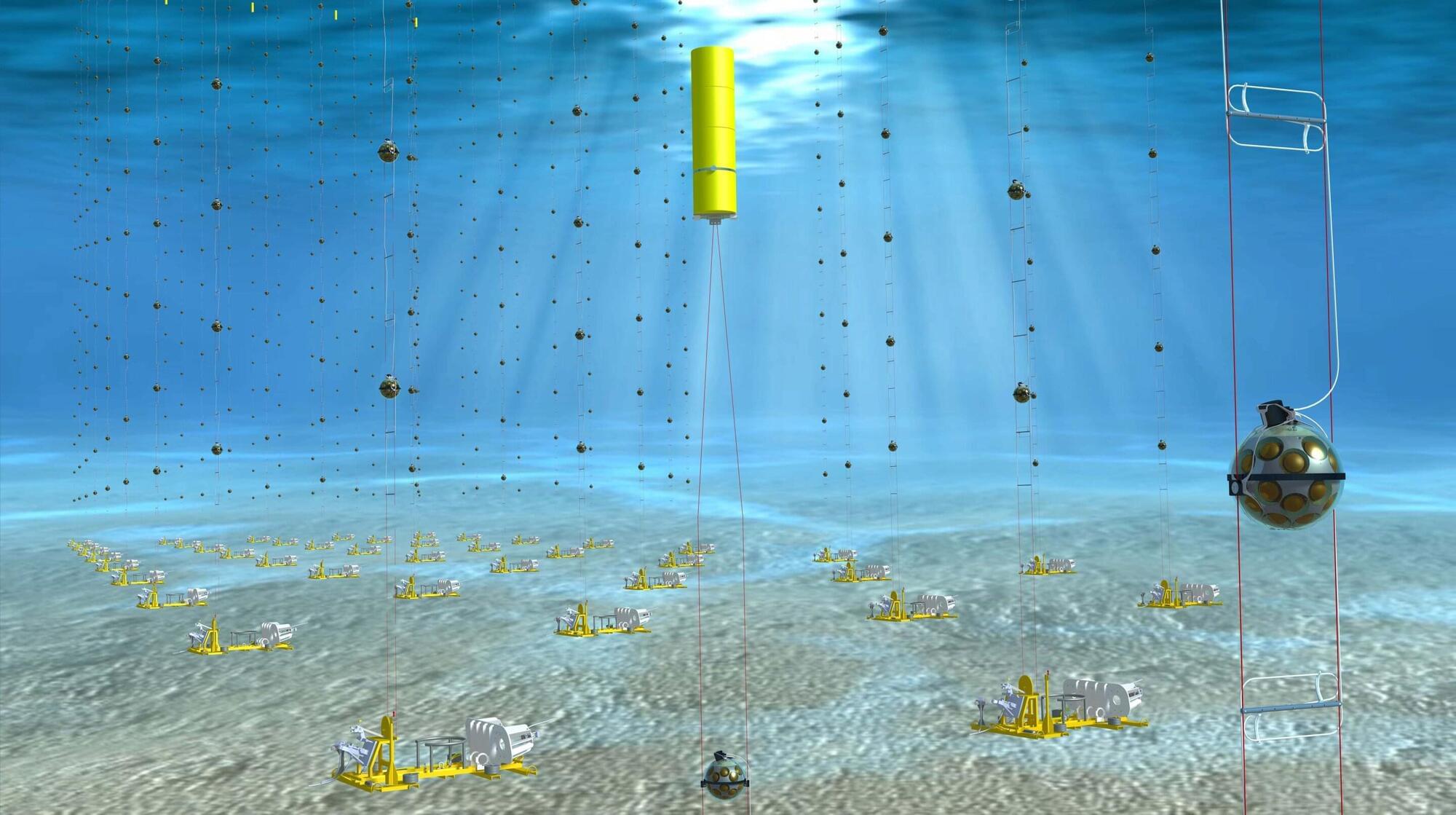
More than three kilometers beneath the surface of the Mediterranean Sea, in pitch-black abyssal waters off the coast of Capo Passero, Sicily, and Toulon, France, international research consortia are building one of the most ambitious physics instruments in human history. The Cubic Kilometre Neutrino Telescope (KM3NeT)—comprising the ARCA (Astroparticle Research with Cosmics in the Abyss) and ORCA (Oscillation Research with Cosmics in the Abyss) arrays—is designed to transform the deep sea into a giant particle detector.
While fundamentally engineered to map the distant high-energy universe through neutrino astronomy, KM3NeT has emerged as the premier proving ground for testing the absolute boundaries of Albert Einstein’s 1905 Special Relativity and 1915 General Relativity. Specifically, researchers are utilizing incoming cosmic neutrinos—infinitely light, neutral fundamental particles that traverse billions of light-years without interaction—to search for subtle breakdowns in Lorentz Invariance. If detected, Lorentz Invariance Violation (LIV) would represent the first observational evidence of quantum gravity, fundamentally altering our understanding of space, time, and the baseline laws governing the cosmos.
The Physics of the Abyss: Why Test Einstein Deep Underwater?

Einstein’s Special Theory of Relativity hinges on the foundational postulate of Lorentz Invariance: the laws of physics, including the speed of light in a vacuum ($c$), remain invariant for all inertial observers regardless of their velocity or energy state. However, modern theoretical paradigms aiming to unify General Relativity with Quantum Mechanics—such as String Theory, Loop Quantum Gravity, and Non-Commutative Geometry—predict that at extremely high energy scales approaching the Planck scale ($\sim 1.22 \times 10^{19}$ GeV), space-time may cease to be smooth and continuous. Instead, space-time may exhibit a discrete, "foamy" quantum structure.
Detecting this theoretical quantum foam requires particle probes operating at energies far beyond the reach of human-made particle accelerators. CERN’s Large Hadron Collider (LHC) operates at a center-of-mass energy of approximately $1.3 \times 10^4$ GeV—trillions of times below the Planck threshold. Ultra-high-energy astrophysical neutrinos, generated by violent cosmic events such as supermassive black hole accretion, gamma-ray bursts, and blazars, arrive at Earth carrying mega-electron-volt to peta-electron-volt ($10^{15}$ eV) energies.
As these ultra-high-energy neutrinos travel across gigaparsecs of space, even infinitesimally small Lorentz-violating perturbations in their propagation speeds or flavor oscillation dynamics accumulate over cosmic time. If higher-energy neutrinos travel slightly faster or slower than lower-energy counterparts—or if their quantum state transformations shift anomalous to Einsteinian geometries—the temporal and spatial arrival signatures recorded by deep-sea detectors will reveal the anomaly.
Engineering the Deep-Sea Array: ARCA and ORCA Architectures
To capture these elusive particle signals, KM3NeT relies on abyssal seawater to act simultaneously as a massive cosmic-ray shield, a target medium for particle interaction, and an optically clear radiator. When a high-energy neutrino collides with an atomic nucleus in the water surrounding the array, it produces charged secondary particles (such as muons, electrons, or taus) moving through the water at speeds faster than the phase velocity of light in water. This superluminal movement generates a cone of faint, blue light known as Cherenkov radiation.
KM3NeT catches these faint optical flashes using vertical detection units—flexible, high-tension lines anchored to the seabed and held upright by submerged buoys, extending up to 700 meters into the water column. Each line is strung with Digital Optical Modules (DOMs): pressure-resistant 17-inch glass spheres engineered to withstand over 350 atmospheres of hydrostatic pressure.
Key Structural and Technological Innovations:
- Multi-PMT Design: Unlike legacy single-tube detectors, each KM3NeT DOM contains 31 three-inch Photomultiplier Tubes (PMTs) directed in all directions. This omnidirectional spatial resolution increases directional photon detection efficiency by a factor of three over previous iterations.
- High-Bandwidth Subsea Telemetry: Each DOM is linked to a custom, radiation-hardened electro-optical backbone cable. Data is streamed continuously via high-throughput subsea optical fiber to shore stations located in Porto Empedocle (Sicily) and La Seyne-sur-Mer (France).
- Sub-Nanosecond Timing Calibration: To detect Lorentz invariance violations through minute differences in photon arrival times, the system utilizes sub-nanosecond clock synchronization across tens of thousands of PMTs spread across cubic kilometers of ocean water.
Verified Data & Operational Metrics Breakdown
The operational specifications of KM3NeT highlight its immense scale compared to legacy and competing astroparticle facilities built across the globe:
| Facility Parameter | KM3NeT / ARCA (Italy) | KM3NeT / ORCA (France) | IceCube (South Pole) | Baikal-GVD (Russia) |
|---|---|---|---|---|
| Primary Target Medium | Deep Seawater (Mediterranean) | Deep Seawater (Mediterranean) | Polar Antarctic Ice | Fresh Water (Lake Baikal) |
| Operational Depth / Coverage | 3,500 meters depth | 2,450 meters depth | 1,450 to 2,450 meters depth | 750 to 1,300 meters depth |
| Target Instrument Volume | ~1.0 Cubic Kilometer | ~0.008 Cubic Kilometer | ~1.0 Cubic Kilometer | ~0.5 Cubic Kilometer |
| Primary Scientific Objective | Astrophysical Neutrinos & LIV | Neutrino Mass Hierarchy / Oscillations | High-Energy Cosmic Rays | Diffuse Cosmic Neutrino Flux |
| Optical Sensor Density | 230 Detection Strings / 4,140 DOMs | 115 Detection Strings / 2,070 DOMs | 86 Strings / 5,160 Digital Optical Modules | 96 Strings / 2,304 Optical Modules |
| Data Throughput Rate | > 25 Gigabits per second (Gbps) | ~ 10 Gigabits per second (Gbps) | ~ 1 Gigabyte per minute (Filtered) | ~ 5 Gigabits per second (Gbps) |
| Angular Resolution (Muons) | < 0.1 Degrees (High precision) | ~ 2 Degrees (Low energy) | < 0.5 Degrees | ~ 0.5 Degrees |
Data Pipelines: Edge Computing and Terabyte Data Streams
Testing Lorentz Invariance Violation requires processing enormous streams of raw optical data to separate faint signal photons from background noise. Deep seawater contains continuous natural background light produced by radioactive Decay of Potassium-40 ($^{40}\text{K}$) naturally present in ocean salts, as well as marine bioluminescence from deep-sea organisms.
To overcome this background noise, KM3NeT uses an "All-Data-To-Shore" operational concept. Rather than performing aggressive hardware-level filtering deep underwater—which risks discarding unexpected quantum anomalies—the detector continuously routes raw digitization data straight to shore stations. Modern edge-compute architecture and onshore high-performance compute clusters execute real-time coincidences algorithms. High-density GPU nodes analyze timing correlations across multiple PMTs within 10-nanosecond windows, stripping out marine noise and reconstructing cosmic muon tracks with angular resolution better than 0.1 degrees.
These precise trajectories enable theoretical physicists to run modified dispersion relation models. If light or neutrino speeds vary as a function of energy ($E$), expressed via the Lorentz-violating expansion equation:
E2 = p2c2 + m2c4 ± sn · (E / EQG)n · p2c2
where $E_{\text{QG}}$ represents the Quantum Gravity energy scale and $s_n$ is a sign factor, the KM3NeT data pipeline can establish new, highly stringent empirical lower bounds on $E_{\text{QG}}$, challenging or verifying quantum gravity models.
Industry, Financial, and Market Implications
While KM3NeT is primarily funded as a fundamental science initiative by European research councils (including INFN in Italy and CNRS in France) under the EU Horizon Europe framework, its structural technologies carry major implications for commercial and capital allocation domains:
1. Subsea Telemetry and Deep-Sea Optical Networks
The deployment of thousands of high-durability optical sensors operating continuously under extreme pressures has driven innovation in subsea cable robustness, high-density optical connectors, and low-attenuation signal routing. Companies specializing in subsea telecom infrastructure, deep-sea robotic installation (ROVs), and subsea power distribution are capturing high-value IP from these infrastructure deployments.
2. Quantum Sensing and Precision Timing Infrastructure
Sub-nanosecond timing networks deployed over large distances provide critical benchmarks for commercial quantum sensing and precision time-stamping technologies. High-frequency trading (HFT) firms, global navigation satellite networks, and defense telecommunications rely heavily on low-jitter clock synchronization derived from methods tested in these deep-sea arrays.
3. Marine Environmental Monitoring and Dual-Use Defense
Because KM3NeT runs continuously, its acoustic calibration sensors, temperature probes, and optical arrays double as real-time, deep-sea environmental monitoring networks. Oceanographers track climate-driven deep-water circulation changes, ocean acidification, and marine acoustic fauna. Furthermore, the acoustic and optical monitoring arrays provide valuable dual-use intelligence for subsea maritime domain awareness, assisting in sovereign underwater asset protection and infrastructure monitoring.
Frequently Asked Questions (People Also Ask)
How does a deep-sea neutrino telescope test Einstein's Theory of General Relativity?
General Relativity assumes space-time is smooth and the speed of light in a vacuum is constant for all energies. Quantum gravity theories suggest space-time at extremely small scales is non-smooth, which could cause ultra-high-energy neutrinos to travel at slightly different speeds depending on their energy. By measuring the precise arrival times and flavor transformations of high-energy neutrinos traveling across billions of light-years, KM3NeT can check for these minute deviations, directly testing whether Lorentz Invariance holds under extreme conditions.
Why is KM3NeT built underwater instead of on land?
Water acts as a natural shield against background radiation from atmospheric particles, while serving as both the collision target for neutrinos and the medium for generating Cherenkov light. Deep ocean water offers extraordinary optical clarity, allowing light to travel dozens of meters without scattering. Building the array at depth (2,450 to 3,500 meters) creates a dark, isolated environment needed to detect ultra-faint optical flashes using photomultiplier tubes.
What happens if a Lorentz Invariance Violation (LIV) is detected?
Detecting a Lorentz Invariance Violation would be a revolutionary event in physics. It would provide the first direct experimental evidence that Einstein's Special and General Relativity are incomplete low-energy approximations of a deeper theory. Such a discovery would confirm the quantum nature of space-time, provide experimental guidance for String Theory and Loop Quantum Gravity, and fundamentally rewrite theoretical physics textbooks.
How does KM3NeT compare to the IceCube Neutrino Observatory in Antarctica?
While IceCube uses natural Antarctic ice as its medium, KM3NeT uses Mediterranean seawater. Seawater has significantly less optical light scattering than glacial ice, enabling KM3NeT to achieve much higher angular resolution (better than 0.1 degrees versus IceCube’s ~0.5 degrees). This allows KM3NeT to point back to cosmic neutrino sources with greater directional accuracy and make more precise spatial timing measurements required for Lorentz Invariance tests.
Future Outlook: The 2030 Precision Physics Horizon
Over the next three to five years, the deployment of KM3NeT's full footprint of detection strings across both the ARCA and ORCA sites will continue to expand overall active target volume. Once fully operational, KM3NeT will join IceCube, the Baikal-GVD in Russia, and future planned arrays like P-ONE (Pacific Ocean Neutrino Experiment) in a global multi-messenger astronomical network.
As multi-messenger astronomy matures—combining real-time alerts from gravitational wave detectors (LIGO/Virgo/KAGRA), electromagnetic observatories (such as the James Webb Space Telescope and the Cherenkov Telescope Array), and deep-sea neutrino detectors—physicists will gain unprecedented capabilities. Coordinated observation of cosmic events, such as neutron star mergers or blazar flares, will allow instantaneous real-time arrival comparisons across gravitational waves, gamma photons, and ultra-high-energy neutrinos.
Through this multi-messenger lens, the Mediterranean seabed will remain at the forefront of modern science. By leveraging deep-sea engineering, subsea optical fiber networks, and massive compute infrastructure, researchers working miles beneath the ocean surface are positioned to answer one of physics' most enduring questions: Is Einstein’s space-time continuous, or will the secrets of quantum gravity be unveiled in the deep ocean abyss?