Financial markets have officially entered a high-stakes era of extreme bifurcation. While major headline indices continue to hover near striking distance of record highs, a granular examination of market breadth reveals a starkly different reality. Wall Street is currently witnessing one of the most pronounced divergence cycles in modern monetary history. On one side of the ledger stands a hyper-concentrated vanguard of artificial intelligence hardware titans, led unconditionally by Nvidia. On the other lies a brooding expanse of declining equities, punctuated by a rare, high-profile stumble from consumer technology bellwether Apple.
For institutional asset allocators, risk managers, and quantitative strategists, this dynamic is not merely an operational anomaly; it is a profound structural test of market liquidity, capitalization weighting, and index integrity. As capital allocation shifts decisively away from broad-market participation toward secular AI infrastructure plays, the broader economic health of the equity market is increasingly obscured by a handful of mega-cap behemoths. This investigative report dissects the macroeconomic catalysts, corporate maneuvers, and valuation mechanics driving the Great Divergence.
Executive Takeaways
Test Our Free AI & Tech Utilities Suite
Calculate LLM API token costs, analyze article dwell-time, or simulate tech DCA returns.
- Extreme Market Concentration: Nvidia and select hyperscale-adjacent tech equities are single-handedly offsetting widespread declines across the broader S&P 500 and Russell 2000 indices.
- The Apple Factor: Apple Inc. has experienced notable downward pressure driven by regulatory headwinds in key international jurisdictions and shifting consumer replacement cycles.
- Valuation Multiples & Infrastructure ROI: Enterprise IT spending remains fiercely anchored to generative AI compute architecture, justifying premium valuation multiples for chipmakers while penalizing stagnant hardware ecosystems.
- Macroeconomic Liquidity Realities: With interest rate expectations in constant flux, institutional capital is retreating from cyclical and small-cap assets, consolidating heavily into balance-sheet-secure, cash-generating tech monoliths.
The Anatomy of a Monolithic Rally: Nvidia’s Unrelenting Dominance
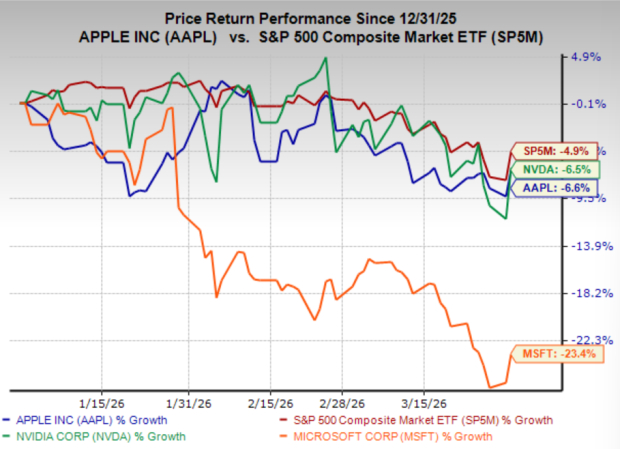
To understand why the broader market can bleed while primary indices hold firm, one must examine the mathematics of capitalization-weighted indices. Nvidia Corporation has transcended its origins as a specialized graphics processing unit (GPU) designer to become the de facto central bank of the artificial intelligence revolution. Enterprise ROI calculations across global Fortune 500 companies are now inextricably linked to Nvidia’s silicon roadmap, creating an unprecedented moat in cloud compute architecture.
During recent trading sessions, as market breadth indicators flashed warning signs and declining issues outnumbered advancing ones by margins exceeding two-to-one on major exchanges, Nvidia surged forward. Institutional inflows into the stock remain relentless. Portfolio managers operating under strict tracking-error constraints find themselves forced to maintain or overweight their exposure to Nvidia, simply because underweighting the stock in a rising index environment introduces career-threatening performance drag.
This self-fulfilling liquidity cycle has insulated the broader market’s top tier from macroeconomic headwinds that are hammering cyclical sectors. Real estate, regional banking, and traditional industrial equities have felt the brunt of prolonged high interest rates and tighter lending standards. Yet, because Nvidia and its immediate peers command trillions of dollars in aggregate market capitalization, their upward trajectory exerts a disproportionate gravitational pull on the S&P 500 and Nasdaq Composite, masking systemic weakness underneath the surface.
The Apple Retrenchment: A Bellwether Signals Caution
Conversely, the downward pressure experienced by Apple Inc. highlights the fragility inherent in even the most dominant consumer technology franchises. Apple's recent valuation friction stems from a complex convergence of geopolitical pressures, antitrust scrutiny, and hardware saturation in its core iPhone segment.
Regulatory compliance costs have escalated sharply, particularly in the European Union under the Digital Markets Act, forcing Apple to alter foundational aspects of its App Store monetization model. Simultaneously, macroeconomic stagnation in key Asian markets has weighed on consumer upgrade cycles. While Apple maintains an enviable fortress balance sheet and peerless share repurchase programs, institutional capital has momentarily rotated away from its consumer-discretionary-leaning profile in favor of pure-play enterprise AI infrastructure providers.
This divergence between Nvidia’s soaring hardware demand and Apple’s consumer-facing challenges underscores a critical thematic shift on Wall Street: investors are currently rewarding capital expenditures directed toward enterprise productivity and machine learning infrastructure over consumer hardware upgrades.
Verified Data & Metrics Breakdown
| Metric / Indicator | Nvidia (NVDA) | Apple (AAPL) | Broader Market (Russell 2000 / S&P Breadth) |
|---|---|---|---|
| Recent Price Action Trend | Strong Upward Momentum | Downward Pressure / Correction | Broad-based Decline / Stagnation |
| Primary Catalyst | Enterprise AI Compute Demand & GPU Backlogs | Regulatory Scrutiny & Slower Upgrade Cycles | Interest Rate Volatility & Credit Tightening |
| Valuation Multiple (Forward P/E) | Elevated, Backed by Triple-Digit Earnings Growth | Stable to Modestly Contracted | Compressed across Cyclical Sectors |
| Institutional Capital Flow | Heavy Net Inflows (FOMO / Index Rebalancing) | Selective Profit-Taking & Reallocation | Capital Flight toward Defensive Assets |
Industry and Market Implications: Winners and Losers
The profound asymmetry defining the current market environment carries sweeping consequences across the global financial ecosystem. Identifying who benefits and who suffers from this dynamic is essential for institutional risk mitigation.
The Winners
- Hyperscale Cloud Providers & AI Pure-Plays: Firms capable of deploying next-generation data center infrastructure continue to capture outsized enterprise IT budgets.
- Passive Index Funds: Due to capitalization weighting, passive vehicles tracking the S&P 500 automatically capture the gains of the AI vanguard, outperforming many actively managed funds struggling with poor market breadth.
- Quantitative Momentum Strategies: Trend-following algorithms that isolate strength and ride high-alpha momentum factors have reaped substantial rewards from the concentration trade.
The Losers
- Small-Cap and Mid-Cap Equities: Deprived of cheap debt financing and facing higher refinancing hurdles, companies in the Russell 2000 are struggling to attract institutional sponsorship.
- Consumer Hardware Ecosystems: Suppliers and manufacturers tied strictly to consumer upgrade cycles face margin compression as enterprise spending dominates capital allocation priorities.
- Active Stock-Pickers: Traditional fundamental analysts attempting to find value across the broader market find their portfolios lagging behind indices heavily skewed by a handful of mega-cap outliers.
Frequently Asked Questions (People Also Ask)
Why are Big Tech stocks rising while the rest of the market falls?
Modern major indices like the S&P 500 and Nasdaq 100 are capitalization-weighted, meaning larger companies have a vastly greater impact on index performance than smaller ones. When enterprise AI leaders like Nvidia experience massive capital inflows, their gains can single-handedly offset declines in hundreds of smaller or cyclical stocks within the same index, creating an illusion of overall market health.
Is the current concentration in Nvidia and AI stocks sustainable?
Wall Street analysts remain deeply divided. Bulls argue that generative AI represents a secular technological shift comparable to the dawn of the internet, justifying sustained high valuations based on explosive earnings growth and enterprise ROI. Bears warn that extreme market concentration leaves indices highly vulnerable to any operational stumble, supply chain disruption, or sentiment shift within the semiconductor sector.
Why is Apple dropping while other tech giants are climbing?
Apple’s recent underperformance is tied to unique headwinds, including stringent regulatory interventions in international markets, slower-than-expected hardware replacement cycles among consumers, and a temporary rotation of institutional capital away from consumer electronics toward enterprise-facing artificial intelligence infrastructure.
How should individual and institutional investors adapt to poor market breadth?
Risk mitigation strategies in low-breadth environments typically involve barbell portfolios—pairing high-conviction, secular growth winners with defensively positioned, cash-rich dividend payers—while actively monitoring macroeconomic indicators such as treasury yields, credit spreads, and central bank liquidity policy.
Future Outlook: Critical Milestones to Monitor
As Wall Street navigates this extraordinary chapter of market mechanics, several key milestones will dictate whether the current bifurcation resolves into a broader economic expansion or precipitates a sharp sector rotation:
- Hyperscaler Capital Expenditure Guidance: Earnings reports from major cloud infrastructure providers will serve as the definitive litmus test for whether enterprise AI demand remains resilient or shows signs of saturation.
- Federal Reserve Monetary Policy Trajectory: Shifts in interest rate expectations will directly impact the cost of capital, potentially breathing new life into battered small-cap and cyclical equities if monetary easing materializes.
- Regulatory and Antitrust Developments: Ongoing global enforcement actions targeting Big Tech monetization models will continue to introduce regulatory compliance friction, particularly for consumer-facing giants like Apple.
Ultimately, the current market dynamic serves as a stark reminder that headline index numbers can tell a deceptive story. While Nvidia and its digital vanguard continue to scale unprecedented heights, the broader health of Wall Street remains inextricably bound to the resolution of macroeconomic pressures and the widening chasm between the AI elite and the rest of corporate America.