WASHINGTON — Four years into its historic mission to rewrite humanity's understanding of the cosmos, the James Webb Space Telescope (JWST) has delivered a breathtaking birthday present to scientists and space enthusiasts alike. NASA has released a mesmerizing, high-definition capture of Centaurus A, a violently warped galaxy serving as the backdrop for an ongoing cosmic collision.
The landmark image, unveiled on Tuesday to mark the fourth anniversary of the observatory's scientific operations, offers unprecedented clarity into the chaotic mechanics of galaxy mergers. By piercing through dense, obscuring lanes of cosmic dust that have long baffled traditional observatories, Webb's advanced infrared instruments are once again proving why the $10 billion observatory is considered the greatest engineering triumph of modern astronomy.
Inside the Centaurus A Collision Site
Centaurus A, located approximately 12 million light-years from Earth in the southern constellation Centaurus, is no ordinary galaxy. It is officially classified as a peculiar galaxy—the result of a titanic merger between a massive elliptical galaxy and a smaller spiral galaxy that began hundreds of millions of years ago.
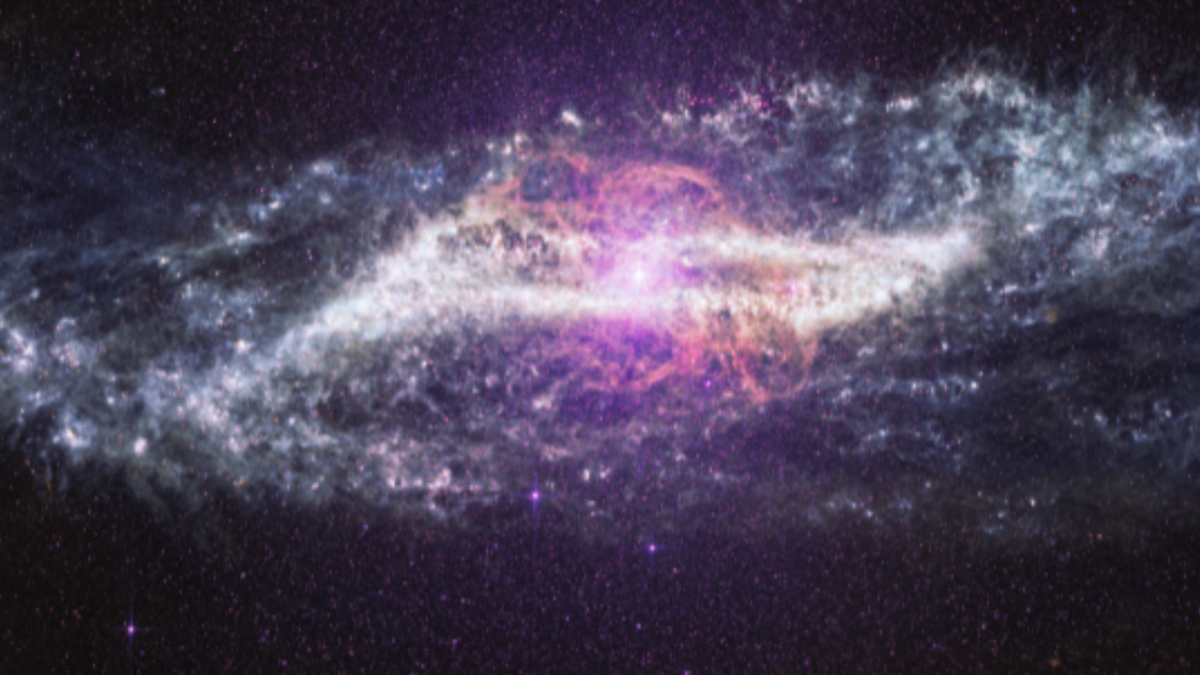
The new JWST capture highlights the chaotic aftermath of this ancient galactic crash. Stretching across the frame is a thick, dark belt of dust and gas that cuts directly across the galaxy's glowing core. In this turbulent crucible, the collision of gas clouds has triggered massive waves of star formation, lighting up stellar nurseries that were previously invisible to optical telescopes like Hubble.
"No single telescope tells the whole story," NASA project scientists emphasized in a joint briefing. "Discoveries build upon discoveries, and what we are seeing in Centaurus A is a masterclass in how galaxies evolve, merge, and transform over cosmic time."
Executive Takeaways: Why the JWST Milestone Matters
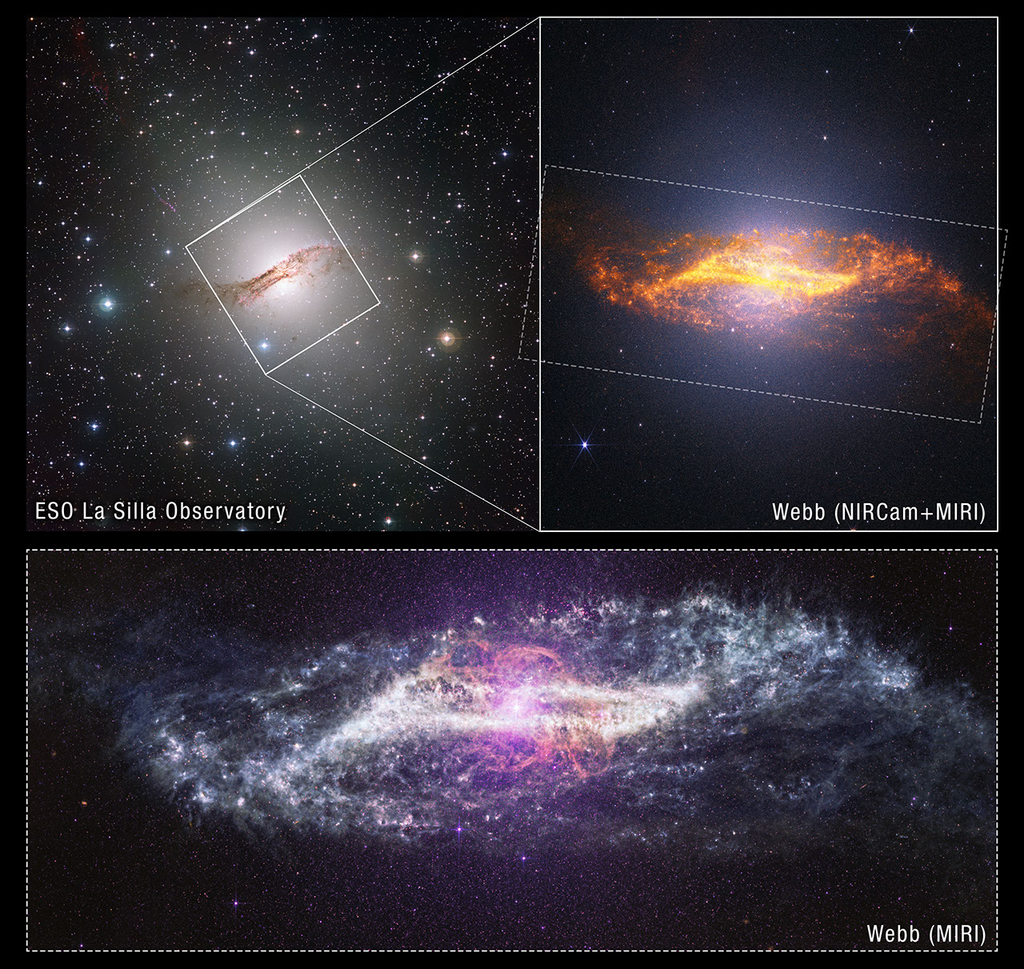
- Unmatched Infrared Vision: Webb’s Near-Infrared Camera (NIRCam) and Mid-Infrared Instrument (MIRI) successfully peered through the heavy dust lanes of Centaurus A, revealing intricate structural details of the galactic core and supermassive black hole environment.
- Four Years of Discovery: Since launching in late 2021 and entering full science operations in July 2022, JWST has fundamentally shifted paradigms in astrophysics, from identifying the earliest galaxies in the universe to characterizing exoplanet atmospheres.
- Decoding Galactic Evolution: The Centaurus A data provides critical empirical models for how local galactic mergers mirror the violent evolution of early galaxies in the primordial universe.
- Global Collaboration: The mission remains a triumphant joint venture led by NASA, the European Space Agency (ESA), and the Canadian Space Agency (CSA).
The Power of Multi-Wavelength Astronomy
While the new image showcases JWST’s peerless capabilities, leading astrophysicists stress that the observatory's true value is unlocked when paired with other scientific instruments. Centaurus A has long been a favorite target for multi-messenger and multi-wavelength astronomy, having been studied extensively by X-ray observatories like NASA’s Chandra X-ray Observatory and radio telescopes around the globe.
At the beating heart of Centaurus A lies an active galactic nucleus powered by a supermassive black hole weighing roughly 55 million times the mass of our sun. This behemoth is currently blasting powerful jets of radio-emitting plasma far out into intergalactic space. By combining Webb’s infrared data with high-energy X-ray and radio maps, researchers can now construct a holistic, multi-dimensional profile of how black hole feedback interacts with surrounding star-forming gas during a merger event.
| Parameter | Data Point |
|---|---|
| Target Object | Centaurus A (NGC 5128) |
| Distance from Earth | ~12 Million Light-Years |
| Primary Instrument Used | JWST NIRCam & MIRI |
| Central Object | Supermassive Black Hole (~55 Million Solar Masses) |
| Significance | 4th Anniversary Showcase of Galactic Evolution |
Looking Ahead: The Next Frontier for Webb
As the James Webb Space Telescope enters its fifth year of operations, the scientific community is optimistic about its remaining operational lifespan. Thanks to an extraordinarily precise initial launch by an Ariane 5 rocket, fuel conservation maneuvers have extended the telescope's projected operational life well beyond its baseline 10-year requirement.
Future observation cycles will continue to target complex regions of star formation, deep-field cosmological surveys, and detailed spectroscopic analysis of potentially habitable exoplanet atmospheres. For now, however, the astronomical community is taking a moment to celebrate four years of revolutionary science—cemented permanently by a stunning portrait of two galaxies locked in a timeless, beautiful dance of creation and chaos.
Frequently Asked Questions
What makes Centaurus A an important target for the James Webb Space Telescope?
Centaurus A is the closest radio galaxy to Earth, making it an ideal laboratory for studying the violent physics of galaxy mergers, star formation triggered by cosmic collisions, and the activity of a central supermassive black hole.
Why did NASA release the Centaurus A image right now?
The stunning new visual data was released to commemorate the fourth anniversary of the James Webb Space Telescope entering full scientific operations in July 2022, highlighting its ongoing contributions to astronomy.