History in the Making: NASA Unveils the Artemis III Crew Chosen to Walk on the Moon
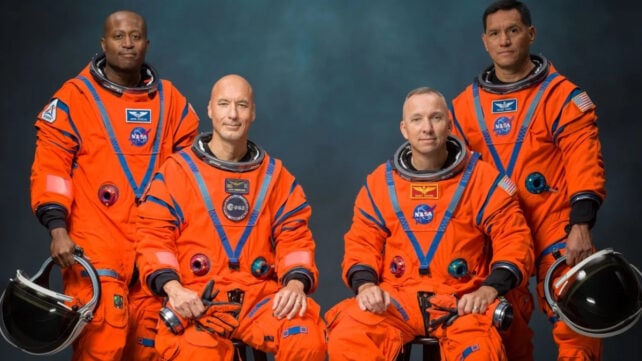
WASHINGTON — In a high-stakes announcement that marks a defining milestone for 21st-century space exploration, NASA has officially revealed the four elite astronauts selected for the Artemis III mission. This historic flight will return humanity to the lunar surface for the first time in more than half a century, cementing a new era of commercial and international collaboration in deep space.
Broadcast live from NASA’s Johnson Space Center in Houston and covered extensively by global wire services, the unveiling ends months of fierce speculation within the aerospace community. The newly named crew represents a diverse blend of flight-test experience, cutting-edge scientific expertise, and the vanguard of modern space exploration.
The Lineup: Who is Heading to the Lunar South Pole?
The Artemis III crew selection is the culmination of rigorous physical, technical, and psychological screening. Unlike the Apollo missions of the 1960s and 70s, which were engineered during the geopolitical heat of the Cold War, this crew steps into a vastly different multilateral landscape. They carry the hopes of a coalition of international space agencies and private commercial partners.
- Unprecedented Diversity & Experience: The team fuses veteran spaceflight commanders with next-generation mission specialists.
- Strategic Advantage: Each crew member has logged extensive training hours in geology, lunar module simulation, and emergency life-support protocols.
- Global Significance: The mission paves the way for a permanent, sustained human presence on the Moon, acting as a critical stepping stone for eventual crewed missions to Mars.
Speaking exclusively to major media outlets following the reveal, NASA leadership emphasized that this crew was chosen not just for their ability to fly spacecraft, but for their resilience under extreme pressure. "These individuals embody the best of humanity's pioneering spirit," noted a senior mission director during the post-announcement briefing. "They are not just going back to the Moon; they are building the infrastructure for our future among the stars."
High-Stakes Economics and the New Space Race
Beyond the geopolitical prestige, the Artemis III mission carries massive economic implications. Trillions of dollars in public and private capital are currently flowing into the space economy, driven by innovations in reusable rocketry, lunar resource extraction, and orbital manufacturing.
Wall Street and global financial markets have closely tracked the commercial partnerships underpinning the Artemis program. Companies specializing in life-support systems, advanced avionics, and lunar surface mobility are seeing unprecedented valuation surges. The success of Artemis III will not only validate NASA’s pivot toward public-private partnerships—exemplified by contracts with aerospace giants like SpaceX and Blue Origin—but will also set the economic baseline for deep-space commerce over the next three decades.
"Investors are looking at lunar exploration through the lens of long-term infrastructure development," notes a leading aerospace equity analyst. "The moment these astronauts step onto the lunar regolith, it transitions from a scientific expedition into an operational marketplace."
Key Mission Parameters at a Glance
| Mission Metric | Artemis III Specification |
|---|---|
| Destination | Lunar South Pole Region |
| Primary Objective | First crewed lunar landing since Apollo 17; scientific sampling & resource assessment |
| Launch Vehicle | NASA Space Launch System (SLS) / Orion Spacecraft |
| Landing System | Human Landing System (HLS) Provider Interface |
| Duration | Approximately one week on the lunar surface |
Targeting the Lunar South Pole
Unlike previous Apollo missions that landed near the lunar equator for safety and simplicity, Artemis III is targeting the treacherous terrain of the lunar South Pole. Scientists believe this region harbors vast deposits of water ice trapped within permanently shadowed craters. Accessing this ice is vital; it can be converted into drinking water, breathable oxygen, and—crucially—rocket propellant for return journeys and deep-space voyages.
However, landing in the South Pole presents monumental engineering and operational challenges. The terrain is rugged, heavily cratered, and illuminated by glancing, low-angle sunlight that casts long, pitch-black shadows. The newly minted crew has spent the last year training in specialized lunar-simulation facilities, practicing navigation over boulders and mastering the specialized geology tools required to unearth pristine samples of the early solar system.
Frequently Asked Questions
When is the Artemis III mission scheduled to launch?
While target dates are continuously evaluated against rigorous technical milestones and safety checks, NASA has structured the Artemis timeline to ensure all life-support, navigation, and landing systems are fully tested during uncrewed and preliminary orbital flights.
How does Artemis III differ from the Apollo missions?
Artemis III focuses on a sustainable, long-term presence at the lunar South Pole rather than short exploration sorties. It leverages advanced commercial landers, modern digital avionics, and includes a more diverse crew composition, all while laying the groundwork for future crewed missions to Mars.
As countdown preparations accelerate, the world watches with bated breath. The four astronauts unveiled today are no longer just representing their respective space agencies—they are carrying the mantle of a species ready to take its next giant leap.