Vijay Expands Cabinet With 23 Ministers: Congress Breaks 59-Year Tamil Nadu Power Drought as Allies Rewarded, AIADMK Rebels Shut Out
Published: May 21, 2026 | Chennai
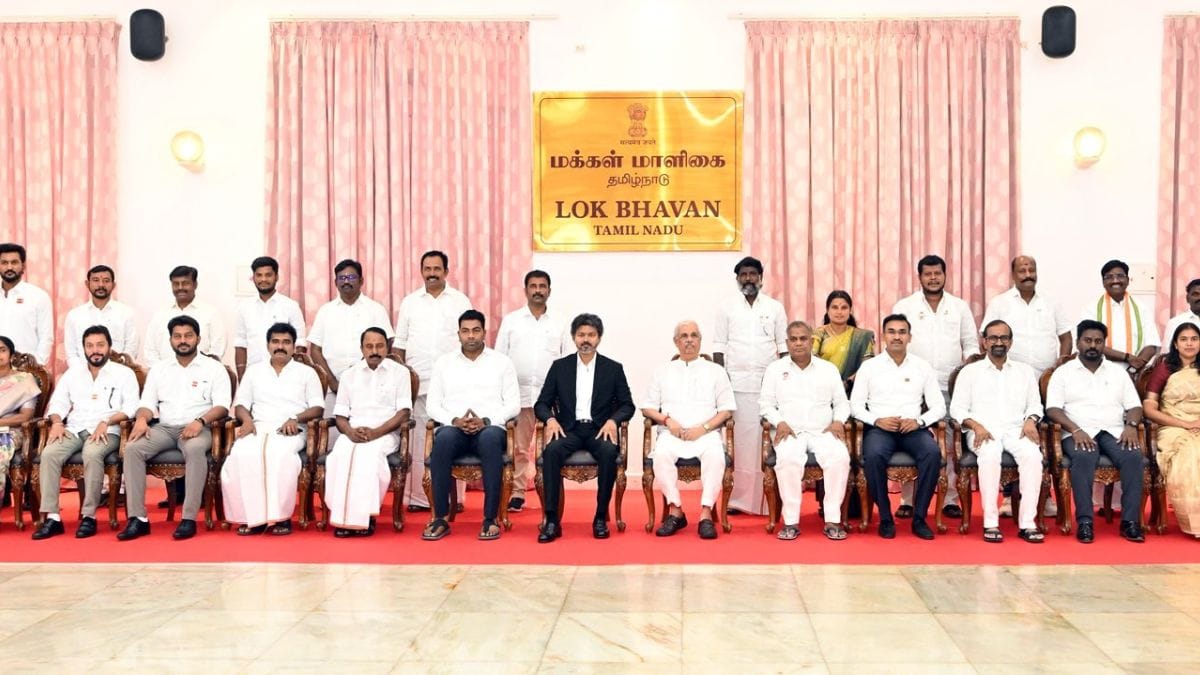
In a watershed political realignment that redraws the power architecture of southern India, Tamil Nadu Chief Minister and Tamilaga Vettri Kazhagam (TVK) founder Vijay on Thursday expanded his council of ministers by inducting 23 new cabinet members. The strategic expansion marks a monumental historic milestone: the Indian National Congress has formally entered the Tamil Nadu state cabinet for the first time in nearly six decades, ending an unbroken drought on Fort St. George that stretches back to 1967.
The high-stakes cabinet exercise, executed under intense political scrutiny at Raj Bhavan in Chennai, signals Vijay's decisive pivot from cinematic demigod to pragmatic coalition manager. Beyond cementing his government's working majority, the expansion establishes a calibrated balance of regional social engineering, ideological deterrence against the Bharatiya Janata Party (BJP), and a calculated rebuff to opportunistic defectors from the fractured All India Anna Dravida Munnetra Kazhagam (AIADMK).
A Historic Breakthrough: Congress Returns to Fort St. George After 59 Years
The single most consequential development of Thursday’s swearing-in ceremony was the induction of the Congress into the executive branch. The grand old party had been frozen out of Tamil Nadu’s governance structures since the historic 1967 assembly election, when C.N. Annadurai’s Dravida Munnetra Kazhagam (DMK) routed the M. Bhaktavatsalam administration, establishing an unyielding, six-decade duopoly of regional Dravidian giants.
Senior Congress leaders in New Delhi and Chennai hailed the cabinet berth as a revitalizing triumph. By securing a seat at the executive table, Congress restores its institutional footprint in India's second-largest state economy. Political observers view this inclusion as the cornerstone of Vijay’s broader national calculus—anchoring his fledgling administration to a national partner while maintaining local hegemony.
Addressing the press following the swearing-in, a senior TVK strategist underscored the ideological alignment: "This administration was formed on the explicit promise of transparent governance and social justice without ideological compromise. Sharing executive responsibility with our alliance partners proves that the era of autocratic, single-party regional dominance has given way to accountable coalition governance."
The Coalition Blueprint: VCK, IUML Locked in for Phase Two
While 23 ministers took their oaths of office today—spanning key portfolios across industrial development, finance, public works, and welfare administration—the Chief Minister’s office confirmed that the coalition framework remains dynamic. High-level wire reports confirmed that a subsequent phase of cabinet expansion is already charted.
Under the finalized power-sharing accord, one ministerial berth each has been reserved for Thol. Thirumavalavan’s Viduthalai Chiruthaigal Katchi (VCK) and the Indian Union Muslim League (IUML). The deliberate staggered induction allows the administration to address internal portfolio distribution while keeping key Dalit and minority voting blocs strategically tied to the government's medium-term legislative stability.
The deferral of the VCK and IUML inductions to the immediate next phase is widely interpreted by Chennai bureau analysts as a tactical move to finalize administrative portfolios without triggering early bureaucratic friction, ensuring smooth departmental transitions as the new government prepares its maiden comprehensive state budget.
Zero Accommodation for AIADMK Rebels: Hard Realpolitik Prevails
Equally telling was what did not happen at the swearing-in dais. Despite weeks of aggressive back-channel lobbying and media speculation, Vijay shut the door firmly on rebel MLAs from the opposition AIADMK.
Multiple dissident legislators from the fragmented AIADMK—who had severed ties with their party leadership in anticipation of ministerial trade-offs—found themselves completely excluded from the roster. Government insiders confirmed that the Chief Minister opted for long-term political credibility over the tactical expediency of absorbing political turncoats.
"There is zero room for transactional opportunism in this council," a cabinet insider close to the Chief Minister noted. "Accommodating defectors would dilute the administration’s anti-corruption credentials and trigger destabilizing friction among loyal TVK cadres who worked the grassroots. The message is definitive: allegiance cannot be bartered post-election."
Executive Breakdown: Phase 1 Cabinet Realignment
| Political Entity | Cabinet Berths (Phase 1) | Upcoming Allocation (Phase 2) | Strategic Portfolio Focus |
|---|---|---|---|
| Tamilaga Vettri Kazhagam (TVK) | 22 | TBD | Home, Finance, Industries, PWD, Transport |
| Indian National Congress (INC) | 1 | 0 | Revenue / Institutional Infrastructure |
| Viduthalai Chiruthaigal Katchi (VCK) | 0 | 1 | Social Welfare & Empowerment (Committed) |
| Indian Union Muslim League (IUML) | 0 | 1 | Minority Welfare & Regional Development |
| AIADMK Rebel Factions | 0 | 0 | Explicitly Excluded / No Induction |
Market Implications: Policy Stability in a $300-Billion Industrial Engine
For institutional investors and macroeconomic monitors, the smooth rollout of Vijay's cabinet offers crucial policy visibility for Tamil Nadu’s $300-billion economy. As the manufacturing capital for India’s automotive, electronics, and renewable hardware sectors, corporate stakeholders were watchful of whether coalition politics would introduce fiscal populism or policy paralysis.
Key Takeaways for Markets and Corporate Leadership:
- Fiscal Discipline vs. Social Welfare: The allocation of economic portfolios suggests a continuation of investor-friendly industrial policies, balancing TVK’s welfare guarantees with disciplined capital expenditure.
- Clean Legislative Runway: By institutionalizing ties with Congress, VCK, and IUML, Vijay avoids the volatility of razor-thin floor tests, insulating high-value industrial corridors from abrupt governance shocks.
- Defeating Factionalism: Refusing to accommodate AIADMK rebels buffers the cabinet against factional blackmail, giving international corporate investors a predictable executive hierarchy to interface with.
The Road Ahead
With 23 portfolios assigned and the Raj Bhavan ceremonies concluded, the Vijay administration turns to its immediate legislative agenda. The upcoming phase-two induction of VCK and IUML representatives will formally complete the ministerial architecture, setting the stage for what is shaping up to be an unprecedented era of coalition governance in Tamil Nadu.
Frequently Asked Questions (FAQ)
Why is Congress's inclusion in the Tamil Nadu cabinet historically significant?
The Congress party had not held ministerial office in Tamil Nadu since March 1967, when the DMK decisively ended its post-independence dominance. Thursday’s induction ends a 59-year absence from state governance, signaling the end of exclusive single-party regional dominance in the state.
Why were rebel AIADMK MLAs denied cabinet positions?
Despite heavy lobbying, Chief Minister Vijay chose to protect his administration’s anti-corruption positioning and preserve cadre morale within TVK. Inducting defectors was deemed an unnecessary reputational and political liability that could destabilize cabinet coherence.